BIFF 2012 - Day 1
Another year, another film festival, I'm sitting in the National Media Museum cafe, having sauntered slowly and quietly from my workplace in Leeds. I have been treated to a live piano recital on entry, pushed past several director-types who are networking each other silly, been offered a free donut and cup of tea by four ladies dressed up to look like the protagonists of the opening night film (complete with referential sign) and I am now writing this opener whilst chuckling at the assorted classic Chuck Jones cartoons being shown on the preview reel. (There's a Chuck Jones Tribute throughout the festival, showing cartoons at the start of most films). There's no sound but Duck Amuck is funny just with the pictures.
My initial impression with the lineup of the Bradford films this year is of slight disappointment, but then that's the impression I got last year before I actually went in and watched them, it turned out that BIFF 2011 had a roster of fantastic films, particularly in the documentaries strand, which seems a little lacking this time around. Maybe if someone from the festival is reading this, you might want to look to places like Kickstarter (and other internet-based promotional platforms) as there are some potentially great new films coming out soon.
But this year is now, and the opening night film was due to start. The foyer became busy with film fans so I took my place in the theatre. There I was surprised to find a complementary bucket of popcorn, and a perhaps less obvious gift to find on your cinema seat, a packet of seeds made to look like a book of matches. I'll see what comes up.
The room became gradually packed out with no spare seats and as is typical for a major film this meant overrun. Colin Philpott, the Media Museum director, said a few welcoming pieces and revealed that a new film production studio will soon be up and running in Bradford, creating new films with a northern flavour. Bronte and Discovery Road will be the first films under this project.
The festival was sponsored by Virgin, so one of their suits was wheeled out to give spiel to a captive audience - but in return we got to see 2:20 - the grand prize winner of last year's selection as a sample of the Virgin Media Shorts programme that begins today.
2:20 (UK) - A brief film that recovers a familiar idea - a tramp points at a man as he sits outside a bar, then leaves him the glasses she was wearing. Putting them on, he can see how long people have left to live. The natural urge to look in a mirror becomes too great. Done well and with a disturbing edge, but the whole 'device to see how long people have left to live' concept has been taken from somewhere else (but I can't place where just at the moment) and nothing new has been added. 7/10
Once the Virgin guy was wheeled back off again we got our first film proper, introduced by BIFF director Tom Vincent:
One Froggy Evening (US) - Before the main film, we were treated to a showing of one of Chuck Jones's best on the big screen where it would have first appeared. A construction worker finds a box in a sealed concrete block, and inside (inexplicably) is a frog, who sings and dances the old show tunes. Seeing dollar signs before his eyes, he tries to show off his find to anyone who will listen, but froggy is particular about his audience. Mysterious, funny and tragic. 8/10
And finally, some 45 minutes after the start time, we managed to see the main event, introduced by BIFF co-director Neil Young.
Damsels In Distress (US) (wiki)
Somewhere in a maybe-alternate part of north America lies a well-to-do university, made up of old, dignified buildings and beautiful gardens. There, three girls experiencing the first thrills of life without adults share a dorm. Violet is the most outspoken and leads them in their naive quests, to find happiness in less attractive men, stop their classmates committing suicide, and do something about the body odour problem of the childish males.
Enter Lilly, a transfer student, whom Violet thinks could make a good fourth leg. Seduced by her need to control and offer advice, Lilly moves in and together they negotiate the tricky subjects of love and boys, stumbling through friendships and maybe-relationships as we do. Sort of.
With talk of tapdance numbers, you might think this would be nauseatingly Glee-like but mercifully it isn't - although it is certainly aimed more at a female audience than male. The girls talk to and about boys, get all confused when they don't get their feelings, and take up the rest of their time as suicide prevention officers and dance craze inventors.
It was a nice touch for director Whit Stillman to record a short intro to his film just for Bradford, but alarm bells always ring whenever a director attempts to explain his own work. Damsels tried hard to be carefree and easygoing, but this resulted in an awkward-feeling dialogue (with some iffy sound) between the main characters in the beginning. This eased somewhat in the middle, and then went completely out of the window at the end when the story broke down completely and the movie relied almost completely on a song and dance finish to tie up some rather weak loose ends that hadn't had time enough applied to them for the audience to care that much.
I wanted to like the film much more than I could as it had a genuine, innocent charm about it, and though it took a while for my face to turn up at the sides I did feel some warmth and humour come through eventually with some nice back and fourth between the characters which wasn't merely the expected bitchiness-as-false-complement behaviour from teens in a college situation, but something a little more ideal, more pleasant, if a little rose tinted view of the first freedoms felt in higher ed.
It could have been much worse, but it could also have been a lot better. It could have been tidied up somewhat - some scenes looked as if they had been quickly shot and dropped in to segue between two other distinct parts of the film giving it a bumpy, disjointed flow. And if the director had given some resolution to various story points instead of leaving it in the air while everyone started dancing it would have felt much more satisfying. As it was, I had to salvage enjoyment from the mixture of goofy frat boys and a handful of clever quips from the girls to see me through the other bits. 6/10


Festival Time Looms
It won't be long before the festival circuit comes alive once more. Usually, Bradford is out of the blocks by now but this year it's moved ahead by a month. My tickets are booked, and there are plenty of potentially great films to see.
So I've been keeping the film intake to a steady trickle so far, just a few to whet my whistle in among the other work that never seems to go away. These are a few that I have managed to catch so far:
Once Upon A Time in Anatolia (wiki)
After hearing that this had won the Grand Prize at Cannes last year, I decided to put my reservations about it's length to one side and see it while I could. Anatolia is a huge section of Turkey, but the film concentrates in one unnamed and sparsely populated region, full of dusty back roads and rolling hills and valleys between small towns and villages.
Following a small group of cars not quite up to the job of negotiating this terrain through the night, the film chronicles the attempts of an increasingly frustrated local police sergeant to get some sense out of Kenan, a drunken waster, and his terrified brother, who have confessed to the killing of a stranger passing through their village, but can't remember where they hurriedly buried them, since they were very, very drunk. Along with them are a few labourers with shovels, a couple of equally out of their depth officers, and the prosecutor, Nusret - a professional-looking middle-aged man with an air of responsibility about him, who aims to get through the formalities as soon as possible and move onto his next job.
It sounds like a comedy, but it isn't. Though there are some semi-comedic touches to the story, such as the low-level incompetence suffered by Nusret by the men around him, the story is played mostly straight. Though the murder forms the backbone of the narrative, much of it is spent learning about the lives of the other characters through dialogue when others are off seeing if Kenan's latest guess is anywhere near the body.
There were some nice things about the film; the acting was believable and the settings, though often shrouded in night were authentic and beautifully rural, hinting at what sights may be visible just beyond the headlights. One of the best bits was a dialogue that ran through the film about one of Nusret's old murder cases, which he thought he had long since put to rest but his verdict is put in doubt after casually bringing it into conversation.
Though the film had these nice parts, they were not enough to keep the clock hands whizzing around at a satisfactory pace; at over two and a half hours, the film runs out of things to say halfway through, and at several points approaching the 2-hour mark you expect the long staring shot you are seeing to mark the end. Once the body is found there aren't many other loose ends to tie, but the director made a point of showing the paperwork and autopsy the next morning in clinical detail, though it added little. The long, quiet moments were joined by the shifting of bottoms on cinema seats.
It was nice. There was an entertaining and well-thought story, but it was stuffed with unnecessary filler. It could have been cut by a half-hour quite easily which would have tightened the script and stopped the clock-watching. A shame. 6/10
Le Havre (site)
Designed to tug at the heartstrings from the off, La Havre introduces us to Marcel, a poor shoe-shiner in the north-western French city, looked down on by those whose shoes he shines, he works alongside the immigrants and the poor of his neighbourhood. Tolerated by his wife, whose life would be much simpler if she didn't have to do all his housework as well as hers. One day he meets Idrissa, a young African boy who has escaped the French border guards on his way through to meet with his parents in London. Childless and feeling an immediate need to protect, Marcel takes time to feed and hide the boy from the pursuing authorities, and just as he has his hands full with that, has to cope with his wife collapsing with a mystery illness.
Le Havre is filmed in a deliberately old-fashioned style. Aside from a few pointers to modern comforts, the washed-out colours, static dialogue shots and a wardrobe of antiquated clothes would fool the casual viewer into thinking it was a digital restoration of a 70's flick but it was in fact made last year. This gives the film a quaint charm, but may be off-putting for some. Personally, I liked it, even though being French it had to have a bit of the philosophizing, but it was minimal and it instead concentrated on tying up the loose ends of a poor-man-doing-good-deeds plot in a delightfully Amelie-style far-fetched sort of way. 7/10
The Pirates! In an Adventure with Scientists (site)
A new Aardman film is almost as welcome an event as a new Pixar or Ghibli offering, especially when they ditch their computer-machines for good old plasticine once more. Flushed Away, though pleasant enough can never match Wallace and Gromit or Chicken Run.
They are taking a risk with this one though; America will be the territory where they stand to make the big money and science.. well, isn't exactly high on the list of people's interests over there, being as it is increasingly marginalized by redneck legislature and shunned by the presidential hopefuls. You can get round some of that with a name change (which Aardman have done, disappointingly but understandably - the US get 'Band of Misfits' as a subtitle) but the film itself will always have those pesky scientists at it's core.
Not content with a general ruffling of feathers, Aardman decided to prod the prudish in the ribs a little further; The Pirates! features a dashing but not very successful pirate captain (voiced by Hugh Grant, who fits surprisingly well into the hat and beard combo) trying to win Pirate of the Year after failing so many times. On his plundering expeditions to prove his place, he runs into Charles Darwin - yes, that hero of the American churchgoers - who points out that the parrot on his shoulder is actually a Dodo and might be worth quite a bit, if taken to the science exhibition in London, that place he can't go since Queen Victoria hates his guts so much for being all piratey.
So as you can imagine, it's going to be a hard sell. Pirates! may mitigate this slightly by setting it in an alternate history where Darwin is a hormonally unfulfilled and slightly slimy man with a devious streak and a monkey butler, and Queen Victoria is an unstoppable fighting machine. This might loosen the collars somewhat but I wouldn't want to be Columbia's PR people.
It's a shame because it's a great film. Almost too full of little plasticine touches, and references to films, places and people, the likes of which you won't catch on a single viewing. Plenty of goofy gags for kids and some more adult references that fortunately stay just the acceptable side of risqué to not require you to cover the ears of the nearest child.
There are even elements in the film that could have been expanded on but aren't - in a good way - such as the curiously feminine-looking pirate amongst his crew, whose name we don't even learn - perhaps leaving enough room to grow the character in a sequel.
It's funny, it's unpredictable and it doesn't feel like an animation too far for the studio; the stop-motion technique is alive and well and looking better than ever, because you know what you're looking at is 'real', rather than conjured up on a computer. The sets are authentic W+G cobbled streets and English pubs and it all hangs together very well indeed. I'd easily watch it again, and probably will.
Oh, and look out for an unexpected inclusion of a Flight of the Conchords song midway through as well which made me smile at least 10% more when I heard it. 8/10
So I've been keeping the film intake to a steady trickle so far, just a few to whet my whistle in among the other work that never seems to go away. These are a few that I have managed to catch so far:
Once Upon A Time in Anatolia (wiki)
After hearing that this had won the Grand Prize at Cannes last year, I decided to put my reservations about it's length to one side and see it while I could. Anatolia is a huge section of Turkey, but the film concentrates in one unnamed and sparsely populated region, full of dusty back roads and rolling hills and valleys between small towns and villages.
Following a small group of cars not quite up to the job of negotiating this terrain through the night, the film chronicles the attempts of an increasingly frustrated local police sergeant to get some sense out of Kenan, a drunken waster, and his terrified brother, who have confessed to the killing of a stranger passing through their village, but can't remember where they hurriedly buried them, since they were very, very drunk. Along with them are a few labourers with shovels, a couple of equally out of their depth officers, and the prosecutor, Nusret - a professional-looking middle-aged man with an air of responsibility about him, who aims to get through the formalities as soon as possible and move onto his next job.
It sounds like a comedy, but it isn't. Though there are some semi-comedic touches to the story, such as the low-level incompetence suffered by Nusret by the men around him, the story is played mostly straight. Though the murder forms the backbone of the narrative, much of it is spent learning about the lives of the other characters through dialogue when others are off seeing if Kenan's latest guess is anywhere near the body.
There were some nice things about the film; the acting was believable and the settings, though often shrouded in night were authentic and beautifully rural, hinting at what sights may be visible just beyond the headlights. One of the best bits was a dialogue that ran through the film about one of Nusret's old murder cases, which he thought he had long since put to rest but his verdict is put in doubt after casually bringing it into conversation.
Though the film had these nice parts, they were not enough to keep the clock hands whizzing around at a satisfactory pace; at over two and a half hours, the film runs out of things to say halfway through, and at several points approaching the 2-hour mark you expect the long staring shot you are seeing to mark the end. Once the body is found there aren't many other loose ends to tie, but the director made a point of showing the paperwork and autopsy the next morning in clinical detail, though it added little. The long, quiet moments were joined by the shifting of bottoms on cinema seats.
It was nice. There was an entertaining and well-thought story, but it was stuffed with unnecessary filler. It could have been cut by a half-hour quite easily which would have tightened the script and stopped the clock-watching. A shame. 6/10
Le Havre (site)
Designed to tug at the heartstrings from the off, La Havre introduces us to Marcel, a poor shoe-shiner in the north-western French city, looked down on by those whose shoes he shines, he works alongside the immigrants and the poor of his neighbourhood. Tolerated by his wife, whose life would be much simpler if she didn't have to do all his housework as well as hers. One day he meets Idrissa, a young African boy who has escaped the French border guards on his way through to meet with his parents in London. Childless and feeling an immediate need to protect, Marcel takes time to feed and hide the boy from the pursuing authorities, and just as he has his hands full with that, has to cope with his wife collapsing with a mystery illness.
Le Havre is filmed in a deliberately old-fashioned style. Aside from a few pointers to modern comforts, the washed-out colours, static dialogue shots and a wardrobe of antiquated clothes would fool the casual viewer into thinking it was a digital restoration of a 70's flick but it was in fact made last year. This gives the film a quaint charm, but may be off-putting for some. Personally, I liked it, even though being French it had to have a bit of the philosophizing, but it was minimal and it instead concentrated on tying up the loose ends of a poor-man-doing-good-deeds plot in a delightfully Amelie-style far-fetched sort of way. 7/10
The Pirates! In an Adventure with Scientists (site)
A new Aardman film is almost as welcome an event as a new Pixar or Ghibli offering, especially when they ditch their computer-machines for good old plasticine once more. Flushed Away, though pleasant enough can never match Wallace and Gromit or Chicken Run.
They are taking a risk with this one though; America will be the territory where they stand to make the big money and science.. well, isn't exactly high on the list of people's interests over there, being as it is increasingly marginalized by redneck legislature and shunned by the presidential hopefuls. You can get round some of that with a name change (which Aardman have done, disappointingly but understandably - the US get 'Band of Misfits' as a subtitle) but the film itself will always have those pesky scientists at it's core.
Not content with a general ruffling of feathers, Aardman decided to prod the prudish in the ribs a little further; The Pirates! features a dashing but not very successful pirate captain (voiced by Hugh Grant, who fits surprisingly well into the hat and beard combo) trying to win Pirate of the Year after failing so many times. On his plundering expeditions to prove his place, he runs into Charles Darwin - yes, that hero of the American churchgoers - who points out that the parrot on his shoulder is actually a Dodo and might be worth quite a bit, if taken to the science exhibition in London, that place he can't go since Queen Victoria hates his guts so much for being all piratey.
So as you can imagine, it's going to be a hard sell. Pirates! may mitigate this slightly by setting it in an alternate history where Darwin is a hormonally unfulfilled and slightly slimy man with a devious streak and a monkey butler, and Queen Victoria is an unstoppable fighting machine. This might loosen the collars somewhat but I wouldn't want to be Columbia's PR people.
It's a shame because it's a great film. Almost too full of little plasticine touches, and references to films, places and people, the likes of which you won't catch on a single viewing. Plenty of goofy gags for kids and some more adult references that fortunately stay just the acceptable side of risqué to not require you to cover the ears of the nearest child.
There are even elements in the film that could have been expanded on but aren't - in a good way - such as the curiously feminine-looking pirate amongst his crew, whose name we don't even learn - perhaps leaving enough room to grow the character in a sequel.
It's funny, it's unpredictable and it doesn't feel like an animation too far for the studio; the stop-motion technique is alive and well and looking better than ever, because you know what you're looking at is 'real', rather than conjured up on a computer. The sets are authentic W+G cobbled streets and English pubs and it all hangs together very well indeed. I'd easily watch it again, and probably will.
Oh, and look out for an unexpected inclusion of a Flight of the Conchords song midway through as well which made me smile at least 10% more when I heard it. 8/10
Short Film Digest 3: Games Special
It's been a while since I did one of these, so have a themed quad on the subject of games.
Caine's Arcade
First up: a lovely little film showing the power of community on the net to bring happiness. Little Caine made use of his time at his fathers' car repair shop to make arcade-style games for people to play, but he never got any customers, until one day a passing film-maker in need of some car repairs wandered in and bought a ticket...
Indie Game: The Movie
The Kickstarter phenomenon is turning into a brilliant way of bringing together like-minded types to 'crowdfund' a project close to their collective hearts. Several of these are film projects, and one of the earliest ones is this; a documentary about the long and surprisingly pitfall-laden process of creating and releasing an indie game to the masses. Unfortunately this isn't the whole film, just an online extra bit to go with the main film, but I'm seriously bought on the trailer and am hopeful a festival will pick it out for inclusion this year (maybe even do a kickstarter strand....)
100 Yen: The Japanese Arcade Experience
Another Kickstarter project that is almost at fruition: What began as a lament for the decline of American arcades (and by extension, arcades in the UK) turned into a celebration of the still-buoyant state of those places in Japan. I can attest myself of the floors and floors of electronica old and new, having pumped more than a few hundred yen coins into them in my time. It feels weird to have something from my childhood talked about in such nostalgic terms, but I suppose that's how things go as you get older.
Arcade
And as a final wallow in the nostalgia of my childhood, here is another film that stands as a ying to the yang of the 100 Yen film; Arcade documents the final days of the last New York video games arcade; a place where people met, had fun and made memories in among the electronic killing sprees. A sad but warm-hearted lament on an institution that is often seen by many as a dingy, dirty place where the ne'er-do-wells hang out, with a possibly happy ending.
Caine's Arcade
First up: a lovely little film showing the power of community on the net to bring happiness. Little Caine made use of his time at his fathers' car repair shop to make arcade-style games for people to play, but he never got any customers, until one day a passing film-maker in need of some car repairs wandered in and bought a ticket...
Indie Game: The Movie
The Kickstarter phenomenon is turning into a brilliant way of bringing together like-minded types to 'crowdfund' a project close to their collective hearts. Several of these are film projects, and one of the earliest ones is this; a documentary about the long and surprisingly pitfall-laden process of creating and releasing an indie game to the masses. Unfortunately this isn't the whole film, just an online extra bit to go with the main film, but I'm seriously bought on the trailer and am hopeful a festival will pick it out for inclusion this year (maybe even do a kickstarter strand....)
100 Yen: The Japanese Arcade Experience
Another Kickstarter project that is almost at fruition: What began as a lament for the decline of American arcades (and by extension, arcades in the UK) turned into a celebration of the still-buoyant state of those places in Japan. I can attest myself of the floors and floors of electronica old and new, having pumped more than a few hundred yen coins into them in my time. It feels weird to have something from my childhood talked about in such nostalgic terms, but I suppose that's how things go as you get older.
Arcade
And as a final wallow in the nostalgia of my childhood, here is another film that stands as a ying to the yang of the 100 Yen film; Arcade documents the final days of the last New York video games arcade; a place where people met, had fun and made memories in among the electronic killing sprees. A sad but warm-hearted lament on an institution that is often seen by many as a dingy, dirty place where the ne'er-do-wells hang out, with a possibly happy ending.
Take Some Advice, TSA
Behold this withering infographic from OnlineCriminalJusticeDegree.com, showing us just what good the TSA is for the world of air travel. Expensive, ineffectual, corrupt.

Created by: OnlineCriminalJusticeDegree.com
The TSA really needs getting rid of.
Created by: OnlineCriminalJusticeDegree.com
The TSA really needs getting rid of.
This Makes Me Happy
What with all the doom and gloom going on, it's nice to have at least one megacorporation able to use it's considerable talents and wealth to do something pretty damn special.
If you haven't seen the Google Maps 8-bit April Fools prank, well you should take a look here:
I love these people. In a thoroughly sexy way. The whole blowing on the cart thing, the authentic Japanese Famicom unit, the Dragon Quest-style box art... I'm so overloaded with geeky nostalgia right now.. I want to have their babies.
But, it's not really coming out though.. a cartridge for a system whose support died out fifteen years ago? Pfft. All just a load of mocked-up screens.
But then you can go to Google Maps and this happens.
The bestest thing ever to happen on the internets. Ever. Not only is the whole planet now an overworld map from any one of those games (not surprising it looks so authentic seeing as Google enlisted Square Enix to help them), but there are also tonnes of easter eggs.. Try going into street view for example, or maybe visit a well-known landmark, or perhaps scour the world for DQ video game characters.
Anyone interested in catching 'em all, might want to go here.
Also related: this is quite fun, a browser game where you protect well-known landmarks from invasion from Google Map pins. It's distracting in a losing-an-hour-of-your-life sort of way.
If you haven't seen the Google Maps 8-bit April Fools prank, well you should take a look here:
I love these people. In a thoroughly sexy way. The whole blowing on the cart thing, the authentic Japanese Famicom unit, the Dragon Quest-style box art... I'm so overloaded with geeky nostalgia right now.. I want to have their babies.
But, it's not really coming out though.. a cartridge for a system whose support died out fifteen years ago? Pfft. All just a load of mocked-up screens.
But then you can go to Google Maps and this happens.
The bestest thing ever to happen on the internets. Ever. Not only is the whole planet now an overworld map from any one of those games (not surprising it looks so authentic seeing as Google enlisted Square Enix to help them), but there are also tonnes of easter eggs.. Try going into street view for example, or maybe visit a well-known landmark, or perhaps scour the world for DQ video game characters.
Anyone interested in catching 'em all, might want to go here.
Also related: this is quite fun, a browser game where you protect well-known landmarks from invasion from Google Map pins. It's distracting in a losing-an-hour-of-your-life sort of way.
Still A Bad Time To Be Black in America
My previous post on the American social and political state started out as a simple grumble about the starched suits on Fox in America and their ability to see bad in everything that isn't basically - well, them. It so quickly and easily turned into a review of why being in America at the moment is a really bad thing.
So when I received word of several racially-themed reasons to reinforce this conclusion, one after another, in my inbox, it felt wrong to ignore them.
The Trayvon Martin case was the then-latest incident to highlight some deep undercurrents that so easily rise to the surface in some districts. A teenager, wearing a hoodie on his way back from the shops to his house, carrying nothing more offensive than sweets and a drink, was apprehended by local neighbourhood self-styled superjusticedude George Zimmerman. He notified the police and - against their wishes - went after him, apprehended him and shot him dead as he screamed in terror.
The police refused to arrest him.
There's a possibility some deeply racist bastard might be thinking that good ol' patriotic Zimmerman, on seeing a young, hooded black kid, 'acting suspiciously', might be somewhat justified in some sort of preventative action. After all, this could have been a danger to the neighbourhood. He wasn't, but he could have been; and in Zimmermans' committed mental state by that point, he was going to be the hero of the community by getting to him before Trayvon got to his 'target'. He must have forgotten to do all the things that you would do before shooting him dead, is all.
So for those looking for justification in his actions, hoping that there is some sort of explanation that doesn't involve widespread racist hate in the force tasked with protecting people on the street: how about this situation, which came to light just a few days later: Kenneth Chamberlain Sr., an elderly and distinguished black man who fought for his country, is shot dead in his own house by police. What heinous crime did he do? He fell asleep at his home, and the medical alarm round his neck - there because he had a heart condition - was accidentally activated. The police came, and responded to the chain lock and his half-asleep assurance that it was a false alarm by tazering him, breaking the door down, shouting racist obscenities at him, apparently shooting him with a beanbag gun, and just for good measure to ensure justice was done, finally shot him dead in his own home with live ammo.
Punishment for the cop involved? Err, no. No punishment, no layoff, not even suspended or stuck on a desk job. His identity has not been released after six months, and he is apparently still at work in the same neighbourhood.
America, what the hell is going on with you? Has the last 50-plus years of civil rights advances gained such small ground that these things can happen now?
Of course, when your would-be president nearly uses the n-word to describe your current president (yes, I know there's a chance that's not the word he intended - but you give me a credible alternative after listening to it closely ten times), it's clear that for all the progress in equality and human rights America and the west in general has managed, we would be naive to think that we are a long way from where we need to be.
Edit: Extra bonus shooting of black people by cops: What do you expect from police in the aftermath of Hurricane Katrina in New Orleans? Assistance, compassion? How about a group of them shooting people from a bridge and then trying to cover it up.
So when I received word of several racially-themed reasons to reinforce this conclusion, one after another, in my inbox, it felt wrong to ignore them.
The Trayvon Martin case was the then-latest incident to highlight some deep undercurrents that so easily rise to the surface in some districts. A teenager, wearing a hoodie on his way back from the shops to his house, carrying nothing more offensive than sweets and a drink, was apprehended by local neighbourhood self-styled superjusticedude George Zimmerman. He notified the police and - against their wishes - went after him, apprehended him and shot him dead as he screamed in terror.
The police refused to arrest him.
There's a possibility some deeply racist bastard might be thinking that good ol' patriotic Zimmerman, on seeing a young, hooded black kid, 'acting suspiciously', might be somewhat justified in some sort of preventative action. After all, this could have been a danger to the neighbourhood. He wasn't, but he could have been; and in Zimmermans' committed mental state by that point, he was going to be the hero of the community by getting to him before Trayvon got to his 'target'. He must have forgotten to do all the things that you would do before shooting him dead, is all.
So for those looking for justification in his actions, hoping that there is some sort of explanation that doesn't involve widespread racist hate in the force tasked with protecting people on the street: how about this situation, which came to light just a few days later: Kenneth Chamberlain Sr., an elderly and distinguished black man who fought for his country, is shot dead in his own house by police. What heinous crime did he do? He fell asleep at his home, and the medical alarm round his neck - there because he had a heart condition - was accidentally activated. The police came, and responded to the chain lock and his half-asleep assurance that it was a false alarm by tazering him, breaking the door down, shouting racist obscenities at him, apparently shooting him with a beanbag gun, and just for good measure to ensure justice was done, finally shot him dead in his own home with live ammo.
Punishment for the cop involved? Err, no. No punishment, no layoff, not even suspended or stuck on a desk job. His identity has not been released after six months, and he is apparently still at work in the same neighbourhood.
America, what the hell is going on with you? Has the last 50-plus years of civil rights advances gained such small ground that these things can happen now?
Of course, when your would-be president nearly uses the n-word to describe your current president (yes, I know there's a chance that's not the word he intended - but you give me a credible alternative after listening to it closely ten times), it's clear that for all the progress in equality and human rights America and the west in general has managed, we would be naive to think that we are a long way from where we need to be.
Edit: Extra bonus shooting of black people by cops: What do you expect from police in the aftermath of Hurricane Katrina in New Orleans? Assistance, compassion? How about a group of them shooting people from a bridge and then trying to cover it up.
A Holiday in Post-Uprising Egypt: Part 5
Day 5: Around Aswan and Back on the Nile
It was the beginning of a brand new year, and the morning was a beautiful one. What beautiful sights were we going to see on the inaugural day of the year?
We took the coach with Hani once more past the church, and down the valley into the dusty residential areas; over the lower dam once more, through the villages that made up the outskirts and up to.. the high dam.
The on-standby tanks told us we were nearing something that would be strategically advantageous to gain control of, or blow up. There was a feeling of being out of place when a tourist bus full of snap-happy westerners goggles at a bunch of blokes who could have several kills under their belt. Onwards we snaked up through the winding streets as the soldiers looked on.
You would think that if you were going to head up to a massive dam, as a tourist destination it would have to have some sort of draw beyond the ability to stand on it and look off into the distance. Maybe a tour of the innards or something; get an appreciation of the thousands of tonnes of machinery and masonry holding back millions of gallons of water.
You'd think so, but no. We got off the bus and, after negotiating the traffic across the dam, were told to go to a small gate, where our tickets would be inspected. Ridiculously, the gate stood on it's own, and you could just walk round it if you wanted.
On the other side of the gate was a load of coaches, (into which ours had camouflaged itself) and a view over the dam, complete with large electric pylons, several structures containing machinery, and a long, 45 degree drop as the dam wall fell away into the distance. It was certainly an impressive structure - especially as it was 60 years old. We waited to be huddled into a group, perhaps to be given a tour by one of the many uniformed workers milling about.
No such luck, no-one came to herd us anywhere. We spent a little while looking over both sides of the dam, then it was back on the bus. About as pointless an exercise as you could imagine. A 'friendship memorial' sculpture looked at us from one end of the dam as we drove past, as if to say we should be grateful for it's existence.
At least the next excursion would be a little better, although it had the slight problem of familiarity. We were heading off back to Philae Temple, this time to see it by day.
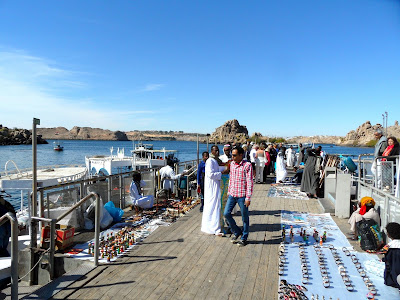
The port, which was previously almost deserted was now heaving with vendors. A dozen or so robed men with towels and rugs slung over their shoulders came to greet us on our disembark, and beyond the turnstyles, the long cobbled run down to the shoreline was now lined down each side with blankets, on top of which was every trinket you could possibly conceive of buying, each manned by a perpetually hopeful vendor.
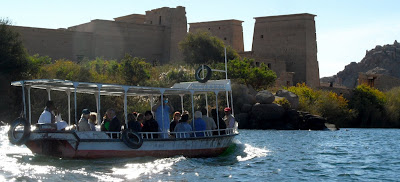
Once at the shore, we got in the first available boat and all wobbled our way inside. We traced the same route to the island, but this time, Hani decided to tug a little on our emotions and tell us about the Nubians.
A race of people originally from a more Sudanese climate, their skin is darker and they have a more African appearance, they were driven from their origins by the Makorae tribes, and thus have no real defined place any more. Hani by happy coincidence had a friend who was in the boat for the ride, who - by coincidence - happened to have an armful or two of trinkets to sell now that he had us by the heartstrings. A couple of our group took the bait as we glided along the calm waters.
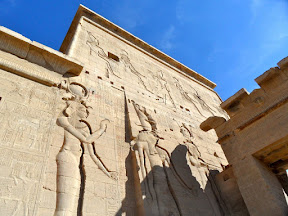
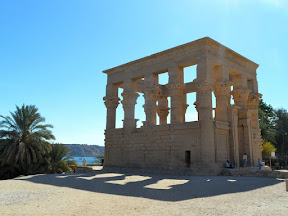
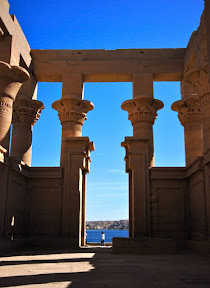
Philae by day is as impressive as by night, and the beautiful noonday sun made the light sandstone almost glow against the cloudless blue skies. Hani took us round once more, pointing out some of the areas left in the shadows from the night before, and then skipped off to the outdoor cafe with instructions for us to find him in a half hour or so.
Since we had explored quite a lot the previous night we spent our time enjoying the sun and trying to capture some of the sights of Philae.
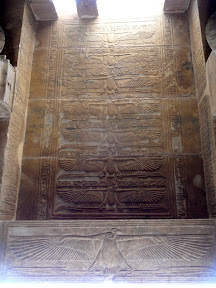
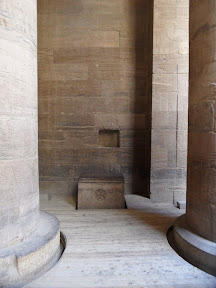
The nooks and corners of the temple now fully lit, included an early example of religious re-appropriation, where the Romans had converted one of the temple rooms into an early church, complete with a crude stone altar and a vandal-level hole bored into the stonework of a nearby wall so a candle, or a statue may be added. Around the sides, the beautiful artwork had been defaced with early Coptic crosses.
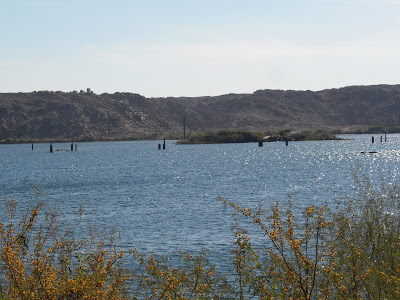
Outside, a small flock of sparrows argued and sunned themselves on one of the more disassembled temple buildings as they tucked into some bread left by a kindly unknown. In the daylight, the waters beyond the grounds were no longer a dark blanket; a handful of wooden posts of varying length stuck out of the waters, highlighting the original place where Philae temple once was before the dam caused the water levels rise (see part 3).
There were some beautiful plants as well; multicoloured jasmine blossoms greeted our entry, and a large bush filled with yellow pompom flowers took a central place in the open grounds. A man, spotting my interest, took a seed pod from the ground and handed it to me. Even for such a benign act, his immediate reaction on me taking it was to hold out his hand for a tip, which was unfortunately just too late, since I had quickly thanked him and then not noticed as I turned my back. Ha.
The seed pod is now sat in my drawer in the kitchen, awaiting a place for the seeds to be sown and to germinate.
We returned to the boat and headed back across the waters. The bus took us back along the dusty roads towards the centre of the city, where we would learn more about the Nubians at their own museum. We stopped off briefly at a papyrus shop that was full of beautiful designs of varying sizes. As with the Alabaster shop, it was tailored for visiting groups and we were treated to a well-rehearsed but rather brief tutorial on how papyrus paper is made, followed by a criminally short amount of time to go round and choose something to buy. We had some differences as to what would be appropriate to take back (I wanted big, the lass wanted small) and unfortunately for them, our inability to decide under pressure meant that we left without paying them a bean.
The Nubian museum had by now been passed a half dozen times and at last we were able to go inside.
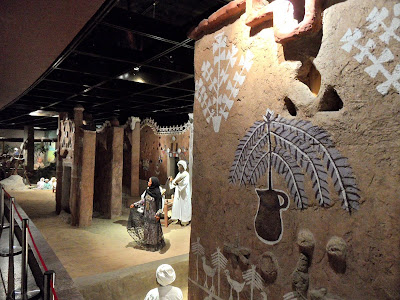
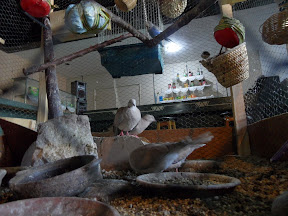
A large, modern building surrounded by a walk-round garden (that we didn't get to see). Inside, the subdued lighting and large hollow rooms, echoing a few dozen quiet footsteps, spread out the Nubian history, and more generally that of the Egyptian race over the centuries. Though I enjoyed walking around the exhibits, I have to confess my favourite bit was the cafe, where - unexpectedly enough, there was a cage of doves who were being terrorised by one very randy budgie.
Hani shouted everyone from the various corners of the museum back to the entrance and we headed off for one final sight. Since the boat would be soon setting forth back up the Nile, we had a second boat ride arranged, this time at the other side of the dam, in Lake Aswan, at the end of the sail-able section of the Nile.
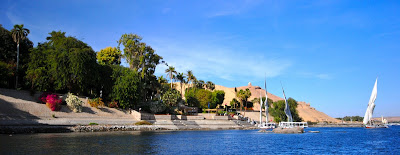
We retrieved our life jackets and got on board a boat, fittingly adorned with a Union Jack. Starting at the base of the cliffs on top of which the Old Cataract, the hotel in Death on the Nile was situated, the little boat chugged along pleasantly in the gorgeous sunlit lake between eastern sail-yachts and large mooring tourist ships.
To give us some photo opportunities the skipper went the long way round the lake behind Elephantine Island, and squeezing between that and Kitchener's Island, to get a look at (but cruelly, not visit - grr), the Aswan Botanical Garden that sits on top of it.
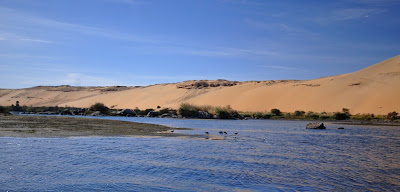
As a consolation, the boat was also threaded through the shallow parts of the lake - which would have been little more than mudflats in high summer - to allow us a look at some of the wildlife wading around them. I think we were more bothered about whether we would get out of it without getting moored on the silt just below our hull to enjoy it too much.
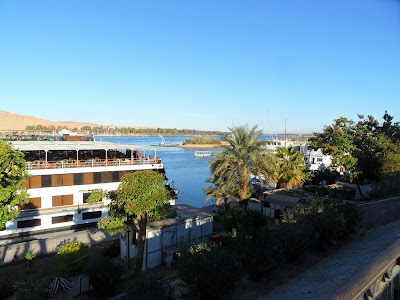
We returned thankfully to the boat and our time at Aswan was cruelly over. As we sat down to our food the engines started to roar into life and we set off again as the afternoon sun got past it's best, leaving only some sightseeing as we settled our food on the downstream trip back north to Luxor.
The route home was pleasantly picturesque but nothing really different from before. One sight we were told to look out for was the bridge, which we met in the dying hour of sunlight, giving it a moody, backlit view. It would have looked better lit up but we were a little early. When we returned to our room, our cheeky cleaners had gone to some trouble to approximate me using towels and my discarded life jacket. Is there anything they can't make?
 |
We took the coach with Hani once more past the church, and down the valley into the dusty residential areas; over the lower dam once more, through the villages that made up the outskirts and up to.. the high dam.
 |
You would think that if you were going to head up to a massive dam, as a tourist destination it would have to have some sort of draw beyond the ability to stand on it and look off into the distance. Maybe a tour of the innards or something; get an appreciation of the thousands of tonnes of machinery and masonry holding back millions of gallons of water.
 |
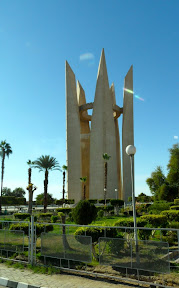 |
No such luck, no-one came to herd us anywhere. We spent a little while looking over both sides of the dam, then it was back on the bus. About as pointless an exercise as you could imagine. A 'friendship memorial' sculpture looked at us from one end of the dam as we drove past, as if to say we should be grateful for it's existence.
At least the next excursion would be a little better, although it had the slight problem of familiarity. We were heading off back to Philae Temple, this time to see it by day.
 |
 |
 |
 |  |
 |  |
 |
 |
 |
 |  |
The seed pod is now sat in my drawer in the kitchen, awaiting a place for the seeds to be sown and to germinate.
 |
 |
 |
 |
 |
 |
 |
 |
 |
 |
 |
 |
Subscribe to:
Posts (Atom)