The Case of Hana and Alice (Jpn) (wiki)
In my past film-watching experience, I've found the rotoscoping technique for producing animation to be a lazy one that causes nothing but a distraction to the film you are watching, to such an extent as to spoil it. There is something, probably somewhere down the uncanny valley about taking every nth frame of a filmed scene and tracing the lines until you have an animated equivalent. Though static shots of Hana and Alice seemed like your average anime, the previews threatened to confirm my worst fears. Though it took a little time to adjust, I'm glad I did see this film. I could so easily have snoozed in bed a few more hours and nearly decided to.
Tetsuko has just moved to a new area and needs to fit in at school. All seems normal until her new classmates start acting weirdly around the desk she chooses, it seems the previous occupant disappeared in mysterious circumstances, and the two free desks next to each other have a mysterious story to them that the other pupils seem reluctant to give up. Tetsuko, being a no-shit spunky type lets curiosity get the better of her, and leads her down a seemingly supernatural rabbit hole that eventually leads to a reclusive ex-pupil living next door.
Without wanting to give too much away, the film is of two strange halves; the first a meditiation on supersition and how that pervades in the fetile imagination of the young; the second an almost slapstick mystery caper of the scooby-doo caliber. Though you would expect a low mark for such a description, the change in direction is welcomed and gives the film chance to tie up several loose ends neatly towards the end. It's funny, entertaining and a little philosophical. 8/10
The Postman's White Nights (Rus) (wiki)
By the time I had realised that my preferred next film, Taxi (it got the Golden Bear this year), had sold out the second anime of the day (Rakuen Tsuiho, which I wasn't that fussed about) was well underway and I was across town, so my only other option was this.
Lyokha is getting on a bit; he is the postman for a remote Russian village, split off from the rest of civilisation for generations by a large lake. He lives a lonely life despite everyone knowing him, and lives alone, each day the same as the rest. Get up, take the motorboat out to get the post, come home and fill the rest of his day with the friends he used to get drunk with, but can't any more. His one hope is to finally win the affections of Irina, an old school friend and crush who lives a single life with her young son. These aside, all he sees are dying memories and the shadows of his youth.
But Irina is getting itchy feet and is looking to move to the city. Can Lyokha manage to woo her before she takes off?
Films such as this one can survive pretty well with just a beautiful landscape, and the lake and countryside shots of a relatively unspoiled corner of Russia are certainly beautiful to look at, but Lyokha's actions too many times are frustrating. He could make himself happier, but he doesn't. Chances are wasted and he doesn't seem to learn from them. For this it's hard to completely like or identify with the character, even though perhaps many would have taken the choice which maintains the status quo you are hoping just this once he will kick himself up the arse a bit for his own good.
I wish I could recommend this more as it had some great roles played by unprofessional actors from the village, and it got many things right, not least the sense of loneliness even in a tight community. 6/10
Miss Hokusai (Jpn) (wiki)
The director of Colorful from a few years back returns with an animated biography of O-Ei, the lesser known daughter of the famous Japanese 19th Century painter, Katsushika Hokusai. Nearing the skills of her father, many of her uncredited works were attributed elsewhere and this film tries to give her back some of that missed fame, albeit a little too late.
It looks like a Ghibli film for much of it's runtime and is similarly beautiful, but it is actually the work of the Production I.G. studio, an outfit that has collaborated with Ghibli several times in the past. But more than a cursory glance exposes the slightly pale imitation. Whereas a Ghibli film could usually be counted on however to have that extra something beyond high production values, something seems sadly missing from this film. It's still very good, but not a sign of the anime crown being passed over yet. It got a lot of the more tender aspects of the film - exploring the uneasy relationship between O-Ei and her parents, and that of her blind sister with which her father wanted little to do. But some of it felt a little too cloying, and I question the use of heavy J-Rock as background music as well, which rasped against the period setting quite uncomfortably.
It wasn't a bad film by any stretch, but again my presupposition about which film would come out as best in my eyes was turned on it's head. 7.5/10
Ghost in the Shell: The New Movie (Jpn) (wiki)
I have a love-hate relationship with Ghost in the Shell. The first film was just complex enough to be considered sophisticated, and I enjoyed the philosophy and style of the second and it was very rewatchable, so I could pick apart and theorise on what Mamoru Oshii was trying to achieve. But starting with 2011's Solid State Society, things just went into overdrive, plot-wise; the double crosses and numerous villains of the piece combined with the subtitle-heavy talking bits in-between where several onions were peeled not just one, made enjoying the film hard work. The New Movie (a strange, out of place generic name) continues this trend and is harder work still.
Set in the early years of the Majors' unit before it became part of Section 9, she and Aramaki's team separately investigate a presidential assassination that occurred simultaneously with a hostage siege, which was seemingly nothing more than a distraction to keep the forces out of the way. More twists and turns than ever - and someone relying on subtitles will struggle to keep up on the first watch) result in a thick soupy mixture of impressive, explosive action scenes mixed with thick talky bits, and you just have to assume that the good guys are hitting the right bad guys for the right reasons in the next action scene.
Ordinarily I would say things will become clear after a few viewings, but I'm not sure I have the stamina any more to work out who is who and get a full appreciation of the reasons everybody had their heads blown apart. If you ignore the storyline pretty much completely and just enjoy the ride the action has to offer you'll probably get a buzz out of it but feel a bit left out. 7/10
Empire of Corpses (Jpn) (wiki)
Well, where do I start with this one? I wasn't expecting a Victorian-era Ghost in the Shell set in London with zombies and buxom women in it, that's for sure. John Watson (yes they borrowed lots of English names) is fascinated with reanimating corpses, a practice the government is using to provide cheap labour after Victor Frankenstein managed to do it a century before. Thing is, he managed it just once and somehow got the corpse to have self determination and a soul, whereas the ones the government churn out are conveniently sub-servant. Watson is motivated to find the old way of doing things since the death of his friend, Friday, the still warm body of which he has managed to smuggle away from the graveyard and bring back to life. He's only good as a scribbler of all of John's experiences, and maybe as a coat rack, but John has big plans.
Such plans got put aside when the government find out about his illegal practices, although they see enough in his work to send him off to try and find Frankenstein's notes which will reveal all. Cue a worldwide hunt with a variety of characters and increasing amounts of destruction. Think Steamboy and you are quite close.
I did enjoy Empire of Corpses; it's well animated, high quality format, but you really, really have to stop yourself from laughing at the rather clumsy and sporadic use of people and places simply because they sound English. There are giant 'computers' dotted across the earth, each called Charles Babbage. Sherlock Holmes shares canon with Moneypenny. They suddenly acquire a submarine called.. yes, the Nautilus. Ghost in the Shell used naming references so much more subtly.
Even when you overcome that hurdle you have to get past the increasingly convoluted and bonkers storyline which lurches between continents with little regard for people stopping for breath, and the ending introduces random new things without any explanation. It's another of those films you just have to sit through and turn off your own internal analytical engine, save for it breaking under the strain of the logical twirling going on. If you can do that, it's an okay film, but you really do need to leave your knowledge of real-life history at the door. 7/10
Showing posts with label Anime. Show all posts
Showing posts with label Anime. Show all posts


OK, Now it's Personal
We all know America is pretty screwed. If you don't, read on.
The interchangeable republican candidates are hateful, intolerant, ignorant idiots - whose campaign videos actually attack each other for any outward sign of education. But I am confident (read:hopeful) that when the eventual presidential candidate is chosen and he opens his mouth on the voting stage, his own idiocy will be loud enough to discount him from enough of the voting slips.
The religious fanatics (who often comprise much the same group) work hard to erase the trail of social development, scientific discovery, technology and knowledge if the subject matter goes against their holy books. Welfare systems lose backing, black people are barred, women are excluded from debates about contraception, clinics are burned and doctors are threatened with their life, children are kicked out of church, the dead have their lives desecrated, and their public school system is under attack from politically and religiously motivated re-imaginings of how things are, and how things work. I certainly wouldn't want to be a parent over there, but - selfishly, I know - it works out well for my lineage because the more indoctrinated creationists and other such woo-peddlers there are, the more openings there will be for people who have actually learned something useful, available to my kids.
Their police are out of control maniacs who heroically swarm round their massively outnumbered and outgunned target and assault them to within an inch of their life, or sometimes kill them. And then actively impede any attempts to file complaints with intimidation and threats. But I am out of their jurisdiction, so my life is relatively safe from their hot lead justice.
Many of the most powerful companies are massively corrupt institutions that avoid taxes, and avoid responsibility for their actions, and certain ones are lobbying with the mostly right-wing representatives in congress for much tighter control over people with the ACTA and SOPA acts. But they are being exposed for their ignorance of the consequences of those bills and it looks like for now, they will not make it into law.
However, their news people - those who are tasked more than anyone else to describe the world to the average American on a daily basis - affect the lives of everyone beyond on a daily basis also, coloring opinion with their own brushes and simplifying reality to make the guided choices of the masses easier to make; and lets just say the quality and impartiality varies.
I get to see snippets of this sort of thing daily thanks to the wonder of RSS feeds. Today however, I found this and it made my jaw drop, somehow also managing to leave my teeth clenched and gnashing together:
I..what?
I just don't understand. Has America really lowered itself to such a level that this can happen? Does a particular demographic of the American people actually entertain these views? Actually sit there, dribbling in front of their screens nodding their heads along to this?
News debates need standpoints to discuss and promote debate. Wheeling on three people whose opinions barely differ is not news, and NOT DEBATE! It's just a fat old man's club, whose patrons sit squarely in their comfort zones and bitching about stuff they clearly don't understand and have no desire to try. Both films are adaptations of stories written decades ago. Both of which have had several other adaptations in the past. They are suddenly a threat to the kiddywinks now? Gaah!
That they've said this about some films with an environmental bent is.. well even I didn't think that a mainstream channel could puke out such a massively ignorant viewpoint? Attacking the president because he wants everyone to have a fair shot? Criticizing a film because it has themes about protecting the environment? Suggesting that you go see the movie and throw popcorn everywhere before storming out? Somehow - somehow - tying all this to the Occupy movement?!
But all this I could handle, because it's America, and they have people as stupid as that over there. (Demonstrably, 1, 2, 3, 4...). But when you have a go at Arrietty, Lou, and for such massively stupid reasons.. well, you have just crossed a line, m'illaddo.
I am watching you, Lou. I don't want to, because every stupid, ill-informed, distrustful, intolerant, paranoid, bigoted, ass-hatted word from your purdy mouth makes me want to punch my computer repeatedly until my hands bleed. But it's clear that you personify all that is wrong with your fine nation, and my eyes are drawn to you and the effect you have on the world like a slow-motion multiple car pile-up.
Please, America. Stop this. Stop this now. It used to be funny from a distance, now it's as batshit scary as the nutters you are apparently fighting against in the name of freedom.
The interchangeable republican candidates are hateful, intolerant, ignorant idiots - whose campaign videos actually attack each other for any outward sign of education. But I am confident (read:hopeful) that when the eventual presidential candidate is chosen and he opens his mouth on the voting stage, his own idiocy will be loud enough to discount him from enough of the voting slips.
The religious fanatics (who often comprise much the same group) work hard to erase the trail of social development, scientific discovery, technology and knowledge if the subject matter goes against their holy books. Welfare systems lose backing, black people are barred, women are excluded from debates about contraception, clinics are burned and doctors are threatened with their life, children are kicked out of church, the dead have their lives desecrated, and their public school system is under attack from politically and religiously motivated re-imaginings of how things are, and how things work. I certainly wouldn't want to be a parent over there, but - selfishly, I know - it works out well for my lineage because the more indoctrinated creationists and other such woo-peddlers there are, the more openings there will be for people who have actually learned something useful, available to my kids.
Their police are out of control maniacs who heroically swarm round their massively outnumbered and outgunned target and assault them to within an inch of their life, or sometimes kill them. And then actively impede any attempts to file complaints with intimidation and threats. But I am out of their jurisdiction, so my life is relatively safe from their hot lead justice.
Many of the most powerful companies are massively corrupt institutions that avoid taxes, and avoid responsibility for their actions, and certain ones are lobbying with the mostly right-wing representatives in congress for much tighter control over people with the ACTA and SOPA acts. But they are being exposed for their ignorance of the consequences of those bills and it looks like for now, they will not make it into law.
However, their news people - those who are tasked more than anyone else to describe the world to the average American on a daily basis - affect the lives of everyone beyond on a daily basis also, coloring opinion with their own brushes and simplifying reality to make the guided choices of the masses easier to make; and lets just say the quality and impartiality varies.
I get to see snippets of this sort of thing daily thanks to the wonder of RSS feeds. Today however, I found this and it made my jaw drop, somehow also managing to leave my teeth clenched and gnashing together:
I..what?
I just don't understand. Has America really lowered itself to such a level that this can happen? Does a particular demographic of the American people actually entertain these views? Actually sit there, dribbling in front of their screens nodding their heads along to this?
News debates need standpoints to discuss and promote debate. Wheeling on three people whose opinions barely differ is not news, and NOT DEBATE! It's just a fat old man's club, whose patrons sit squarely in their comfort zones and bitching about stuff they clearly don't understand and have no desire to try. Both films are adaptations of stories written decades ago. Both of which have had several other adaptations in the past. They are suddenly a threat to the kiddywinks now? Gaah!
That they've said this about some films with an environmental bent is.. well even I didn't think that a mainstream channel could puke out such a massively ignorant viewpoint? Attacking the president because he wants everyone to have a fair shot? Criticizing a film because it has themes about protecting the environment? Suggesting that you go see the movie and throw popcorn everywhere before storming out? Somehow - somehow - tying all this to the Occupy movement?!
But all this I could handle, because it's America, and they have people as stupid as that over there. (Demonstrably, 1, 2, 3, 4...). But when you have a go at Arrietty, Lou, and for such massively stupid reasons.. well, you have just crossed a line, m'illaddo.
I am watching you, Lou. I don't want to, because every stupid, ill-informed, distrustful, intolerant, paranoid, bigoted, ass-hatted word from your purdy mouth makes me want to punch my computer repeatedly until my hands bleed. But it's clear that you personify all that is wrong with your fine nation, and my eyes are drawn to you and the effect you have on the world like a slow-motion multiple car pile-up.
Please, America. Stop this. Stop this now. It used to be funny from a distance, now it's as batshit scary as the nutters you are apparently fighting against in the name of freedom.
Leeds Film Festival 2011: Day 12
Karate-Robo Zaborgar (Jpn) (wiki)
The Power Rangers have a lot to answer for, not least a slew of terribly cheesy/brilliantly cheesy (delete as appropriate) Saturday morning kids shows. But even they cannot be blamed for this attempt to take the format to the nth level. Zaborgar is a human-sized robot inherited by Daimon, a scientist's son, on his fathers' death. He has guns in his mouth, and small cars come out of his feet. And he can do Tai-chi and Karate. And he's a motorcyle in his spare time. Controlled by a helmet that Daimon wears with what appears to be a shower attachment on the side, Daimon and robot quickly form a bond taking over from inept police and getting rid of crooks, but when strangely alluring sexy half robot Miss Borg comes along to wreak havoc on behalf of evil organisation Sigma his simple feelings of right and wrong are suddenly muddied.
Even by the high standards set by Japan, KRZ is batshit mental, and relentlessly so. Think about every single stereotypical trait of crazy Japanese films, and to a wider extent, culture. Obsession with bodily function, skimpy women with lots of boob and crotch shots and fights peppered with impossible feats of gravity to name but three. KRZ has all these and more, and flaunts them almost as if to say to the rest of the world: this is how you see us, so this is what you get, kicking them merrily in the crotch while they say it.
Whether this brand of unrelenting action is for you or not I can't say. I just sat there in helpless, slack-jawed mirth. Its unabashed confidence leaps out of the screen at you, and even though the elements are all from a dozen other cheesy films, it's entertaining right to the final scene - a decisive fight between father and son on a massive pair of metal breasts. 7/10
Colorful (Jpn) (wiki)
Almost as an antidote to KRZ, Colorful exemplifies the quieter, gentler side of Japanese cinema, unfortunately one that is rarely seen and thus rarely considered representative of the animé medium.
To be fair though, Colorful is part of a pretty niche corner. If I could sit it alongside some other examples, last years' Mai Mai Miracle, and maybe Shinkai's Children Who Chase Lost Voices (which I'll see Saturday) would go into the same group, alongside Haibane-Renmei, Whisper of the Heart and Only Yesterday, i.e. quietly powerful pieces commenting on aspects of family, relationships and life, love and death, and all ones that I rate highly.
In Colorful, someone (we are deliberately not shown his face or hear his voice) reaches a waiting area in a perceived afterlife, where a sharply-suited childlike figure waits to intercept him before he takes the train to limbo. Purapura tells the man he did a terrible thing in his life, and that he is to be given a fresh start, another chance. He is to inhabit the body of Makoto, a young boy who has just committed suicide, waking up in a hospital bed just after the body is vacated.
'Makoto' inherits a loving but destructive family, whose members are slowly causing it to fall apart. Father works long hours, and his lack of backbone means he is taken advantage on. Mother had an affair, and his new brother shunned the old Makoto because he was doing badly with his studies. School is little better, but at least most of the kids don't go near him for what he did, save for some figures who seem to have had an influence on his mental state. Given only six months, Makoto must try and make sense of this young boys' life and try and put some things to rights, and also work out what he did in his own life.
Bodyswap films tend to be comedy-led, but this one is played with a more serious tone, although some moments of warm humour do show themselves. The action is minimal, concentrating on the strained relationship between the family and friends and Makoto's rediscovery of himself and what it is to be alive. Artistically, it uses a muted palette of pastel shades and an unstylised form to produce a look and style reminiscent of the works of Yoshitoshi ABe, restricting the use of computer graphics to incidental background features such as the flow of water, where it belongs. Though much of the film is played at a slow pace, I did find it almost as rewarding as the films mentioned above when taken as a whole; it's pleasant though not exhilarating in the main body, but it builds to a satisfying and emotional ending that will cause a sniffle or two. Checking my fellow audience members' reactions on leaving (a nice festival mix of young and old) it invited positive, crackling comments across the board. A film to change perceptions. 7.5/10
Mars (US) (site)
When I saw Moon earlier in the year, it was one of a pair of films celebrating (and lamenting) the passing of an age of space exploration, which for the moment will have to fade into the background for a while. This low-budget indie slacker film is the first one I have seen that explicitly works with the realisation that the space program as it is, is in a bit of trouble. Although it does this in a tongue in cheek way.
Charlie is the central character - and third wheel - as one of a trio of astronauts heading to Mars following in the jet stream of the European Space Agency, who have just sent an un-manned robot - ART - up there to look for life. Set eleven years after an alternate, Russian Beagle II set down rather clumsily and got stuck, bringing with it a load of bacteria from a low ranking dogsbody with a bad cold. The nasty, shady government wants them to change course for shadowy reasons and intercept ART to see if they can get to the booty - the possibility of extraterrestrial life - first.
Mars uses a distinctive animation technique, applying a computer generated moire to standard film footage to create something akin to a live action comic-book style. This is a bit garish but it does have the advantage of more easily blending in the characters and cardboard locations with the artificial landscape created around them. The acting was so-so, some of the lesser players looking like they had been brought in at the last minute, but it was a bit of a laugh and not really aiming for a realistic portrayal of mystery and suspense on a foreign planet. What let it down a bit was an abrupt ending and a feeling that the money ran out, which was a shame as the film had some really good ideas and was genuinely sharp and funny. 7/10
The Power Rangers have a lot to answer for, not least a slew of terribly cheesy/brilliantly cheesy (delete as appropriate) Saturday morning kids shows. But even they cannot be blamed for this attempt to take the format to the nth level. Zaborgar is a human-sized robot inherited by Daimon, a scientist's son, on his fathers' death. He has guns in his mouth, and small cars come out of his feet. And he can do Tai-chi and Karate. And he's a motorcyle in his spare time. Controlled by a helmet that Daimon wears with what appears to be a shower attachment on the side, Daimon and robot quickly form a bond taking over from inept police and getting rid of crooks, but when strangely alluring sexy half robot Miss Borg comes along to wreak havoc on behalf of evil organisation Sigma his simple feelings of right and wrong are suddenly muddied.
Even by the high standards set by Japan, KRZ is batshit mental, and relentlessly so. Think about every single stereotypical trait of crazy Japanese films, and to a wider extent, culture. Obsession with bodily function, skimpy women with lots of boob and crotch shots and fights peppered with impossible feats of gravity to name but three. KRZ has all these and more, and flaunts them almost as if to say to the rest of the world: this is how you see us, so this is what you get, kicking them merrily in the crotch while they say it.
Whether this brand of unrelenting action is for you or not I can't say. I just sat there in helpless, slack-jawed mirth. Its unabashed confidence leaps out of the screen at you, and even though the elements are all from a dozen other cheesy films, it's entertaining right to the final scene - a decisive fight between father and son on a massive pair of metal breasts. 7/10
Colorful (Jpn) (wiki)
Almost as an antidote to KRZ, Colorful exemplifies the quieter, gentler side of Japanese cinema, unfortunately one that is rarely seen and thus rarely considered representative of the animé medium.
To be fair though, Colorful is part of a pretty niche corner. If I could sit it alongside some other examples, last years' Mai Mai Miracle, and maybe Shinkai's Children Who Chase Lost Voices (which I'll see Saturday) would go into the same group, alongside Haibane-Renmei, Whisper of the Heart and Only Yesterday, i.e. quietly powerful pieces commenting on aspects of family, relationships and life, love and death, and all ones that I rate highly.
In Colorful, someone (we are deliberately not shown his face or hear his voice) reaches a waiting area in a perceived afterlife, where a sharply-suited childlike figure waits to intercept him before he takes the train to limbo. Purapura tells the man he did a terrible thing in his life, and that he is to be given a fresh start, another chance. He is to inhabit the body of Makoto, a young boy who has just committed suicide, waking up in a hospital bed just after the body is vacated.
'Makoto' inherits a loving but destructive family, whose members are slowly causing it to fall apart. Father works long hours, and his lack of backbone means he is taken advantage on. Mother had an affair, and his new brother shunned the old Makoto because he was doing badly with his studies. School is little better, but at least most of the kids don't go near him for what he did, save for some figures who seem to have had an influence on his mental state. Given only six months, Makoto must try and make sense of this young boys' life and try and put some things to rights, and also work out what he did in his own life.
Bodyswap films tend to be comedy-led, but this one is played with a more serious tone, although some moments of warm humour do show themselves. The action is minimal, concentrating on the strained relationship between the family and friends and Makoto's rediscovery of himself and what it is to be alive. Artistically, it uses a muted palette of pastel shades and an unstylised form to produce a look and style reminiscent of the works of Yoshitoshi ABe, restricting the use of computer graphics to incidental background features such as the flow of water, where it belongs. Though much of the film is played at a slow pace, I did find it almost as rewarding as the films mentioned above when taken as a whole; it's pleasant though not exhilarating in the main body, but it builds to a satisfying and emotional ending that will cause a sniffle or two. Checking my fellow audience members' reactions on leaving (a nice festival mix of young and old) it invited positive, crackling comments across the board. A film to change perceptions. 7.5/10
Mars (US) (site)
When I saw Moon earlier in the year, it was one of a pair of films celebrating (and lamenting) the passing of an age of space exploration, which for the moment will have to fade into the background for a while. This low-budget indie slacker film is the first one I have seen that explicitly works with the realisation that the space program as it is, is in a bit of trouble. Although it does this in a tongue in cheek way.
Charlie is the central character - and third wheel - as one of a trio of astronauts heading to Mars following in the jet stream of the European Space Agency, who have just sent an un-manned robot - ART - up there to look for life. Set eleven years after an alternate, Russian Beagle II set down rather clumsily and got stuck, bringing with it a load of bacteria from a low ranking dogsbody with a bad cold. The nasty, shady government wants them to change course for shadowy reasons and intercept ART to see if they can get to the booty - the possibility of extraterrestrial life - first.
Mars uses a distinctive animation technique, applying a computer generated moire to standard film footage to create something akin to a live action comic-book style. This is a bit garish but it does have the advantage of more easily blending in the characters and cardboard locations with the artificial landscape created around them. The acting was so-so, some of the lesser players looking like they had been brought in at the last minute, but it was a bit of a laugh and not really aiming for a realistic portrayal of mystery and suspense on a foreign planet. What let it down a bit was an abrupt ending and a feeling that the money ran out, which was a shame as the film had some really good ideas and was genuinely sharp and funny. 7/10
Edinburgh Film Festival 2011
Just a quick post to highlight the upcoming Edinburgh film festival, which I'll be attending in the first few days. The brochure has just gone live, and one film in particular stood out: they are showing the English language dub of the new Ghibli film The Borrower Arrietty (18 and 20 June), which I'm not going to miss if I can at all help it. By coincidence, they will also be showing Countdown to Zero (21 June), another film I saw while in Japan and well worth a look.
Greetings from Japan
Just a quick post, I landed yesterday and am now stuck in the torrential rain in Ueno, Tokyo. Massive kerfuffle with checked baggage that didn't take the journey with me yesterday and has only just turned up at the hotel. The last 24 hours have been a massive adrenaline-fuelled worry since if it didn't arrive today, then I might as well wave goodbye to it as tomorrow I fly to Okinawa.
However I did manage to get away for a little bit today; I got my priorities right and went to see the new Studio Ghibli film, The Borrower Arrietty, based on the Borrowers tales. Even though it was in Japanese with no subtitles, it was still very understandable and a lovely film, the art style of the characters and backgrounds reminding me a lot of Whisper of the Heart. I look forward to an English translation, but that's years off so I'm glad I got the privilege to see it while here. I've spent the rest of the time exploring the Yamanote line and smiled warmly whenever I recognized an area that I rushed through in panic last time.
Ja ne, Fancy-plants.
However I did manage to get away for a little bit today; I got my priorities right and went to see the new Studio Ghibli film, The Borrower Arrietty, based on the Borrowers tales. Even though it was in Japanese with no subtitles, it was still very understandable and a lovely film, the art style of the characters and backgrounds reminding me a lot of Whisper of the Heart. I look forward to an English translation, but that's years off so I'm glad I got the privilege to see it while here. I've spent the rest of the time exploring the Yamanote line and smiled warmly whenever I recognized an area that I rushed through in panic last time.
Ja ne, Fancy-plants.
Filling in Between Festivals
In this quiet time (festivally-speaking) it appears that some films have slipped under the reviewing radar, having seen them in the small notches of time between work, garden, sleep and holiday preparations. So before they leak out of my face, here are a few films you may (or may not) want to consider the next time the crop up in the bargain bins.
The Sky Crawlers (Jpn) (wiki)
Shown early this year as part of the Leeds Young Persons Film Festival, this was a film I was determined that I would see at some point on the big screen, and although I was in a theatre with a load of noisy kids and babies (whose parents had clearly ignored the mature content advice on the flyer), it didn't spoil the screening too much.
The Sky Crawlers is an adaptation of a multi-volume book of the same name, and brought to film by Mamoru Oshii, the anime director in charge of anime hits such as Patlabor, the experimental Angel's Egg (caught at the tail end of LIFF 09) and most notably, Ghost in the Shell. It's set in an alternate universe not so different to ours, except the world is in a state of perpetual war. In a similar vein to one of the stories in Kino's Journey, the countries of the world have offered up a solution to the problem of unwinnable wars, and that is to sanitise it, package it, and put it on the nightly news. As aerial dogfights rage above the clouds, the civilian population get on with their lives pretty much as normal below.
Those who are given the role as soldiers do so under mysterious circumstance, and enter the training ranks barely into their teens. As one squadron receives a new recruit; an unnamed young man in his mid teens, we follow his hopeless and sterile acceptance of what he needs to do while he remains lucky enough to dodge the bullets. The awkward relationship with his fellow pilots and ground crew rarely progress beyond teasing out small personality traits and guessing at the rest, as invariably the next sortie may end up with one or more of them disappearing. Amongst all this, he develops a glimmer of a relationship with a young female captain who has spent many days seeing less planes arrive back than left.
Oshii's film cannot fail to impress technically and visually. It's traditional cel animation merged with 3D graphics work well together, and anyone who watched Last Exile through with interest will definitely find themselves in cosy territory. Newcomers to anime, and in particular, Oshii's work, may however become annoyed by the apparent laziness of some of the scenes, often saturated with uncomfortable silences and little in the way of movement, but I believe that this is deliberate and not for reasons of saving painting extra cels; these children are in a hopeless situation, unquestioningly doing their duty as it is all they know. No parents, no guidance on what it is to be a person, and no hope to get out, other than in flames. It is some of these scenes (especially the protracted one in the restaurant) where a lot of the character development is done, where we get some small insight into both the past lives of the couple, and their true feelings about their situation. It is then that the blank stares and silent moods become meaningful and less of an annoyance for the audience.
With that said, many will look on The Sky Crawlers and think of it as silly or pretentious, and in some ways it is, but for me it was one of those films that got better the more I thought about it afterwards, and it was certainly enough to encourage me to look at getting the translated books, should they ever come out. 7.5/10
Night and Day (US)
Tom Cruise. There are many things that are brought to mind when his name comes up, and I'll be willing to bet the tipping point between what we think of him now and what we used to think of him when he did films like Rain Man and Born on the Fourth of July, balances on his crazy-assed sofa-jumping stint.
Ever since then he has worked hard in his films to get some of his credibility back, and has done this quite often by sticking himself into the white-teethed super-cool action hero pose that paints him in a positive light. But, much as I liked Vanilla Sky, Collateral and multiple Mission Impossiblei, I will always have a niggling doubt at the back of my head that he's doing these sorts of films to say basically, 'hey, so I'm a Scientologist, but don't be scared of me; I'm still the old Tom you know and love, yeah? Now watch how cool I look when I shoot this gun..'.
Knight and Day is a particularly brazen addition to this format, with Cruise playing the international super secret super spy who like James Bond can get out of any scrape with a lot of car chases and wise-cracks. Throw into the mix a ditzy blonde Cameron Diaz who somehow turns from idiot to competent secret agent (and love interest) within an hour or so, to keep Cruises' starched loins from getting any creases in them, and you have a pretty good if predictable and slightly manipulative action film poised to get at least one sequel. Looking at it too hard, trying to extract anything meaningful, or regarding the main character as Tom Cruise, rather than Mysterious Mr Knight (you see what they did there) will only spoil what enjoyment there is, so don't bother. 6.5/10
The Illusionist (Fra/UK) (wiki)
The works of Jaques Tati is unlikely to roll off the tongue of most people including myself, so let's get the wikipedia lookup out of the way now. Tati was a filmmaker specialising in a few whimsical but highly respected comic pieces through the fifties and sixties, often starring in some of the main parts. The Illusionist is a similarly toned animated work by Sylvain Chomet, he of The Triplets of Belleville, based on an unpublished work by Tati about the life of an ageing magician doing the rounds of the cabaret circuits in the fifties, just as the style was retreating behind the curtains as the new rock and roll kids burst in. It's clear from the appearance of the unnamed magician that Tati himself was destined for the role, if it ever would be committed to film in his lifetime.
Leaving France for England, he tries to stay ahead of the wave of new culture by playing ever smaller concert halls with his trusty top hat and angry rabbit. His agent comes up with increasingly sparse lists of venues willing to show him, and those that do rarely have more than a couple of punters. As he enters Scotland, he is limited to performing in a pub, minutes before technology catches up with him and they get electricity, and thus can plug in their shiny new jukebox.
But 'Tati' makes an unlikely friend in a young girl working as a cleaner at the pub he stays in. Entranced and convinced that this ageing man can do real magic, and maybe missing a father figure in her life, she packs up what little she has and follows him to his next stop in Edinburgh.
The rest of the film is a bittersweet tragi-comedy about the two finding comfort and meaning in each other's company, rendered beautifully in pastel watercolour and old-fashioned cel animation, and a minimum amount of dialogue (much like in Tati's films). The Illusionist has next to no action, so don't bother if you're looking for that. But what it is, is a cosy warm blanket of a film, gently humorous with touches of both satire and genuine heart that leaves you with a slight lump in the throat. 7.5/10
Inception (US) (wiki)
Mainstream films that promise not to underestimate its audience don't exactly come around too often these days, so when I saw the praise for Inception, it had to be seen. Inception stars one-time chubby-cheeked child actor with a face like a slapped arse, Leonardo Di Caprio, whose film output these days is showing him to be a much more accomplished actor than I gave him credit for. He plays agent Dom Cobb, who with his partner Arthur do Men In Black-style jobs where they dive into the dreams of the rich and/or dangerous, extract information from their brains, and pass it on to the relevant authorities.
Cobb is offered the chance to get out of the business, having lost his wife to some dream-related experiments some time ago and haunted by her angered shadows in his own dreams ever since. But this job is a bigger one than before, instead of extracting information, they need to insert a thought into a mind; to alter the actions of a powerful man just as he takes the reins of a massive business empire from his dying father.
This is where things get complicated; the only way of successfully planting a thought is to get the subject to think that it is his idea, and that is going to require travelling down several 'levels' of dream state, (the second level being a dream within a dream, and so on). This raises an interesting dynamic, as the perception of time in each dream level is exponentially multiplied; you may have a dream that seems to go on for days, but you've only slept through the night, and this is magnified with each level down the agents travel.
A plan is hatched, and several dream agents are brought in, Mission Impossible-like to make it happen. One constructs the dream worlds, one is in charge of operating the electronics, and the others just have to pray it all works. They get into the head of their unconscious and dreaming target, plant the idea through several psychological twists and levels of dreaming, and then work their way back up the stack and get out before their time is up. At this point, the audience is expected to keep track of several dimensions of dreamscape, each with their own parallel but different temporal settings, and a whole load of plot and character development, not least Cobb's less than helpful after image of a wife, who is out to get back at him for abandoning her.
It's all terrifically complicated, but not once does the film ever feel overwhelming, I think that is down to giving the impression of all things happening in parallel but instead you're just heading down one side of an upturned triangle and back up the other.
Inception is a brilliant film. It starts a little shaky with some slightly creaky dialogue, but that quickly disappears and the action and intrigue quickly ramps up. It becomes meaty and enjoyable to get your teeth into, and complex enough to warrant multiple viewings to get all the details. Best of all it has that rarest of things, an ending that is both ambiguous and satisfying leaving you to work out between yourselves exactly what the situation is. 8.5/10
With the Tokyo Film Festival (which I'll be able to catch some of towards the end of my trip) and LIFF '10 coming up soon, there will be plenty more films on the horizon. Stay tuned.
The Sky Crawlers (Jpn) (wiki)
Shown early this year as part of the Leeds Young Persons Film Festival, this was a film I was determined that I would see at some point on the big screen, and although I was in a theatre with a load of noisy kids and babies (whose parents had clearly ignored the mature content advice on the flyer), it didn't spoil the screening too much.
The Sky Crawlers is an adaptation of a multi-volume book of the same name, and brought to film by Mamoru Oshii, the anime director in charge of anime hits such as Patlabor, the experimental Angel's Egg (caught at the tail end of LIFF 09) and most notably, Ghost in the Shell. It's set in an alternate universe not so different to ours, except the world is in a state of perpetual war. In a similar vein to one of the stories in Kino's Journey, the countries of the world have offered up a solution to the problem of unwinnable wars, and that is to sanitise it, package it, and put it on the nightly news. As aerial dogfights rage above the clouds, the civilian population get on with their lives pretty much as normal below.
Those who are given the role as soldiers do so under mysterious circumstance, and enter the training ranks barely into their teens. As one squadron receives a new recruit; an unnamed young man in his mid teens, we follow his hopeless and sterile acceptance of what he needs to do while he remains lucky enough to dodge the bullets. The awkward relationship with his fellow pilots and ground crew rarely progress beyond teasing out small personality traits and guessing at the rest, as invariably the next sortie may end up with one or more of them disappearing. Amongst all this, he develops a glimmer of a relationship with a young female captain who has spent many days seeing less planes arrive back than left.
Oshii's film cannot fail to impress technically and visually. It's traditional cel animation merged with 3D graphics work well together, and anyone who watched Last Exile through with interest will definitely find themselves in cosy territory. Newcomers to anime, and in particular, Oshii's work, may however become annoyed by the apparent laziness of some of the scenes, often saturated with uncomfortable silences and little in the way of movement, but I believe that this is deliberate and not for reasons of saving painting extra cels; these children are in a hopeless situation, unquestioningly doing their duty as it is all they know. No parents, no guidance on what it is to be a person, and no hope to get out, other than in flames. It is some of these scenes (especially the protracted one in the restaurant) where a lot of the character development is done, where we get some small insight into both the past lives of the couple, and their true feelings about their situation. It is then that the blank stares and silent moods become meaningful and less of an annoyance for the audience.
With that said, many will look on The Sky Crawlers and think of it as silly or pretentious, and in some ways it is, but for me it was one of those films that got better the more I thought about it afterwards, and it was certainly enough to encourage me to look at getting the translated books, should they ever come out. 7.5/10
Night and Day (US)
Tom Cruise. There are many things that are brought to mind when his name comes up, and I'll be willing to bet the tipping point between what we think of him now and what we used to think of him when he did films like Rain Man and Born on the Fourth of July, balances on his crazy-assed sofa-jumping stint.
Ever since then he has worked hard in his films to get some of his credibility back, and has done this quite often by sticking himself into the white-teethed super-cool action hero pose that paints him in a positive light. But, much as I liked Vanilla Sky, Collateral and multiple Mission Impossiblei, I will always have a niggling doubt at the back of my head that he's doing these sorts of films to say basically, 'hey, so I'm a Scientologist, but don't be scared of me; I'm still the old Tom you know and love, yeah? Now watch how cool I look when I shoot this gun..'.
Knight and Day is a particularly brazen addition to this format, with Cruise playing the international super secret super spy who like James Bond can get out of any scrape with a lot of car chases and wise-cracks. Throw into the mix a ditzy blonde Cameron Diaz who somehow turns from idiot to competent secret agent (and love interest) within an hour or so, to keep Cruises' starched loins from getting any creases in them, and you have a pretty good if predictable and slightly manipulative action film poised to get at least one sequel. Looking at it too hard, trying to extract anything meaningful, or regarding the main character as Tom Cruise, rather than Mysterious Mr Knight (you see what they did there) will only spoil what enjoyment there is, so don't bother. 6.5/10
The Illusionist (Fra/UK) (wiki)
The works of Jaques Tati is unlikely to roll off the tongue of most people including myself, so let's get the wikipedia lookup out of the way now. Tati was a filmmaker specialising in a few whimsical but highly respected comic pieces through the fifties and sixties, often starring in some of the main parts. The Illusionist is a similarly toned animated work by Sylvain Chomet, he of The Triplets of Belleville, based on an unpublished work by Tati about the life of an ageing magician doing the rounds of the cabaret circuits in the fifties, just as the style was retreating behind the curtains as the new rock and roll kids burst in. It's clear from the appearance of the unnamed magician that Tati himself was destined for the role, if it ever would be committed to film in his lifetime.
Leaving France for England, he tries to stay ahead of the wave of new culture by playing ever smaller concert halls with his trusty top hat and angry rabbit. His agent comes up with increasingly sparse lists of venues willing to show him, and those that do rarely have more than a couple of punters. As he enters Scotland, he is limited to performing in a pub, minutes before technology catches up with him and they get electricity, and thus can plug in their shiny new jukebox.
But 'Tati' makes an unlikely friend in a young girl working as a cleaner at the pub he stays in. Entranced and convinced that this ageing man can do real magic, and maybe missing a father figure in her life, she packs up what little she has and follows him to his next stop in Edinburgh.
The rest of the film is a bittersweet tragi-comedy about the two finding comfort and meaning in each other's company, rendered beautifully in pastel watercolour and old-fashioned cel animation, and a minimum amount of dialogue (much like in Tati's films). The Illusionist has next to no action, so don't bother if you're looking for that. But what it is, is a cosy warm blanket of a film, gently humorous with touches of both satire and genuine heart that leaves you with a slight lump in the throat. 7.5/10
Inception (US) (wiki)
Mainstream films that promise not to underestimate its audience don't exactly come around too often these days, so when I saw the praise for Inception, it had to be seen. Inception stars one-time chubby-cheeked child actor with a face like a slapped arse, Leonardo Di Caprio, whose film output these days is showing him to be a much more accomplished actor than I gave him credit for. He plays agent Dom Cobb, who with his partner Arthur do Men In Black-style jobs where they dive into the dreams of the rich and/or dangerous, extract information from their brains, and pass it on to the relevant authorities.
Cobb is offered the chance to get out of the business, having lost his wife to some dream-related experiments some time ago and haunted by her angered shadows in his own dreams ever since. But this job is a bigger one than before, instead of extracting information, they need to insert a thought into a mind; to alter the actions of a powerful man just as he takes the reins of a massive business empire from his dying father.
This is where things get complicated; the only way of successfully planting a thought is to get the subject to think that it is his idea, and that is going to require travelling down several 'levels' of dream state, (the second level being a dream within a dream, and so on). This raises an interesting dynamic, as the perception of time in each dream level is exponentially multiplied; you may have a dream that seems to go on for days, but you've only slept through the night, and this is magnified with each level down the agents travel.
A plan is hatched, and several dream agents are brought in, Mission Impossible-like to make it happen. One constructs the dream worlds, one is in charge of operating the electronics, and the others just have to pray it all works. They get into the head of their unconscious and dreaming target, plant the idea through several psychological twists and levels of dreaming, and then work their way back up the stack and get out before their time is up. At this point, the audience is expected to keep track of several dimensions of dreamscape, each with their own parallel but different temporal settings, and a whole load of plot and character development, not least Cobb's less than helpful after image of a wife, who is out to get back at him for abandoning her.
It's all terrifically complicated, but not once does the film ever feel overwhelming, I think that is down to giving the impression of all things happening in parallel but instead you're just heading down one side of an upturned triangle and back up the other.
Inception is a brilliant film. It starts a little shaky with some slightly creaky dialogue, but that quickly disappears and the action and intrigue quickly ramps up. It becomes meaty and enjoyable to get your teeth into, and complex enough to warrant multiple viewings to get all the details. Best of all it has that rarest of things, an ending that is both ambiguous and satisfying leaving you to work out between yourselves exactly what the situation is. 8.5/10
With the Tokyo Film Festival (which I'll be able to catch some of towards the end of my trip) and LIFF '10 coming up soon, there will be plenty more films on the horizon. Stay tuned.
Leeds Film Festival 2009
It's here! *dances*
The peeps at the festival have now launched the main site, which lists about 180 film events over November, which has me slavering at the prospect.
The first film I looked for was Ponyo which to my delight has been included this year. Seeing a new Miyazaki epic is always a pleasure, especially as this one has been drawn completely by hand, with no computer effects used at all. Apparently it's as smooth and gorgeous as any they've done before, but I don't want to look too much into it so I don't spoil my enjoyment. (Did that with Howl and Earthsea and regretted it.)
Although Oshii's Sky Crawlers has again been left out (AGAIN) of a screening, we do get one of his oldest but most beautiful films, Angel's Egg, which despite being 20+ years old, is only now getting it's European premiere.
There's a lot more besides (the anime is very much in a minority), including the new Coen Brothers film A Serious Man gets its premiere, plus Paul Giamatti (as himself) selling his soul in Cold Souls. Opening film The Men who Stare at Goats must also be up there as a possible future great. Get yourself a brochure or check the website to see just how much is up there.
I have put together a Plan-ET- readable events file, so anyone with Plan-ET can create a schedule for themselves against it. The LIFF brochure has a really useful timetable in the back that you can scrawl over, but will quickly fall apart and get messy with scribbles over it. Plan-ET will enable you to set priorities and work out the best order of films to watch, which even if you're going for just a few films, is pretty handy to have. If you are getting one of their film passes, I would definitely recommend using Plan-ET to help make up your film-going schedule.
If you want a free copy of Plan-ET, the latest version can be got if you send a request to planet.fancysoft@googlemail.com. (yes, I promised I would host it somewhere, I just haven't got round to it yet) I will send you a copy of the runnable JAR file (requires Java 1.6) and the LIFF 2009 event file. I would also send out updated jars to those who have already sent me requests in the past.
Oh yes, and as usual I'll be telling you all about the lovely films I see as I go.
The peeps at the festival have now launched the main site, which lists about 180 film events over November, which has me slavering at the prospect.
The first film I looked for was Ponyo which to my delight has been included this year. Seeing a new Miyazaki epic is always a pleasure, especially as this one has been drawn completely by hand, with no computer effects used at all. Apparently it's as smooth and gorgeous as any they've done before, but I don't want to look too much into it so I don't spoil my enjoyment. (Did that with Howl and Earthsea and regretted it.)
Although Oshii's Sky Crawlers has again been left out (AGAIN) of a screening, we do get one of his oldest but most beautiful films, Angel's Egg, which despite being 20+ years old, is only now getting it's European premiere.
There's a lot more besides (the anime is very much in a minority), including the new Coen Brothers film A Serious Man gets its premiere, plus Paul Giamatti (as himself) selling his soul in Cold Souls. Opening film The Men who Stare at Goats must also be up there as a possible future great. Get yourself a brochure or check the website to see just how much is up there.
I have put together a Plan-ET- readable events file, so anyone with Plan-ET can create a schedule for themselves against it. The LIFF brochure has a really useful timetable in the back that you can scrawl over, but will quickly fall apart and get messy with scribbles over it. Plan-ET will enable you to set priorities and work out the best order of films to watch, which even if you're going for just a few films, is pretty handy to have. If you are getting one of their film passes, I would definitely recommend using Plan-ET to help make up your film-going schedule.
If you want a free copy of Plan-ET, the latest version can be got if you send a request to planet.fancysoft@googlemail.com. (yes, I promised I would host it somewhere, I just haven't got round to it yet) I will send you a copy of the runnable JAR file (requires Java 1.6) and the LIFF 2009 event file. I would also send out updated jars to those who have already sent me requests in the past.
Oh yes, and as usual I'll be telling you all about the lovely films I see as I go.
Japan 22 : Fancyplants' Big Day Out

It was time to leave Fujikawaguchi. I was not in any great rush to leave the pure, fresh air of the mountains, but I was becoming a little short on cash, so after getting a shower and wishing the people in the hostel good bye, I left on foot in the direction of the train station with the intention of calling at the local post office ATM on the way. It was closed when I arrived, so after getting a little bit of nosh at the 7-Eleven over the road I sat outside until the cashier dutifully opened the doors for me. Spare folding would be very useful to me today.

Back at the station, the next train out would be a little while, so there was a little time to peruse through the in-station tourist shop and buy a few souvenirs. The trains outside were lined up on their tracks, painted with crazy cartoon mountains to give their passengers a garish and slightly embarrassing appearance as they glided through the picturesque countryside. I paid for a ticket and boarded mine, a definite tourist train- although it was a little past its best, the on-board TV screen had long since been shaken loose of its connection to the looping video of the mountain and its sights, and as the train gathered pace, each wobble and bump on the privately-owned track randomised the image.
So I concentrated on the view outside, the steadily shrinking Mt Fuji to the south, and the increasing amount of structure and form to the landscape as we headed east and the forests vistas were replaced with built-up areas once more. I switched trains at Otsuki to a JR-owned line, which allowed me to make use of the last day of my Japan Rail pass. My destination would be the city of Mitaka, home of countless Sakura trees and most notably, the Studio Ghibli Museum, a building dedicated to some of the finest anime movies of all; a giant exhibit of film chronology mixed with adventure playground, designed by Hayao Miyazaki and Isao Takahata, veteran directors and artists responsible for most of the output in the firm's 20-plus year history. It's somewhere any animé fan should visit once in their lifetime, and definitely so if they ever find themselves in Japan.
I had my ticket ready, or rather a voucher for the ticket, which I had got myself a couple of months previous from a place called MyBus, the designated ticket provider for the UK. That was a little weird. The London number I had called was connected through and I found myself being greeted in Japanese. This was my first ever experience of the language and suddenly I was tongue-tied. Garbling some confused sentence not out of place in Boris Johnsons' repertoire, the lady at the other side thankfully switched to English and we carried on. She apparently had a lot of reactions like that.
I had planned my entire trip around the ticket in fact, so that I could use it at the end of my journey. Oh yes, I had every intention of leaving the museum with a travel fee-incurring amount of tat to bring home with me. However, I didn't get off at the Mitaka stop. I carried on until hitting the Yamanote line at Shinjuku. Good old Yamanote line - how I had missed thee. The last time I had seen it was on the third day of the trip, leaving Ueno on my first Shinkansen ride to Sendai. It was almost like coming home.
I had a room booked in Shinjuku, but it was at a hotel quite a way from the station and getting there would take a while, and also, I might not be allowed in just yet. Instead, I compromised by finding a spare locker in Shinjuku station, sticking both my bags into it (sans a couple of maps and the all important ticket-voucher) and headed back on the same line to Mitaka.

Arriving at the station, the map pointed to a long, straight dual carriageway. In between the opposite lanes of the road was a small ditch through which a gentle stream flowed, the swaying branches of a hundred or more Sakura trees - now in full bloom - creating a pleasant, dappled canopy softening the hard, straight lines of the road. At the head of the long road was a little sign with a Totoro on top, diligently pointing the way to the museum.
I strolled down the road, taking in the pleasant sights; word was that Miyazaki chose Mitaka because of its greater prevalence of natural open spaces than most other wards in central Tokyo, being someone who infinitely prefers a natural scene to look out of the window at as he works at his desk. Even the tarmac on the road to the museum was infused with little specks which sparkled in the sunlight.

 The museum emerged slowly from its hideaway behind a group of trees and bushes, the first thing you see is the large, faux ticket booth placed at the gated entrance area. A huge Totoro sat behind the window and provided rare photo opportunities. I stayed there for a short while as gaggles of families passed by, the children (and some of the parents) squealing and pointing excitedly at the booth and posing for photos.
I carried on down the path, taking me along the side of the museum building, a large, chunky sand-coloured structure a few stories high, styled similarly to some of the buildings in Miyazaki's films with smoothed edges and small stained glass windows. From the pathway, a wrought-iron spiral staircase protruded from the upper floor of the building giving access to the roof. Little more about the innards of the building was obvious from the outside, and I had little choice but to work my way through the outer gardens and join the gaggle of excited children and parents, standing in a large queue outside talking excitedly with each other about the experience ahead.

Eventually, I made it to the entrance, where my voucher was swapped for a special museum ticket, a kind of souvenir itself, being a few cells of one of the Ghibli films, encased in a little cardboard frame. Since it showed a few frames from Princess Mononoke, it now sits proudly next to my Ashitaka and San Cominica figures.
There is a slight picture break here; the reason for this is that the museum staff were very vigilant on anyone taking pictures of the inside of the building, stating that Miyazaki wishes people to remember it in their minds and hearts. Out of respect for his wishes, I'll be brief with the contents of the museum.
The museum was designed largely by Miyazaki himself, and many little references to films and other works pepper the museum. It's designed with a childlike exploration in mind, with multiple ways to get up through the different floors from the bottom to the top. The idea is for the kids to go off and crawl through holes and go up stairs and generally lark about like children, while the parents and big kids such as myself stroll through the rooms and exhibits.
Each ticket provides its owner with a single viewing of an exclusive Ghibli Museum Short Film at the in-house Saturn Theatre screening room on the ground floor, although the time and day you go will determine which you see, and you won't know until you get there. I danced about like the other kids in the queue with fingers crossed it would be 'The Day I Harvested a Star', but was more than happy to get to see Koro's Big Day Out, a lovely little flick about a puppy who escapes from his young owner and gets into all sorts of scrapes as the panic-stricken pup tries to find its way back, occasionally helped by well-meaning strangers along the way. Like many of their films, it was a little cute, a little funny, and a little scary, and both parents and children alike spent the entire film with big goofy smiles on their faces.
Slowly I made my way from the bottom to the top, each floor packed with squealing, running children and cooing adults. There was a section of exhibits on the film processes, one made up like Miyazaki's typically cluttered artists' rooms, a book library with titles from all over the world picked out specially by Miyazaki because of their imaginative stories. There were also rooms that were devoted to installations by other artists the world over; there had previously been exhibits by Pixar and Aardman Animations, and this time it was a collection of works based on Tolstoy's picture book version of the old-fashioned fairy-tale The 3 Bears.
On the top floor was the main draw if you were 7 or under: a massive furry catbus that took up most of the room, crawling with a constantly rotated group of children. I had heard about this before, but was not expecting the gaggle of parents, museum staff and huge numbers of kids. I had joked before leaving for Japan that I was definitely going to have myself photographed inside the catbus, but there was going to be no way, the staff had a very rigid age limit set and short of setting the fire alarm off there was nothing I could do after my third beg to the alpha staff member.
By now, the museum was operating at capacity. I went outside to the balconies and visited the Straw Hat Cafe, which was hugely busy. They were serving slice after slice of cartoon-style cakes and ice creams and hot dogs, and finally after a lot of waiting I managed to get a large strawberry cream cake and a seat and gorged on it for a while. The influx of people was relentless and the exit which I could see below me was populated by parents in two minds whether to step through the exit, often with children trying to drag them the other way for a final look round. The result - it was getting seriously packed.

After finishing off my cake, I headed up those wrought iron spiral steps to the top, where an enormous robot from Laputa stood in the centre of a rooftop garden, waiting for small children to come along to pose for pictures (the no cameras rule didn't apply outside). Behind him was a small area for parents to get their breath back and walk in peace amongst the bamboo and grasses, although it was clear that a few more months would be needed before it recovered from the winter.
There was only one thing left to do, and that was head to the souvenir shop. 'Mamma Aiuto' was packed with official Ghibli stuff. Everything from little badges to enormous plushes (especially of the perennial Totoro's) and plenty in between - artbooks, DVD's, soundtracks, loads of soft toys, fragile looking and expensive glasses, cutlery and dinner sets, and some very desirable but very pricey (30,000 yen or more - about £150) framed cell and background scenes from the films. I sat for a little while after perusing what was on offer on the helpfully-positioned benches outside, debating about one of the cells I had seen (a beautiful sunset scene from Whisper of the Heart going for about 37,000 yen) and finally coming down on 'no' since it would never survive the trip, and its not something you can fold (and its really expensive).
Decision time came when an elderly lady made some subtle glances in my direction that she wanted my place on the crowded seat. With only a cursory thought towards how I was going to transport anything else back with me, I launched back into the shop and bought myself some little badges (little Totoros and one of Miyazaki in his self-imposed characture as a pig) some DVD's (including the Short Films collection and the Ghibli Museum DVD with the Russian animator Yuri Norstein), a couple of soundtracks I was missing, the official museum book, and the Laputa artbook, a large high-quality, book containing stills from the film as well as all sorts of concept art as well - which I had spent a long time searching for in the UK without success. Since they were there I also got the accompanying books for Koro, Mei and the Kittenbus and The Day I harvested a Star, since they were all in the same style and I couldn't decide between them. About 20,000 yen all in. I must be mad.

Heaving it outside, it was impractical to try and work my way round the museum any more since some of it would be almost certainly damaged by the knees and elbows of a thousand or more visitors. I hesitantly crossed the threshold of the entrance, a very one-way road as explained by the staff member there, and my visit was over.

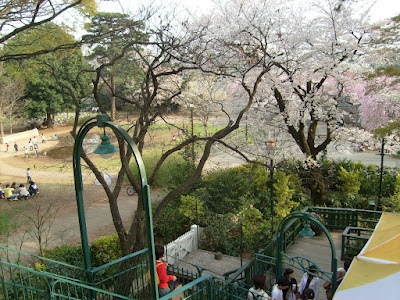
Behind the museum is the large Inokashira Park, and rather than going back via the road, I strolled through the park in the warm April sun. It was almost as crowded as the museum, with gravel tracks around squares of grassed land covered with people sitting and chatting in the sun, jogging round or playing football. I took a breather on a park bench and watched the world go by for a while and it occurred to me for the first time that my holiday was nearly at a close.
Back at the station, I was a little annoyed to see a branded Ghibli bus waiting to transport passengers down to the museum, although on reflection my trip there was more enjoyable by foot (wouldn't have minded it taking me back though). I boarded my train to Shinjuku and it hit me just what I had left myself to do. Now I had three bulky Mamma Aiuto bags to go with my two backpacks and another large plastic bag containing the Mt Fuji choccy. Instead of taking them all at once, I figured I should find my hotel first and come back for half of it.
Shinjuku station was large and busy - in fact it is officially the busiest in Japan, and the evening had just begun, meaning revellers were heading out and tired office staff were coming back. I made a stab at the direction of the hotel, my map being a typical JTB map that is sort of right but also sort of not. I passed through some of Shinjuku before finding myself back at the station, this time at the east side, having passed three separate people pleasantly trying to sell me massages and 'Big American Man' sex sessions (yes, I declined). Shinjuku station happily had a tourist information office, a cramped one-person booth which I squeezed into and asked the thankfully English speaking person for directions. The described some landmarks to work by and some street names (some of the larger shops in Japan often have enormous cube-shaped advertising boards on their roofs) and sent me on my way.

Somehow, and I don't fully know even now, I managed to work through the shopping complexes and wide roads and their crossing areas (which always had a million people trying to cross from each side), past glittering windows advertising cheap, hi-tech gadgetry and displaying posters of various western icons (Timberlake, Beckham etc.). The route took me out of that district and into a slightly different one, where the retail outfits were replaced by red neon and lots of X's. Fortunately they passed by and finally up a road my hotel. I checked in, put my bags down, and retraced my steps to the station to hulk back my remaining possessions.
After getting myself some food at a nearby Italian restaurant, I did a little bit of photo transferring and headed to bed, tired and aching. Tomorrow was my final full day - a day which would be spent at least partially getting more stuff for gifts for folks back home. I would also have to try and find another suitcase, into which this growing pile of tat would have to go. For now, I just watched some telly until my eyes got heavy.
Leeds Film Festival - Day 11
Documentary Shorts Competition
Don't Shoot (South Africa) - Riaan Cruywagen is a seasoned newsreader on South African public TV since the late 70's, and has so been around to comment on the many events that have happened in the last 30 years. This documentary gives voice to both him and his critics; those who saw the riots and violence outside their windows, or worse, and had it referred to on the TV as a 'colourful demonstration'. Cruywagen responds repeatedly and vehemontly by pointing out he is a newsreader, not his place to either judge or compile the news; just read it out in an authoritative and convincing manner. This short documentary reveals the man behind the wig (it must be...) and his unprovoked self-justification is unsettling. 7/10
Plane Days (UK) - A group of plane spotters, old and young, male and female, sit in and around their cars outside Heathow airport, collecting airplane tail numbers like an adult version of football stickers. Some have gone to real expense, high-powered binoculars, laptops with specialised radar software and a direct link into the heathrow flight data. The way they track the planes mercilessly across the skies, which are pictured largely as skulking reflections in house windows, they seem to be doing it to satisfy some male hunter instinct, the women surely there because their husbands dragged them into it. It was an affectionate, non-judgemental window on the lives and motivations of these people. 7.5/10
Bidcatcher (Netherlands) - A strange fly-on-the-wall documentary about a netherlands auction house specialising in second hand large earth moving diggers and trucks, the sort whose wheels are larger than a man. Other than being slightly interesting to see huge machinery lining up like cars to the highest bidder, it wasn't very attention-holding. 5/10
The Consolation of Children (UK) - An affectionate tribute to the life of Arthur Worsley, and 'Charlie' his ventriloquists dummy, from his son and mother. Ed sullivans claims that he was the best ever were a little hard to swallow, until you saw him in full 'gottle of geer' flow, which showed off his talents perfectly. Since his death, Charlie has been resurrected from the suitcase and is often seen around the house, Arthur and Charlie were so inseperable that the presence of the dummy allows the family to retain a piece of the man. 7.5/10
52 Procent [52 Percent] (Poland) - The clinical, cattle-like process of finding the most suitable ballerinas from this years crop of young girls is troublesome to watch. And it's not so much a case of 'pushy mum' either - the kids want to get there more than anything in the world, and this is exemplified with Alla, who's legs are a little shorter than the 'ideal' 52% ratio of legs to height. Alla is given a second chance if she can somehow get those extra few millimeters, and puts herself through intense pain and suffering stretching her legs in all sorts of directions. Another well-made silent comment on an interesting section of society. 7/10
Going to Sleep is Something Absolutely Certain in Life (Italy) - A train heads through the night, the camera pointing out of the window, catching the dimly highlighted scenes of devastation outside. Occasionally, a passenger narrates over the imagery, fading in and out of a conversation with someone else. This film is a personal account of the devastation brought on in his home town, which I suspect but am not sure, refers to New Orleans, since there are American symbols in amongst the detritus of collapsed buildings and felled trees. As a personal record of the event, it has special meaning, but an entire film squinting to see what you're looking at began to grate. 4.5/10
Blauw [Blue] (Netherlands) - Three people interact with water in different ways; an aged fisherman on the blustery, rocky shoreline, a professional diver, and a young child messing around in a swimming pool with his dad all get to share their views. The kid was definitely the most smile-inducing to watch. 6/10
The Existence (Poland) (review)
This one is definitely not for the squeamish. Jerzy Nowak, an elderly actor has in the remaining months of his life decided to donate his body to scientific research when he dies, much to the shock of his family and friends. This is more involved than it sounds - the will has to be correctly worded so as to be compliant with the legalities of the situation, and when donated to science, the body in question ceases to be considered a person, and instead is merely an object, a property of whoever gets it to experiment on. At the start of the film, we see the sort of conditions such an ex-person has to look forward to; a submerged tank in a medical university vault holds one such specimen, and it is raised, dumped on a stretcher, hosed down and then carted off to be poked and prodded by some new medical students.
Norwak is seen preparing for the final day; having music composed for his funeral, visiting his lawyer to get everything sorted out, buying a suit and renewing his wedding vows, and visiting the medical university where he may end up spending two years before whatever is left of him is buried. It is a very good view of a man who is putting on a brave face, but occasionally emotion breaks through and his bottom lip begins to quiver, and it's difficult not to become affected by it all. If you can stomach the gruesome imagery (mostly at the start and end) then this is a well-done film. 7.5/10
From Inside (US) (site)
Based on a graphic novel of the same name by John Bergin, From Inside is an animation about a pregnant woman riding a train to an unknown destination, across a post-apocalypse wasteland, plowing through the remains of people and communities after some catastrophe. As the train ploughs on, it stops to pick up water, kill cattle for meat, and whenever it rains, in case of flooding the tracks. One day the train picks up a man with an injured dog, who begins leaving gifts for the woman, and as the birthing date gets ever closer, she suffers resentment from the other passengers for her preferential treatment.
From Inside is animation, but only just. Many scenes are simply a still or partially animated picture, with others being completely rendered in 3D, especially the train (which travels on tracks that have strangely survived when everything else has been obliterated). This restricted form of animation is sort of okay, especially when you realise that most of the animation has been done by Bergin alone, and the sketch style of the woman, often in silhouette against the train windows, fits well as an echo to its graphic novel roots. However, it just didn't hold much attention; it seemed a labour of love by the director, particularly the many 3D scenes that panned around the train as it went along as if to say 'I really spent a long time rendering this damn train and I'm gonna make sure I get my moneys worth..'. It all ended rather strangely as well, which I won't bother explaining, suffice to say it drew 'pfft's from the audience rather than the intended reaction which I think should have been quiet awe at what we had seen. I hear the novel itself is a very good one, but you should read that and ignore the film, for the latter spoils the former. 5/10
Sword of the Stranger (Japan) (wiki)
At last, a bit of anime. Leeds has been usually pretty generous with anime films across the years, but it turned up a bit short this year, with no Sky Crawlers or Ponyo to be seen. Sword of the Stranger had to shoulder my expectations pretty much on its own this year, and it did a solid job of it. Kotaro and his dog Tobimaru are on the run, sheltering in a remote temple where a ronin, Nanashi has decided to have a kip. Nanashi is your typical tight-lipped guy who refuses to fight again due to secret past blah but he can handle a sword like a pro blah, and he finds himself accompanying the kid through trecherous areas to return him to sanctury, for there are people out looking for him.
Various Chinese factions want to get hold of Kotaro, and have to do it within a few days or else they will have to wait a year to perform their mysterious rituals, creating a game of cat and mouse with each side trying to get hold of the kid for themselves, leading to plenty of bloody fights.
There was virtually nothing about Sword of the Stranger that could be considered original. It has typical anime feel and a predictable story ending in a showdown between the two main fighters. Made by Studio Bones, they of Cowboy Bebop and Wolf's Rain, with plenty of artistic ancestry on show from both sources. With such a pedigree, it was never going to be awful. Fluid animation, well coreographed fight scenes, and a good, solid story (although who was on who's side got a bit confusing), and though it did nothing original, what it did do, it did well. 7.5/10
Don't Shoot (South Africa) - Riaan Cruywagen is a seasoned newsreader on South African public TV since the late 70's, and has so been around to comment on the many events that have happened in the last 30 years. This documentary gives voice to both him and his critics; those who saw the riots and violence outside their windows, or worse, and had it referred to on the TV as a 'colourful demonstration'. Cruywagen responds repeatedly and vehemontly by pointing out he is a newsreader, not his place to either judge or compile the news; just read it out in an authoritative and convincing manner. This short documentary reveals the man behind the wig (it must be...) and his unprovoked self-justification is unsettling. 7/10

Plane Days (UK) - A group of plane spotters, old and young, male and female, sit in and around their cars outside Heathow airport, collecting airplane tail numbers like an adult version of football stickers. Some have gone to real expense, high-powered binoculars, laptops with specialised radar software and a direct link into the heathrow flight data. The way they track the planes mercilessly across the skies, which are pictured largely as skulking reflections in house windows, they seem to be doing it to satisfy some male hunter instinct, the women surely there because their husbands dragged them into it. It was an affectionate, non-judgemental window on the lives and motivations of these people. 7.5/10
Bidcatcher (Netherlands) - A strange fly-on-the-wall documentary about a netherlands auction house specialising in second hand large earth moving diggers and trucks, the sort whose wheels are larger than a man. Other than being slightly interesting to see huge machinery lining up like cars to the highest bidder, it wasn't very attention-holding. 5/10
The Consolation of Children (UK) - An affectionate tribute to the life of Arthur Worsley, and 'Charlie' his ventriloquists dummy, from his son and mother. Ed sullivans claims that he was the best ever were a little hard to swallow, until you saw him in full 'gottle of geer' flow, which showed off his talents perfectly. Since his death, Charlie has been resurrected from the suitcase and is often seen around the house, Arthur and Charlie were so inseperable that the presence of the dummy allows the family to retain a piece of the man. 7.5/10
52 Procent [52 Percent] (Poland) - The clinical, cattle-like process of finding the most suitable ballerinas from this years crop of young girls is troublesome to watch. And it's not so much a case of 'pushy mum' either - the kids want to get there more than anything in the world, and this is exemplified with Alla, who's legs are a little shorter than the 'ideal' 52% ratio of legs to height. Alla is given a second chance if she can somehow get those extra few millimeters, and puts herself through intense pain and suffering stretching her legs in all sorts of directions. Another well-made silent comment on an interesting section of society. 7/10
Going to Sleep is Something Absolutely Certain in Life (Italy) - A train heads through the night, the camera pointing out of the window, catching the dimly highlighted scenes of devastation outside. Occasionally, a passenger narrates over the imagery, fading in and out of a conversation with someone else. This film is a personal account of the devastation brought on in his home town, which I suspect but am not sure, refers to New Orleans, since there are American symbols in amongst the detritus of collapsed buildings and felled trees. As a personal record of the event, it has special meaning, but an entire film squinting to see what you're looking at began to grate. 4.5/10
Blauw [Blue] (Netherlands) - Three people interact with water in different ways; an aged fisherman on the blustery, rocky shoreline, a professional diver, and a young child messing around in a swimming pool with his dad all get to share their views. The kid was definitely the most smile-inducing to watch. 6/10
The Existence (Poland) (review)
This one is definitely not for the squeamish. Jerzy Nowak, an elderly actor has in the remaining months of his life decided to donate his body to scientific research when he dies, much to the shock of his family and friends. This is more involved than it sounds - the will has to be correctly worded so as to be compliant with the legalities of the situation, and when donated to science, the body in question ceases to be considered a person, and instead is merely an object, a property of whoever gets it to experiment on. At the start of the film, we see the sort of conditions such an ex-person has to look forward to; a submerged tank in a medical university vault holds one such specimen, and it is raised, dumped on a stretcher, hosed down and then carted off to be poked and prodded by some new medical students.
Norwak is seen preparing for the final day; having music composed for his funeral, visiting his lawyer to get everything sorted out, buying a suit and renewing his wedding vows, and visiting the medical university where he may end up spending two years before whatever is left of him is buried. It is a very good view of a man who is putting on a brave face, but occasionally emotion breaks through and his bottom lip begins to quiver, and it's difficult not to become affected by it all. If you can stomach the gruesome imagery (mostly at the start and end) then this is a well-done film. 7.5/10
From Inside (US) (site)
Based on a graphic novel of the same name by John Bergin, From Inside is an animation about a pregnant woman riding a train to an unknown destination, across a post-apocalypse wasteland, plowing through the remains of people and communities after some catastrophe. As the train ploughs on, it stops to pick up water, kill cattle for meat, and whenever it rains, in case of flooding the tracks. One day the train picks up a man with an injured dog, who begins leaving gifts for the woman, and as the birthing date gets ever closer, she suffers resentment from the other passengers for her preferential treatment.
From Inside is animation, but only just. Many scenes are simply a still or partially animated picture, with others being completely rendered in 3D, especially the train (which travels on tracks that have strangely survived when everything else has been obliterated). This restricted form of animation is sort of okay, especially when you realise that most of the animation has been done by Bergin alone, and the sketch style of the woman, often in silhouette against the train windows, fits well as an echo to its graphic novel roots. However, it just didn't hold much attention; it seemed a labour of love by the director, particularly the many 3D scenes that panned around the train as it went along as if to say 'I really spent a long time rendering this damn train and I'm gonna make sure I get my moneys worth..'. It all ended rather strangely as well, which I won't bother explaining, suffice to say it drew 'pfft's from the audience rather than the intended reaction which I think should have been quiet awe at what we had seen. I hear the novel itself is a very good one, but you should read that and ignore the film, for the latter spoils the former. 5/10
Sword of the Stranger (Japan) (wiki)
At last, a bit of anime. Leeds has been usually pretty generous with anime films across the years, but it turned up a bit short this year, with no Sky Crawlers or Ponyo to be seen. Sword of the Stranger had to shoulder my expectations pretty much on its own this year, and it did a solid job of it. Kotaro and his dog Tobimaru are on the run, sheltering in a remote temple where a ronin, Nanashi has decided to have a kip. Nanashi is your typical tight-lipped guy who refuses to fight again due to secret past blah but he can handle a sword like a pro blah, and he finds himself accompanying the kid through trecherous areas to return him to sanctury, for there are people out looking for him.
Various Chinese factions want to get hold of Kotaro, and have to do it within a few days or else they will have to wait a year to perform their mysterious rituals, creating a game of cat and mouse with each side trying to get hold of the kid for themselves, leading to plenty of bloody fights.
There was virtually nothing about Sword of the Stranger that could be considered original. It has typical anime feel and a predictable story ending in a showdown between the two main fighters. Made by Studio Bones, they of Cowboy Bebop and Wolf's Rain, with plenty of artistic ancestry on show from both sources. With such a pedigree, it was never going to be awful. Fluid animation, well coreographed fight scenes, and a good, solid story (although who was on who's side got a bit confusing), and though it did nothing original, what it did do, it did well. 7.5/10
Not Angels
 This post is a tribute to perhaps my favourite series of all time: Haibane-Renmei. Now over 5 years old, it still continues to fascinate and affect me each time I watch it, and have felt the need for some time to put my feelings into words. Sure, I love to watch an action flick like Indiana Jones, or something satirical or scathing or just plain wrong like Family Guy, but this answers to a different part of my brain.
Haibane-Renmei was created originally as a self-published manga by a rising artist called Yoshitoshi ABe. More a light-hearted comic strip back then, the only similarity was with the angelic-like creatures that inhabited the world. Abe decided that he would make a 13-part anime using such creatures, but would set the mood to be darker and deeper.
Synopsis
 It follows the story of a young girl who in the opening minutes of the first episode falls to earth. At the same time, a woman discovers a giant cocoon in one of the rooms of a run-down old school building. Dressed in second hand clothing, and spouting charcoal grey wings and a halo, she readies the room for the hatching with the help of similar beings. These are the Haibane, people born into a town with no idea why they are there, and only the most fleeting memories of who they used to be.
Once hatched and awake, the new girl is introduced to the group and asked about the dream she had. As is the custom of the Haibane, each one is given a name according to their dream; In the case of the new arrival, she is named 'Rakka' meaning 'to fall'.
And so the series charts Rakka's first year at Old Home, the name given to the semi-collapsed building that the Haibane use as their 'nest'. If it stayed as just that, the series probably would not have been very special, but its beauty comes from the relationships that develop between the Haibane, how they fit into the world and have to bend to the whim of the rules laid down by the Renmei, a sort of governing body of people whom the Haibane may only communicate via a designated intermediary.
 In particular, the bond that grows between Rakka and Reki is the strongest. Reki is the 'house mother' to the younger Haibane due to her length of time in the world and her take-charge nature. As the series progresses we see that it is in fact Reki that is the focus of the story. Her mysterious cocoon dream was almost entirely wiped from her mind and the small subtle clues given in the dialogue of the first episodes only hint about the mysterious and deeply troubled past she keeps so well hidden.
Yet neither Reki nor the Renmei are 'baddies' - in fact there are no western-style 'baddies' in the series; it concentrates purely on the interactions and development between characters, wrapped in a storyline so tightly woven that it gains that often credited but rarely deserved simile of an onion, where you can peel back successive layers of story to find deeper threads in the narrative undercurrents. Despite being animated, the characters through their actions and reactions to the story become fleshed out, believable, complicated human beings with an admirable 'make the best of it' approach to their aimless situation - they come into being, spend an amount of time in Glie (the walled town containing Old Home) as poor second class citizens, and then mysteriously and without warning take their Day of Flight, where they leave the world forever.
So we get to see lives in miniature, where people are born, live, grow and die within a short time frame, and we also get to see the consequences of this overlapping and repeating cycle on the lives of the other Haibane, who build intertwining relationships that are then without warning cut apart without explanation. It is more than just 'following the adventures of someone adjusting to an unfamiliar situation' and instead provides a peek at a recognisable and repeating, replaying cycle of events. Centering in upon a crucial period in a story that could stretch thousands of years in either direction, it molds itself around the experiences of the viewer, and in doing so, encouraging them to reach their own conclusions as to what happened both before and after, rather than taking the approach of saying 'this is what it all means' and attempting to explain everything. Such themes cannot be easily fit into words and the interpretation of what happens will be different for everyone.
I should note that even though the series uses symbolism from various religions, these are only used to give a feeling to the show, and the story itself is not religious in tone or meaning, it is more a collection of themes revolving around spirit, loss, redemption and the threads weaved between people that are worn and snapped on the sharp edge between life and death. I certainly wouldn't have liked the series if it attempted to preach any religious doctrine - my personal attitudes towards organised religion are short-fused, yet the series still managed to grab a tight hold of me.
Reception
Unfortunately, Haibane-Renmei has been largely overlooked by the general public (mostly down to zero advertising, and there being no particular pigeonhole to sell it through in a western market), and has little to no chance of ever being shown on television, but has nonetheless affected an increasingly large group of people who have experienced it. Despite being quite abstract and occurring in a fictional world, the series touches such raw emotions because its themes can be universally understood and empathized with.
 But don't just take my word for it - a quick google search comes up with considerable interest on the net; both from anime sites and other people who have no interest in anime, have by chance encountered it, were moved deeply by it, and felt the need to show their appreciation. Just a few quotes:
'Beautiful, engaging, haunting and unique'
Anime News Network
'..to refer to it merely as anime seems somehow inadequate. It is a something delightful and moving, subtle and sweeping, humorous and unsettling, and begins speaking on a level not entirely visible of things not yet seen.'
Heroic Cinema
'It is much more of a spiritual and emotional journey that artfully plays on timeless themes of salvation, meaning, purpose, love, loss, and trust. In many ways it is a metaphor for our own experience: We come into this world from some unknown place, and try to figure out why we're here. Along the way, we have to say goodbye to people we love, knowing not where they are going, but certain that soon enough we ourselves will be following them, and having never really understood what anything was all about. And yet, we somehow find a meaning in all the confusion and sadness. I think that's what this series is about.'
Amazon.com Review
'Can a television series qualify as great literature? In principle I don’t see any reason why one couldn’t, but few of them have any such ambitions. In any case great literature has to pass the test of time, and perhaps the medium hasn’t been around long enough. If one ever does qualify, it might well be this strange haunting story about people who have wings and halos, but who are not angels.'
Funblog
'I usually don't like TV-series. I also don't really like anime, except for the films of Miyazaki. But Haibane Renmei is hard to classify as a standard anime.' ... 'On the surface Haibane Renmei seems like a fairly simple drama. This is because it's the impression the series tries to give us. On the first couple of episodes, there is an underlying uncertainty and darkness. As the series progresses in its 13 episode span, it becomes deeper and more thought provoking. It never spells out things clearly to the audience, and never answers all our questions. It remains wonderfully subtle, and after I finished watching it I thought about the series and its themes for several days.'
Review on IMDB
Anime News Network
'..to refer to it merely as anime seems somehow inadequate. It is a something delightful and moving, subtle and sweeping, humorous and unsettling, and begins speaking on a level not entirely visible of things not yet seen.'
Heroic Cinema
'It is much more of a spiritual and emotional journey that artfully plays on timeless themes of salvation, meaning, purpose, love, loss, and trust. In many ways it is a metaphor for our own experience: We come into this world from some unknown place, and try to figure out why we're here. Along the way, we have to say goodbye to people we love, knowing not where they are going, but certain that soon enough we ourselves will be following them, and having never really understood what anything was all about. And yet, we somehow find a meaning in all the confusion and sadness. I think that's what this series is about.'
Amazon.com Review
'Can a television series qualify as great literature? In principle I don’t see any reason why one couldn’t, but few of them have any such ambitions. In any case great literature has to pass the test of time, and perhaps the medium hasn’t been around long enough. If one ever does qualify, it might well be this strange haunting story about people who have wings and halos, but who are not angels.'
Funblog
'I usually don't like TV-series. I also don't really like anime, except for the films of Miyazaki. But Haibane Renmei is hard to classify as a standard anime.' ... 'On the surface Haibane Renmei seems like a fairly simple drama. This is because it's the impression the series tries to give us. On the first couple of episodes, there is an underlying uncertainty and darkness. As the series progresses in its 13 episode span, it becomes deeper and more thought provoking. It never spells out things clearly to the audience, and never answers all our questions. It remains wonderfully subtle, and after I finished watching it I thought about the series and its themes for several days.'
Review on IMDB
There are many more. Something intangible about the series has the power to grab the soul, but there are those who would watch such a series and be thoroughly underwhelmed by it. No guns, no explosions, no sex or violence, and none of the typical anime cliches like pneumatic flying robot women. Also, many people in the west still hold the opinion that something animated cannot possibly live up to such praise leaving it purely the domain for children and 'geeks', and maintain a safe distance from it. The series has to negotiate its way through all sorts of hoops just to get put in a DVD player.
I truly believe that this story should be experienced by as many people as possible; it was the first story in a long while to make me seriously think about what it was I was watching, and changed my opinion about Anime as a medium capable of telling as emotional, mature and beautiful a story as any example from literature, film or television.
 If you have the time and the patience, do yourself a big favour and watch it.
Offical Site
- the english-language site by Geneon
Wikipedia entry
- a more in-depth synopsis
The Charcoal Feather Federation
- if you want to read further into various theories inspired by the series, this is a good place to go. The bulletin board is still abuzz after 5 years.
All pictures are acknowledged as copyright Yoshitoshi ABe.
Subscribe to:
Posts (Atom)