Showing posts with label Studio Ghibli Museum. Show all posts

Japan 2010: 20 - Where I Become a Slave to Consumerism

Since my first job today would be to get the necessary folding to see me through an exhaustive shopping trip (I really didn't know what I'd be buying but it would sure as hell be expensive), I let my tired body rest in my little room which would form the base of operations until I left to catch my plane. For the most part, I had left the souvenir-buying until this point, although weakness and a need to take home something from each place I'd been to meant that there was already much for me to lug home already. Today however was totally for me. I haven't many friends who care much for anime-related merchandise so this would be pretty much all mine. Today I had two goals; visit the Ghibli Museum (for the second time) and since it was on at the time, try and see at least a couple of films at the Tokyo International Film Festival. In other words, several of my passions would all come together in a single day.

The post office opened at 9am sharp and I was there at the door as soon as it did. The sun was shining and the skies had exhausted their supplies of rain, at least for the moment. Out came another 20,000 yen, but when I handed over my final travellers cheque to get another ten thousand to play with, they wouldn't take it. I asked where was the nearest place and they pointed me at the Mizuho bank branch around the corner.

There is an undercurrent of disquiet in the UK about our banks and how they have managed to change from safe, family-run establishments operated by a man in a bowler hat who you had to be very nice to in order for him to lend you some money, to the massively over-powerful corporations they are today, and how that has done its bit to land us where we are now. Well, as I entered this bank, it felt a little like I had gone backwards in time.

They had the usual people behind glass screens on the ground floor, but my business was upstairs. A stout man of advancing years greeted me at the top and asked me to sit in the waiting area, and offered me a drink. He asked in broken English what I was after, and I showed them my cheque. Looking over, a pair of desks with chairs on either side with a divider between was all that stood between myself and a whole array of workers, sat at their desks surrounded by stacks and reams of paper, calling to one another and holding up forms to fill, barely a computer between them. At the desks, one mature-looking man who looked quite senior was sternly reviewing a written application form of commendable thickness, filled in by a much younger applicant, now perched nervously on the other side, sitting on his hands and trying to avoid eye contact.

I'm not saying these guys necessarily had it right, but the careful, respectful and above all nerve-wracking atmosphere bestowed on it's custom felt like when things hit the fan again like they did, this little bank wouldn't be one of those that needed a bail-out.

The other desk was free but with no assistant manning it, I waited. After a couple of minutes, a young bespectacled man found a little time between typing and form filling to serve me. I handed over the cheque and filled in a form or two, and then was asked to go back to my seat for a while as my cheque disappeared into the paper forest. About five minutes later, he returned with a crisp note and a thank you slip. I bowed to everyone and left.

Stocked up on hard cash, I headed off in the direction of Mitaka. The YeastEAST mini-bakery in Otsuka station was the closest eatery that looked open and they did take-out so took a quick detour in there. (Recommended: their absolutely gorgeous bacon-bread sticks. Very yum), and then went south back to Shinjuku.

The trip to Mitaka was back towards Mt. Fuji again although not as far, and this time I would be taking the museum bus that I had clocked eyes on just as I was leaving last time. Down the stairs out of the station, there is a bus stop dedicated to the route of the bus. A bus conductor in a museum hat was stood at the bus as I ran towards it and stopped my entry onto the bus, and pointed to the large metal unit just to the side. It even had it's own ticket machine.

The driver waited patiently an extra minute while I fumbled enough cash for a return ticket (300yen return, 200yen 1 way), and then got on. It was standing room only. I ended up stood next to Rob and James - a couple of guys from Essex. Mid-late twenties, they'd been friends since young and were living the dream of visiting the country. They had the figures you might associate with lots of cult-TV viewing, and had a lot of facial hair, through which were a couple of slightly haggard looks, maybe from the jetlag, or perhaps a bit too much sake the night before. James was in crutches, clearly a sizeable accident wasn't going to keep him away from his trip. We chatted as the bus bounced towards the museum, this being their first time and had to come see it while doing a week around Tokyo.

The stop came and most people filed off. The three of us jointly approached the Totoro ticket booth together, the two guys forgetting their age briefly and going all squealy and childlike, whereas my reaction was one of returning to an old friend. A couple of pictures at the booth later and they raced ahead, the crutches not stopping James from leaving me for dust.
I strolled down the entrance pathway, surveying the Miyazaki-styled structure. It was pretty much as before, only with a lot more creeping ivy up the walls, and as with many other places, the gardens were now in need of a bit of tidying.

It was half past ten so the foot traffic was relatively light but things started to busy up pretty soon afterwards. Even out of season, the museum gets plenty of attention from all over the world.

Indoors, things were similarly recognisable, and as before, I was discouraged from taking pictures so you'll just have to read for a bit. I exchanged my voucher for my proper ticket at the reception (Totoro and Mei this time) and strolled at a relaxed pace down the stairs into the main area.

The layout hadn't changed, but there were a few subtle differences; the giant dolls house with the film scenes behind the windows had swapped around a bit and included entries for Ponyo, Earthsea and Arrietty, and there was a lovely circular 'evolution' animation being shown through the exploded film camera in the corner; a lowly bacterial creature morphs and grows and escapes the predators evolving around him before attaining a human-like form where he meets his true love.

I figured that the Saturn Theatre should be next before the queues got too big. One batch had just gone in and I checked the boards - MonMon the Water Spider was playing. It didn't grab my attention so much when I'd first heard of this one, but an exclusive Ghibli short film isn't something you can get picky about. Rob and James were in the queue and I ended up behind them. We compared film strips, and they were suitably jealous of my Totoro one; Robs was a scene from Howl where Sophie sees the burning city, whereas between us we couldn't place James's strip at all - it was a vague countryside scene - we guessed either Mononoke or Totoro. We stood and chatted, each of us with a subdued excitement bubbling under our domestic conversation, and finally we all filed in.

Mon Mon is a little water spider living in a quiet lake, who one day sees a water boatman (woman) and falls deeply in love, but he is of the water and she the air, and it doesn't help that she tries to eat him when he goes to say hello. The best part of the film is the music, which is played as a pair of solo pieces that come together at the end as they meet on equal but opposite terms. Not even a nearby child not knowing how to keep quiet could spoil the film, and I was completely charmed by it, along with all the other children in the room.

Up on the second floor, things had stayed much the same in the artists' study, save for a few new sketches on the walls, although I noticed that the new stuff seemed to be at the expense of most of the Takahata material. The 'guest room' which last time was the 'three bears' exhibit looked as if it was between exhibitions, and contained just a handful of stands displaying preview reels of some future shorts.

Upstairs, the Catbus exhibit was still off-bounds to the adults (boo), and was again crawling with kids, watched over by patient and slightly jealous-looking parents. Along with the kids this time was a whole nest of soot-sprite toys which were being flung merrily about, which I didn't recall being there last time.
The adjacent book store and Mama Aiuto rooms were respectively dead quiet and intensely packed as usual, so I looked a bit through both of them to see what they had, and then left for the balcony exit for some much needed air.
The Laputa robot was still attracting pushy parents and small children to it's feet for photo opportunities, so I went behind for a while to the peace and quiet of the grass borders. A nice airy breeze tempered the heat of the sun nicely and the rustle of the scrub calmed me down again while I contemplated my shopping list. An Arrietty art book was a definite, and perhaps a MonMon picture book as well (Ghibli do a mini art book for each of their short films and I'd already got a couple from the set at home).

I headed back into the chaos of Mama Aiuto first. Suddenly I had the purchasing shrewdness of a twelve year-old on a sugary high. There was an English language museum booklet going for 1000yen (with a free poster) so I had that; they had several soundtracks (including the lovely MonMon one and the Arrietty album, plus a Ghibli songs one for luck - about 7000yen total), a round tin of cookies for 1600yen, plus by some miracle I also considered my friends as well in all the buying; I got a couple of squidgy fluffy Totoros (2000yen each), as presents for their newly arrived children.

13000yen down straight away. I sat panting on one of the knowingly placed benches just outside the shop, glad to be out of the madness and thankful I had resisted the urge to try for some hugely-expensive clothing or one of their giant Porco Rosso airfix plane models. I could quite easily have walked away with most of that shop had I not been constantly pushed around the store by fellow eager buyers.

Thankful I'd left the relatively sedate bookshop until last, I quietly strolled around with my sizeable baggage without fear of knocking too many people over. I picked up an Arrietty art book (2900yen - which I'm sure was more expensive than when I'd seen it in that Yurakucho cinema, but I couldn't be arsed going back for a few hundred savings). I also got the Monmon book (1000yen), but passed on the Ponyo art book, although it was very tempting. They had some books from Aardman and Pixar for sale there as well, but they were all in Japanese so I gave them a miss.

I walked back past Mama Aiuto's with blinkers on my eyes, resisting any temptation to return and buy more things. Instead I went outside and tried without luck to get a seat at the Straw Hat cafe, which again was impossible, although Rob and James were there tucking into some strawberry cheesecake. I settled for a banana ice cream at the take-away and sat at a remote seat munching in the shade.

It was pretty busy now and midday was long gone, so I took a final tour around the more interesting rooms and then left.

The bus had just left, but another followed quickly behind. At Mitaka station it was 2.30, so I retraced my steps to the hotel, dropped everything safely off, and then got back on the loop line - this time for Hamamatsucho.

Hamamatsucho station is in Minato, on the opposite side of the Yamanote loop to Otsuka and my next stopoff on the way to Roppongi, a fashionable district of Tokyo. Minato, is close by and is the home of the Tokyo Tower, which sits directly between the station and Roppongi Hills, where the Tokyo Film Festival was entering it's final phases and where I would be headed for the evening. It had been recommended that I should get on the subway from Ebisu, as that was more direct but I figured it would be nicer to get off from the south-east end of the Yamanote line and take a walk through the area to see what it was all about. This was perhaps foolhardy if I was going to catch any films because things were getting late, but it was my only chance while here.
As busy and bustling as any Tokyo district, I emerged onto a busy main street and oriented myself according to my printed out map with additional scribblings. The roads were wide and the buildings were chunky and covered in neon signs, and everything felt ready to move into the nightlife phase of which the area is know, now not so many hours away.
The first part of my journey was simple - just head in the direction of the Tokyo Tower - poking cheekily out above the tops of the buildings - and I would be on the right track.

The modern buildings continued on for some time, although these were mitigated slightly by a section of road on the way to the Buddhist Zozo-ji temple, straddled by several Torii gates, some of which had their own traffic lights.
Zozo-ji is a large temple in Shiba Park, situated just next to the tower. You enter through a huge gaudy red Daimon gate whose ornamental roofs stick out over the busy road in front. As the night was drawing in, the tower lit up a similarly seductive rouge colour behind the main shrine building, as a few final worshippers paid their respects for the evening. I scurried across the main concourse and out of the side exit, and carried on up the road.

The tower was still open for lifts to the top, but I was clock-watching once more. It was half past five and the next film that I wanted to catch was at six. I figured that I could return and get some nice views from the top once things got properly dark. The imposing red structure did look beautiful in the evening light. In the entrance area below, they were erecting a large Christmas tree in preparation for the festivities over the next few weeks.

Past the tower, I was reliant completely on the map. I passed a rather long castle structure, where every entrance had a manned guard house outside; it appeared to be one of the many embassy buildings in the area. I tried not to make eye contact as I went past, and probably over compensated my look of innocence at walking somewhere really quickly.
Beyond that, things took on a style similar to Shinjuku or Akihabara, although the atmosphere felt a little different, a little more exhausted businessman-like. Large multifloor shopping complexes (including another Don Quijote with a bloody rollercoaster on the roof!) and many a restaurant, nightclub or some more adult emporium did their bit to add to the neon decoration. For many of the latter, they had employed western men (strangely, mostly black guys) to drum up business by coming over to you and acting chummy in the hope you would follow them in and insert some notes between nubile ladyskin and lacy underwear. If you've never been through such a Japanese district before and suddenly you're being called 'my man' by the fourth or fifth black guy in a row, a certain uneasy feeling creeps over you. I kept my pace up and moved through quickly.

Though I had lost my place on the map, I knew I was close as there were TIFF posters attached to all the lampposts in the area, although none actually included any arrows to point me in the right direction. I took a guess and headed down a side road which by good fortune ended up at the base of the Roppongi Hills complex, and was greeted at the intersection by a building that insisted on counting down numbers on massive LCD-style readouts. Up the hill beyond was the commercial area, and the place had definitely stepped up a gear on the posh front. I felt out of place in my t-shirt and jeans.
Eventually I found the entrance, although rather than finding myself in a cinema, it was a complicated multilevel shopping arcade with concrete parks and covered areas, little curious pathways everywhere and precious little signage. Not what you want when searching desperately for a festival.
To my intense relief I eventually spotted a load of TIFF posters and got on the right track, heading up a few floors and emerging into an open area where a booth and a red carpet (and a huge sign) told me I had finally arrived. I approached the booth expecting a ticket exchange (or being told I didn't look tidy enough to enter) but was instead guided helpfully through a set of nearby double doors into the cinema reception.

The queues were mercifully short. I took a final scan of the films still left I could see. Roman Polanski's Ghost Writer looked pretty cool but it had sold out (still not seen it), but The Elephant and Countdown to Zero still had tickets going, so I got them. I would only be seeing two films at this festival (plus a short), but I could now say that I had at least been.

--- Mini Festival Time! ---

Wake Up TAMALA!
(Jpn) (full, unsubbed movie)


A short-ish animation before The Elephant, TAMILA is an environmentally-themed film about a punk cat living in cat city, where it hasn't stopped raining. Saving a bumblebee from drowning, she goes to sleep that night and dreams of walking through time, seeing cat (read:human) technology develop, along with the inevitable war and pollution that comes with it. When she wakes, the earth is a wasteland, and is left with the bee to walk through the scorched remains a la Grave of the Fireflies (although nowhere near on par), with a similarly happy ending.

The flash-animated style and the childish feel of the film (which was surprisingly English subtitled) set me up for something far more cute and cuddly for what it eventually turned into, which got unusually morose and rather graphic in places, trying to drive home the message of 'wake up or die', to it's adult audience. This confused mix of the childish cutesyness and the adult themes put me off it a bit, but it felt as if I was not part of the intended audience. 6/10

The Elephant (Rus) (imdb)

A relatively overlooked film even on the festival circuit, I could find precious little about it online, save for the TIFF page. Bodhi is an elderly elephant in the employ of a travelling circus, who one day refuses to perform all her tricks in the middle of a show. Calling the vet, the outlook is bleak; the bills to fix her would be huge and they don't have the cash. Young and upcoming ringmaster Sergei takes the decision to have her taken away to the knackers yard, and in a fit of ruthless cunning, uses the opportunity to abandon Boni, his girlfriend there with the elephant, a girl who he sees as little more than an annoying distraction.

Sergei and family arranged for the help of Zarezin, an off-the-rails truck driver to transport Bodhi to the fate of the poison injection, and when Boni decides to come along for the ride, the three of them start an uneasy friendship, Zarezin's cold approach to getting the job done eventually melting when Boni finds out about the elephant's fate, turning the film into a sort of Smokey and the Bandit 2, but gentler, and with more heart. Perhaps the best part of the film comes at the end, where Bodhi is allowed to roam through the countryside, and the choice of the elephant's name becomes clear. Yes, it was a bit of a contrived road movie, and there was little in here that was 'original', but it was still very enjoyable, and by the end there was a lump in my throat. 7.5/10

Countdown to Zero (US) (wiki)


2010 was a good year for hard-hitting and ambitious documentaries. This one, by the producer of An Inconvenient Truth, concentrates on the proliferation of nuclear weapons across the globe and the threat of nuclear war that hangs over us, which struck a chord with me having been in the Nagasaki Atomic Bomb museum a week or so before. As a special treat, the mayors of both Hiroshima and Nagasaki [with the help of an English translator for the international crowd], and Lucy Walker, the director of the film, gave live speeches before the film on the big screen,

Some spectacular but disquieting footage had been compiled of bomb blasts - both from controlled tests and from terrorist attacks, which were not nuclear, but put you in mind of the chaos that could come from a terrorist cell getting their hands on one - with the film helpfully providing a handful of ways that a terrorist could do just that with a remarkable ease. Tales of near misses - where accident or miscommunication meant that it was only the steady hand of the guy at the top that stopped an all-out war. A particularly alarming example was during the Yeltsin reign, where a miscommunication of an incoming nuclear missile happened by luck to catch the Russian leader between drunken hazes and he held back from thumping his fist down on the red button.

As an authoritative look into the problems the world faces by the presence of the bombs, this film provides a full and descriptive picture of where we are now, and it's not all obvious stuff either. Though a film basically about a perpetual sword of damocles above all our heads is pretty grim to think about, the latter part of it does take a more upbeat tone, concentrating on the work that has been done to bring the world back from the brink. It's yet another recommended eye-opener of a documentary that you should catch if you can. 8/10

------

I left the cinema sometime close to 10pm, having spent what felt like a criminally short time at the festival compared to my usual efforts. However, I had my tickets as proof I'd been, and thanks to an adjacent shop selling all sorts of film apparel, I walked away with a dual language TIFF 2010 catalogue as well to go in my collection.
Leaving the cinema was easy, but escaping from the labyrinth that was the Roppongi Hills complex was something else entirely. I had lost my bearings completely coming out in the dark, and my attempts to find an exit (curiously unsignposted) led me through half-closed shopping malls, giant spiders and underground car parks; none of which bore exit-shaped fruit. By the time I happened upon the real exit, I was getting a bit stressed. I wouldn't want to be trapped there in a fire or an earthquake, that's for sure.

Using the Tokyo Tower in the distance as a guide once more and fending off the attentions of five (five!) separate black guys asking me in to five separate nightclubs, I scurried on through until I ended up back at Don Quijote's, and since it was still open I took a quick look.

At the entrance they had a small tank with a big fish swimming around in it, and above was six floors of the same crammed in tat as was in the other branches, although this was the first time I had managed to find some Engrish during my trip - and I had been on the lookout.
I headed to the top in the hope of seeing this rooftop rollercoaster, but they had barriers up and it was apparently out of action. I left without buying.
Back at the Tokyo Tower, I took a closer look at their opening hours; and was surprised to find that the lifts to the top stopped at 8pm, so I wouldn't be experiencing that this time either. Boo. Everything was closing up, so I headed back to the station and off to the hotel.


Hotel Review: Otsuka Station Hotel (4800 yen/night, 3 nights)
I finished up in a place similar to where I started. The main draw for this hotel is that it is pretty cheap (for a downtown Tokyo hotel), and it is (very) close to a Yamanote line train station, which is what you need when you're trying to bulk up on souvenirs. If you are the sort of person who could sleep pretty much anywhere there is a functional bed, then this is a bargain option, but the room was poky and could have been cleaner,and the utilities were a little thin on the ground. However, the staff were very friendly and helpful and they do speak a little English, so on balance it was better than Ueno. Internet: free (1 machine at the reception) 7/10
A small restaurant called the Miami Garden looked quite nice, just outside Otsuka station when I got back, so I had a bit of a wash and freshen up, and then went in for a pepperoni pizza, ordering it just after 11pm - about 5 minutes before they stopped making food for the day. Though it was on my plate in what felt like seconds, it went down very nicely thank you very much.

I read about some of the films I had missed at the festival, but I didn't mind so much. Not many people can say they had been but I could. I packed my new things away in the case, somehow managing to cram it all in, and then concentrated on what was going to happen tomorrow - my last full day in Japan, and what I would get for the last few friends and family that wouldn't be happy with a squishy Totoro in their Christmas stocking.

Japan 22 : Fancyplants' Big Day Out


It was time to leave Fujikawaguchi. I was not in any great rush to leave the pure, fresh air of the mountains, but I was becoming a little short on cash, so after getting a shower and wishing the people in the hostel good bye, I left on foot in the direction of the train station with the intention of calling at the local post office ATM on the way. It was closed when I arrived, so after getting a little bit of nosh at the 7-Eleven over the road I sat outside until the cashier dutifully opened the doors for me. Spare folding would be very useful to me today.

Back at the station, the next train out would be a little while, so there was a little time to peruse through the in-station tourist shop and buy a few souvenirs. The trains outside were lined up on their tracks, painted with crazy cartoon mountains to give their passengers a garish and slightly embarrassing appearance as they glided through the picturesque countryside. I paid for a ticket and boarded mine, a definite tourist train- although it was a little past its best, the on-board TV screen had long since been shaken loose of its connection to the looping video of the mountain and its sights, and as the train gathered pace, each wobble and bump on the privately-owned track randomised the image.

So I concentrated on the view outside, the steadily shrinking Mt Fuji to the south, and the increasing amount of structure and form to the landscape as we headed east and the forests vistas were replaced with built-up areas once more. I switched trains at Otsuki to a JR-owned line, which allowed me to make use of the last day of my Japan Rail pass. My destination would be the city of Mitaka, home of countless Sakura trees and most notably, the Studio Ghibli Museum, a building dedicated to some of the finest anime movies of all; a giant exhibit of film chronology mixed with adventure playground, designed by Hayao Miyazaki and Isao Takahata, veteran directors and artists responsible for most of the output in the firm's 20-plus year history. It's somewhere any animé fan should visit once in their lifetime, and definitely so if they ever find themselves in Japan.

I had my ticket ready, or rather a voucher for the ticket, which I had got myself a couple of months previous from a place called MyBus, the designated ticket provider for the UK. That was a little weird. The London number I had called was connected through and I found myself being greeted in Japanese. This was my first ever experience of the language and suddenly I was tongue-tied. Garbling some confused sentence not out of place in Boris Johnsons' repertoire, the lady at the other side thankfully switched to English and we carried on. She apparently had a lot of reactions like that.

I had planned my entire trip around the ticket in fact, so that I could use it at the end of my journey. Oh yes, I had every intention of leaving the museum with a travel fee-incurring amount of tat to bring home with me. However, I didn't get off at the Mitaka stop. I carried on until hitting the Yamanote line at Shinjuku. Good old Yamanote line - how I had missed thee. The last time I had seen it was on the third day of the trip, leaving Ueno on my first Shinkansen ride to Sendai. It was almost like coming home.

I had a room booked in Shinjuku, but it was at a hotel quite a way from the station and getting there would take a while, and also, I might not be allowed in just yet. Instead, I compromised by finding a spare locker in Shinjuku station, sticking both my bags into it (sans a couple of maps and the all important ticket-voucher) and headed back on the same line to Mitaka.

Arriving at the station, the map pointed to a long, straight dual carriageway. In between the opposite lanes of the road was a small ditch through which a gentle stream flowed, the swaying branches of a hundred or more Sakura trees - now in full bloom - creating a pleasant, dappled canopy softening the hard, straight lines of the road. At the head of the long road was a little sign with a Totoro on top, diligently pointing the way to the museum.

I strolled down the road, taking in the pleasant sights; word was that Miyazaki chose Mitaka because of its greater prevalence of natural open spaces than most other wards in central Tokyo, being someone who infinitely prefers a natural scene to look out of the window at as he works at his desk. Even the tarmac on the road to the museum was infused with little specks which sparkled in the sunlight.

The museum emerged slowly from its hideaway behind a group of trees and bushes, the first thing you see is the large, faux ticket booth placed at the gated entrance area. A huge Totoro sat behind the window and provided rare photo opportunities. I stayed there for a short while as gaggles of families passed by, the children (and some of the parents) squealing and pointing excitedly at the booth and posing for photos.

I carried on down the path, taking me along the side of the museum building, a large, chunky sand-coloured structure a few stories high, styled similarly to some of the buildings in Miyazaki's films with smoothed edges and small stained glass windows. From the pathway, a wrought-iron spiral staircase protruded from the upper floor of the building giving access to the roof. Little more about the innards of the building was obvious from the outside, and I had little choice but to work my way through the outer gardens and join the gaggle of excited children and parents, standing in a large queue outside talking excitedly with each other about the experience ahead.

Eventually, I made it to the entrance, where my voucher was swapped for a special museum ticket, a kind of souvenir itself, being a few cells of one of the Ghibli films, encased in a little cardboard frame. Since it showed a few frames from Princess Mononoke, it now sits proudly next to my Ashitaka and San Cominica figures.

There is a slight picture break here; the reason for this is that the museum staff were very vigilant on anyone taking pictures of the inside of the building, stating that Miyazaki wishes people to remember it in their minds and hearts. Out of respect for his wishes, I'll be brief with the contents of the museum.

The museum was designed largely by Miyazaki himself, and many little references to films and other works pepper the museum. It's designed with a childlike exploration in mind, with multiple ways to get up through the different floors from the bottom to the top. The idea is for the kids to go off and crawl through holes and go up stairs and generally lark about like children, while the parents and big kids such as myself stroll through the rooms and exhibits.

Each ticket provides its owner with a single viewing of an exclusive Ghibli Museum Short Film at the in-house Saturn Theatre screening room on the ground floor, although the time and day you go will determine which you see, and you won't know until you get there. I danced about like the other kids in the queue with fingers crossed it would be 'The Day I Harvested a Star', but was more than happy to get to see Koro's Big Day Out, a lovely little flick about a puppy who escapes from his young owner and gets into all sorts of scrapes as the panic-stricken pup tries to find its way back, occasionally helped by well-meaning strangers along the way. Like many of their films, it was a little cute, a little funny, and a little scary, and both parents and children alike spent the entire film with big goofy smiles on their faces.

Slowly I made my way from the bottom to the top, each floor packed with squealing, running children and cooing adults. There was a section of exhibits on the film processes, one made up like Miyazaki's typically cluttered artists' rooms, a book library with titles from all over the world picked out specially by Miyazaki because of their imaginative stories. There were also rooms that were devoted to installations by other artists the world over; there had previously been exhibits by Pixar and Aardman Animations, and this time it was a collection of works based on Tolstoy's picture book version of the old-fashioned fairy-tale The 3 Bears.

On the top floor was the main draw if you were 7 or under: a massive furry catbus that took up most of the room, crawling with a constantly rotated group of children. I had heard about this before, but was not expecting the gaggle of parents, museum staff and huge numbers of kids. I had joked before leaving for Japan that I was definitely going to have myself photographed inside the catbus, but there was going to be no way, the staff had a very rigid age limit set and short of setting the fire alarm off there was nothing I could do after my third beg to the alpha staff member.

By now, the museum was operating at capacity. I went outside to the balconies and visited the Straw Hat Cafe, which was hugely busy. They were serving slice after slice of cartoon-style cakes and ice creams and hot dogs, and finally after a lot of waiting I managed to get a large strawberry cream cake and a seat and gorged on it for a while. The influx of people was relentless and the exit which I could see below me was populated by parents in two minds whether to step through the exit, often with children trying to drag them the other way for a final look round. The result - it was getting seriously packed.

After finishing off my cake, I headed up those wrought iron spiral steps to the top, where an enormous robot from Laputa stood in the centre of a rooftop garden, waiting for small children to come along to pose for pictures (the no cameras rule didn't apply outside). Behind him was a small area for parents to get their breath back and walk in peace amongst the bamboo and grasses, although it was clear that a few more months would be needed before it recovered from the winter.

There was only one thing left to do, and that was head to the souvenir shop. 'Mamma Aiuto' was packed with official Ghibli stuff. Everything from little badges to enormous plushes (especially of the perennial Totoro's) and plenty in between - artbooks, DVD's, soundtracks, loads of soft toys, fragile looking and expensive glasses, cutlery and dinner sets, and some very desirable but very pricey (30,000 yen or more - about £150) framed cell and background scenes from the films. I sat for a little while after perusing what was on offer on the helpfully-positioned benches outside, debating about one of the cells I had seen (a beautiful sunset scene from Whisper of the Heart going for about 37,000 yen) and finally coming down on 'no' since it would never survive the trip, and its not something you can fold (and its really expensive).

Decision time came when an elderly lady made some subtle glances in my direction that she wanted my place on the crowded seat. With only a cursory thought towards how I was going to transport anything else back with me, I launched back into the shop and bought myself some little badges (little Totoros and one of Miyazaki in his self-imposed characture as a pig) some DVD's (including the Short Films collection and the Ghibli Museum DVD with the Russian animator Yuri Norstein), a couple of soundtracks I was missing, the official museum book, and the Laputa artbook, a large high-quality, book containing stills from the film as well as all sorts of concept art as well - which I had spent a long time searching for in the UK without success. Since they were there I also got the accompanying books for Koro, Mei and the Kittenbus and The Day I harvested a Star, since they were all in the same style and I couldn't decide between them. About 20,000 yen all in. I must be mad.

Heaving it outside, it was impractical to try and work my way round the museum any more since some of it would be almost certainly damaged by the knees and elbows of a thousand or more visitors. I hesitantly crossed the threshold of the entrance, a very one-way road as explained by the staff member there, and my visit was over.


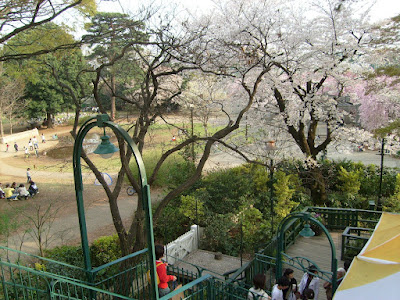
Behind the museum is the large Inokashira Park, and rather than going back via the road, I strolled through the park in the warm April sun. It was almost as crowded as the museum, with gravel tracks around squares of grassed land covered with people sitting and chatting in the sun, jogging round or playing football. I took a breather on a park bench and watched the world go by for a while and it occurred to me for the first time that my holiday was nearly at a close.

Back at the station, I was a little annoyed to see a branded Ghibli bus waiting to transport passengers down to the museum, although on reflection my trip there was more enjoyable by foot (wouldn't have minded it taking me back though). I boarded my train to Shinjuku and it hit me just what I had left myself to do. Now I had three bulky Mamma Aiuto bags to go with my two backpacks and another large plastic bag containing the Mt Fuji choccy. Instead of taking them all at once, I figured I should find my hotel first and come back for half of it.

Shinjuku station was large and busy - in fact it is officially the busiest in Japan, and the evening had just begun, meaning revellers were heading out and tired office staff were coming back. I made a stab at the direction of the hotel, my map being a typical JTB map that is sort of right but also sort of not. I passed through some of Shinjuku before finding myself back at the station, this time at the east side, having passed three separate people pleasantly trying to sell me massages and 'Big American Man' sex sessions (yes, I declined). Shinjuku station happily had a tourist information office, a cramped one-person booth which I squeezed into and asked the thankfully English speaking person for directions. The described some landmarks to work by and some street names (some of the larger shops in Japan often have enormous cube-shaped advertising boards on their roofs) and sent me on my way.

Somehow, and I don't fully know even now, I managed to work through the shopping complexes and wide roads and their crossing areas (which always had a million people trying to cross from each side), past glittering windows advertising cheap, hi-tech gadgetry and displaying posters of various western icons (Timberlake, Beckham etc.). The route took me out of that district and into a slightly different one, where the retail outfits were replaced by red neon and lots of X's. Fortunately they passed by and finally up a road my hotel. I checked in, put my bags down, and retraced my steps to the station to hulk back my remaining possessions.

After getting myself some food at a nearby Italian restaurant, I did a little bit of photo transferring and headed to bed, tired and aching. Tomorrow was my final full day - a day which would be spent at least partially getting more stuff for gifts for folks back home. I would also have to try and find another suitcase, into which this growing pile of tat would have to go. For now, I just watched some telly until my eyes got heavy.