Showing posts with label Fujigoku. Show all posts

Japan 22 : Fancyplants' Big Day Out


It was time to leave Fujikawaguchi. I was not in any great rush to leave the pure, fresh air of the mountains, but I was becoming a little short on cash, so after getting a shower and wishing the people in the hostel good bye, I left on foot in the direction of the train station with the intention of calling at the local post office ATM on the way. It was closed when I arrived, so after getting a little bit of nosh at the 7-Eleven over the road I sat outside until the cashier dutifully opened the doors for me. Spare folding would be very useful to me today.

Back at the station, the next train out would be a little while, so there was a little time to peruse through the in-station tourist shop and buy a few souvenirs. The trains outside were lined up on their tracks, painted with crazy cartoon mountains to give their passengers a garish and slightly embarrassing appearance as they glided through the picturesque countryside. I paid for a ticket and boarded mine, a definite tourist train- although it was a little past its best, the on-board TV screen had long since been shaken loose of its connection to the looping video of the mountain and its sights, and as the train gathered pace, each wobble and bump on the privately-owned track randomised the image.

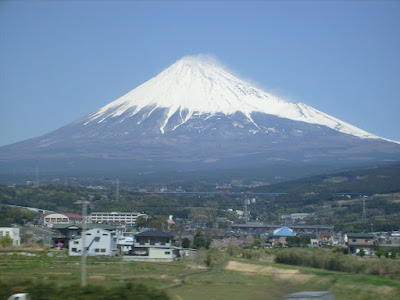
So I concentrated on the view outside, the steadily shrinking Mt Fuji to the south, and the increasing amount of structure and form to the landscape as we headed east and the forests vistas were replaced with built-up areas once more. I switched trains at Otsuki to a JR-owned line, which allowed me to make use of the last day of my Japan Rail pass. My destination would be the city of Mitaka, home of countless Sakura trees and most notably, the Studio Ghibli Museum, a building dedicated to some of the finest anime movies of all; a giant exhibit of film chronology mixed with adventure playground, designed by Hayao Miyazaki and Isao Takahata, veteran directors and artists responsible for most of the output in the firm's 20-plus year history. It's somewhere any animé fan should visit once in their lifetime, and definitely so if they ever find themselves in Japan.

I had my ticket ready, or rather a voucher for the ticket, which I had got myself a couple of months previous from a place called MyBus, the designated ticket provider for the UK. That was a little weird. The London number I had called was connected through and I found myself being greeted in Japanese. This was my first ever experience of the language and suddenly I was tongue-tied. Garbling some confused sentence not out of place in Boris Johnsons' repertoire, the lady at the other side thankfully switched to English and we carried on. She apparently had a lot of reactions like that.

I had planned my entire trip around the ticket in fact, so that I could use it at the end of my journey. Oh yes, I had every intention of leaving the museum with a travel fee-incurring amount of tat to bring home with me. However, I didn't get off at the Mitaka stop. I carried on until hitting the Yamanote line at Shinjuku. Good old Yamanote line - how I had missed thee. The last time I had seen it was on the third day of the trip, leaving Ueno on my first Shinkansen ride to Sendai. It was almost like coming home.

I had a room booked in Shinjuku, but it was at a hotel quite a way from the station and getting there would take a while, and also, I might not be allowed in just yet. Instead, I compromised by finding a spare locker in Shinjuku station, sticking both my bags into it (sans a couple of maps and the all important ticket-voucher) and headed back on the same line to Mitaka.

Arriving at the station, the map pointed to a long, straight dual carriageway. In between the opposite lanes of the road was a small ditch through which a gentle stream flowed, the swaying branches of a hundred or more Sakura trees - now in full bloom - creating a pleasant, dappled canopy softening the hard, straight lines of the road. At the head of the long road was a little sign with a Totoro on top, diligently pointing the way to the museum.

I strolled down the road, taking in the pleasant sights; word was that Miyazaki chose Mitaka because of its greater prevalence of natural open spaces than most other wards in central Tokyo, being someone who infinitely prefers a natural scene to look out of the window at as he works at his desk. Even the tarmac on the road to the museum was infused with little specks which sparkled in the sunlight.

The museum emerged slowly from its hideaway behind a group of trees and bushes, the first thing you see is the large, faux ticket booth placed at the gated entrance area. A huge Totoro sat behind the window and provided rare photo opportunities. I stayed there for a short while as gaggles of families passed by, the children (and some of the parents) squealing and pointing excitedly at the booth and posing for photos.

I carried on down the path, taking me along the side of the museum building, a large, chunky sand-coloured structure a few stories high, styled similarly to some of the buildings in Miyazaki's films with smoothed edges and small stained glass windows. From the pathway, a wrought-iron spiral staircase protruded from the upper floor of the building giving access to the roof. Little more about the innards of the building was obvious from the outside, and I had little choice but to work my way through the outer gardens and join the gaggle of excited children and parents, standing in a large queue outside talking excitedly with each other about the experience ahead.

Eventually, I made it to the entrance, where my voucher was swapped for a special museum ticket, a kind of souvenir itself, being a few cells of one of the Ghibli films, encased in a little cardboard frame. Since it showed a few frames from Princess Mononoke, it now sits proudly next to my Ashitaka and San Cominica figures.

There is a slight picture break here; the reason for this is that the museum staff were very vigilant on anyone taking pictures of the inside of the building, stating that Miyazaki wishes people to remember it in their minds and hearts. Out of respect for his wishes, I'll be brief with the contents of the museum.

The museum was designed largely by Miyazaki himself, and many little references to films and other works pepper the museum. It's designed with a childlike exploration in mind, with multiple ways to get up through the different floors from the bottom to the top. The idea is for the kids to go off and crawl through holes and go up stairs and generally lark about like children, while the parents and big kids such as myself stroll through the rooms and exhibits.

Each ticket provides its owner with a single viewing of an exclusive Ghibli Museum Short Film at the in-house Saturn Theatre screening room on the ground floor, although the time and day you go will determine which you see, and you won't know until you get there. I danced about like the other kids in the queue with fingers crossed it would be 'The Day I Harvested a Star', but was more than happy to get to see Koro's Big Day Out, a lovely little flick about a puppy who escapes from his young owner and gets into all sorts of scrapes as the panic-stricken pup tries to find its way back, occasionally helped by well-meaning strangers along the way. Like many of their films, it was a little cute, a little funny, and a little scary, and both parents and children alike spent the entire film with big goofy smiles on their faces.

Slowly I made my way from the bottom to the top, each floor packed with squealing, running children and cooing adults. There was a section of exhibits on the film processes, one made up like Miyazaki's typically cluttered artists' rooms, a book library with titles from all over the world picked out specially by Miyazaki because of their imaginative stories. There were also rooms that were devoted to installations by other artists the world over; there had previously been exhibits by Pixar and Aardman Animations, and this time it was a collection of works based on Tolstoy's picture book version of the old-fashioned fairy-tale The 3 Bears.

On the top floor was the main draw if you were 7 or under: a massive furry catbus that took up most of the room, crawling with a constantly rotated group of children. I had heard about this before, but was not expecting the gaggle of parents, museum staff and huge numbers of kids. I had joked before leaving for Japan that I was definitely going to have myself photographed inside the catbus, but there was going to be no way, the staff had a very rigid age limit set and short of setting the fire alarm off there was nothing I could do after my third beg to the alpha staff member.

By now, the museum was operating at capacity. I went outside to the balconies and visited the Straw Hat Cafe, which was hugely busy. They were serving slice after slice of cartoon-style cakes and ice creams and hot dogs, and finally after a lot of waiting I managed to get a large strawberry cream cake and a seat and gorged on it for a while. The influx of people was relentless and the exit which I could see below me was populated by parents in two minds whether to step through the exit, often with children trying to drag them the other way for a final look round. The result - it was getting seriously packed.

After finishing off my cake, I headed up those wrought iron spiral steps to the top, where an enormous robot from Laputa stood in the centre of a rooftop garden, waiting for small children to come along to pose for pictures (the no cameras rule didn't apply outside). Behind him was a small area for parents to get their breath back and walk in peace amongst the bamboo and grasses, although it was clear that a few more months would be needed before it recovered from the winter.
There was only one thing left to do, and that was head to the souvenir shop. 'Mamma Aiuto' was packed with official Ghibli stuff. Everything from little badges to enormous plushes (especially of the perennial Totoro's) and plenty in between - artbooks, DVD's, soundtracks, loads of soft toys, fragile looking and expensive glasses, cutlery and dinner sets, and some very desirable but very pricey (30,000 yen or more - about £150) framed cell and background scenes from the films. I sat for a little while after perusing what was on offer on the helpfully-positioned benches outside, debating about one of the cells I had seen (a beautiful sunset scene from Whisper of the Heart going for about 37,000 yen) and finally coming down on 'no' since it would never survive the trip, and its not something you can fold (and its really expensive).

Decision time came when an elderly lady made some subtle glances in my direction that she wanted my place on the crowded seat. With only a cursory thought towards how I was going to transport anything else back with me, I launched back into the shop and bought myself some little badges (little Totoros and one of Miyazaki in his self-imposed characture as a pig) some DVD's (including the Short Films collection and the Ghibli Museum DVD with the Russian animator Yuri Norstein), a couple of soundtracks I was missing, the official museum book, and the Laputa artbook, a large high-quality, book containing stills from the film as well as all sorts of concept art as well - which I had spent a long time searching for in the UK without success. Since they were there I also got the accompanying books for Koro, Mei and the Kittenbus and The Day I harvested a Star, since they were all in the same style and I couldn't decide between them. About 20,000 yen all in. I must be mad.

Heaving it outside, it was impractical to try and work my way round the museum any more since some of it would be almost certainly damaged by the knees and elbows of a thousand or more visitors. I hesitantly crossed the threshold of the entrance, a very one-way road as explained by the staff member there, and my visit was over.


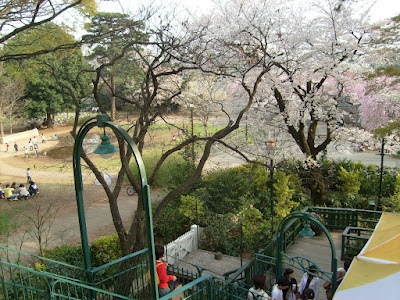
Behind the museum is the large Inokashira Park, and rather than going back via the road, I strolled through the park in the warm April sun. It was almost as crowded as the museum, with gravel tracks around squares of grassed land covered with people sitting and chatting in the sun, jogging round or playing football. I took a breather on a park bench and watched the world go by for a while and it occurred to me for the first time that my holiday was nearly at a close.

Back at the station, I was a little annoyed to see a branded Ghibli bus waiting to transport passengers down to the museum, although on reflection my trip there was more enjoyable by foot (wouldn't have minded it taking me back though). I boarded my train to Shinjuku and it hit me just what I had left myself to do. Now I had three bulky Mamma Aiuto bags to go with my two backpacks and another large plastic bag containing the Mt Fuji choccy. Instead of taking them all at once, I figured I should find my hotel first and come back for half of it.

Shinjuku station was large and busy - in fact it is officially the busiest in Japan, and the evening had just begun, meaning revellers were heading out and tired office staff were coming back. I made a stab at the direction of the hotel, my map being a typical JTB map that is sort of right but also sort of not. I passed through some of Shinjuku before finding myself back at the station, this time at the east side, having passed three separate people pleasantly trying to sell me massages and 'Big American Man' sex sessions (yes, I declined). Shinjuku station happily had a tourist information office, a cramped one-person booth which I squeezed into and asked the thankfully English speaking person for directions. The described some landmarks to work by and some street names (some of the larger shops in Japan often have enormous cube-shaped advertising boards on their roofs) and sent me on my way.

Somehow, and I don't fully know even now, I managed to work through the shopping complexes and wide roads and their crossing areas (which always had a million people trying to cross from each side), past glittering windows advertising cheap, hi-tech gadgetry and displaying posters of various western icons (Timberlake, Beckham etc.). The route took me out of that district and into a slightly different one, where the retail outfits were replaced by red neon and lots of X's. Fortunately they passed by and finally up a road my hotel. I checked in, put my bags down, and retraced my steps to the station to hulk back my remaining possessions.

After getting myself some food at a nearby Italian restaurant, I did a little bit of photo transferring and headed to bed, tired and aching. Tomorrow was my final full day - a day which would be spent at least partially getting more stuff for gifts for folks back home. I would also have to try and find another suitcase, into which this growing pile of tat would have to go. For now, I just watched some telly until my eyes got heavy.

Japan 21 : Going Downhill Fast


I woke the following morning to the sounds of bed springs. It appeared that the girl on the top bunk across from me had invited her boyfriend in and they were waking each other up with some 'snuggling'. The girl on my top bunk was either asleep or absent, and the Chinese guy had turned into a mass of crumpled bedsheets. The bright sunlight from outside was a positive sign that I could get up without looking like some sort of cat burglar, so checked my watch (about 7am), excused myself from the apologising couple and headed to the bathroom.

Everything was chilled ice cold, with a gentle, fresh mountain breeze coming from the bathroom window. I got myself a quick shower and shared a sink with an unknown lady as we brushed our teeth in unison. I had fortunately decided to dress before leaving the cubicle because everyone else had been woken up by the new day ahead of them and were beginning to queue up for the amenities.

I packed away my things and straightened my bed, taking the smaller of my backpacks so I could stock up on snacks for the day ahead. I left my larger pack down the side of the bed, this time with a degree more confidence, and said goodbye to the now singular girl and headed to the ground floor. Some kind soul in the kitchen area lent me some milk and pointed towards a communal pile of slightly musty but usable teabags had been supplied for westerners parched for a cuppa. It wasn't the most recognisable of leaf, but it tasted like home.

Dave came in a little later and we had a quick chat about what we were doing. Dave was heading wherever the retro bus took him and I was doing much the same only by manual means. The bus in question was a fleet of identical tourist buses in a retro style that made regular stops around the Sai and Kawaguchi lakes. Though the thought of being chauffeured around sounded pretty good for a day, it kind of restricted where I could go and meant I would be at the mercy of the bus times, so I declined Dave's offer of going round together and stuck with my original plan of pedal power.

After checking outside that the howling winds I had occasionally heard through the night had actually gone, I handed over a banknote to the girl behind the table. 1000 yen got me a days' loan of one of the hostel hire bikes, and if I was to get a decent days' sightseeing in, it was going to be a prudent purchase.


I started out by getting back to the Kawaguchiko Oohashi bridge and then heading along the shoreline around the larger part of the lake. The narrow road generally followed the perimeter of the lake, although it was often some distance from it and was replaced with walking and cycle tracks that went a bit closer. I passed some picnic areas at Yagisaki Park, just coming back to life after the winter and guarded by some of the most intimidatingly large ducks I have ever seen, shortly followed by the Kawaguchiko Muse Museum. This was a small building set a little away from the lake, and was the home to the work of Yuki Atae. Though the premise of walking around a museum dedicated to some cloth dolls doesn't sound much fun, I have to say, this place won me over. The models of children, old people and the odd nymph or sprite, were beautiful and their features and poses were so expressive, I could not fail to walk out of there impressed.


Shortly afterwards, the road wound back on itself as it negotiated around a square of land set on a small hillock and was home to a major shrine. The Fuji Omuro Sengen Shrine was more of a collection of shrines, with a large Shinto temple and a stone-built Buddhist building located in their own walled areas and connected together by a track that went through the site. Some of the sculptures were beautiful, such as the sphere surrounded by dragons, the entrance pathway lined with giant stone lanterns and a sculpture dedicated to the art of Yabusame, or shooting arrows from horseback, which is often depicted as here with an arrow shot through a fan. I pushed the bike around the area as respectfully as I could, taking in the sights on offer, a journey that was marred only slightly on my exit through the lantern path to find one of the houses next door airing their dirty mattress out of the window.

I headed up a random side road to the hills above on a whim - and with little more than a nice view to show for it, I freewheeled back down and gathered a little pace, heading to the western side of the lake. Between the Omuro Sengen Shrine and here there was little in the way of tourist attractions that I could see, so I enjoyed the fresh air as I got used to cycling around the twisting roads. After a short while I came across a large, blue road sign offering me a choice of direction. Either carry on around where I was going, or head west, up a steep hill towards lake Sai. In order to give me some temptation, a shrine was placed a few hundred yards up, surrounded by tall trees and looking intriguing, so I decided to take a little look and then perhaps head back.

Something happened at that shrine, because common sense went right out the window. The deceptive hill was bad enough to get to the shrine, but it was clearly steeper the further up it went. My mind had been made up however, that I wasn't going to simply freewheel it back down again, but finish the climb to the top; that way, I could say I had seen two of the Fuji Five Lakes (3 if you count Yamanaka on the way in).

The hill was steep and it got steeper. The poor little bike, though well oiled, just didn't have the gears to make cycling up it a practical option and so I got off around the corner. The road was steep enough at one point for it to have to loop back on itself and wind back and forth a couple of times like you sometimes get. A dirt track off to one side was just too much of a temptation for me, it seemed to be able to cut the while twisty bit completely out, and it did, in a way. Unfortunately that way culminated in a large set of bike-unfriendly stone steps at the top, resulting in much pedal-shin bruising and swearing.

It did get me almost to the top, and after a gently curving corner's worth of hill, I was greeted with a tunnel, fortunately the engineers who built this road decided enough was enough and they would bore a hole through the rest.

Coming out the other side brought me face to face with lake Sai, and the view was both refreshing and different to Kawaguchi. Much less evidence of tourism, with few houses or hotels, many obscured from view by the still-present forests, and what there was in the way of buildings looked a bit chocolate-box and not so much geared to the sort of tourist trade I expected - perhaps they were made for the people who actually lived there. It felt like I had stumbled upon their 'secret place' where the local residents would hide from the onslaught of the obnoxious tourists the rest of the year, hidden through a tunnel at the top of a hill so steep it would probably kill a good percentage of those who tried to make it. Then one of the retro buses pootled past me and I realised perhaps not.

Even so, Sai was definitely worth the trip. After cycling for a while on the gently undulating north side, I let the bike roll down a dirt track to the waters edge. Lake Sai was beautiful, and as I looked around it was clear just how remote it was up here, the dense forests overbearing in all directions, so large that Mt Fuji itself could only just manage to poke its tip above them. The waters were beautiful crystal clear and the air was as fresh as any I had ever breathed.

I crunched through the stony gravel at the shore side for a while before heading back to the bike. I was getting a little peckish and was relieved to come across a cafe as I hit the north-west edge of the lake. I cycled past initially thinking it was closed, but thankfully it wasn't after checking the door. Inside was a quite surreal scene. A small band of musicians made of plastic were playing along to the Mission:Impossible theme tune amongst others, with a group of tubby owls for an audience. It was enough to stop me in my tracks, and was only jarred out of my hypnotised trance by a familiar 'hello' from the corner of the room. It was Dave again, who had got off the bus at Sai and was taking a breather. He was doing a rather good pencil drawing of Mount Fuji, which by this time had found a gap in the mountains and was looking its usual dominant self. We chatted about what we had seen and done over some green tea and kitkats (the cafe didn't have much to eat) and among other sites he mentioned a strange place further along named the 'Saiko Batcave' - something that we both thought would be good to visit, only so that we could say we did.

After a while I had got my breath back and departed again. Just outside the cafe was one of the Fuji maps, which showed many of the attractions. There was the bat cave over on the other side of the lake, and also an intriguing 'icicle cave' located on a loop that would take me away from Sai and then back again, meeting up just next to the bat cave. There was also a 'Saiko Wild Bird's Forest Park' as well just around the corner. It was decided - I would try to fit all three in. Not long afterwards, I came across a log-cabin building set back from the road. This was the bird sanctuary. It was fortunately free (or at least, nobody charged me an entrance fee). The lower floor was a gallery of pictures and taxidermy, and the pictures continued up the stairs to the first floor observation room. There didn't seem to be much to observe, though. The trees to the left were still bare branches, and the open area to the right was the site of what looked like what used to be a giant ice sculpture of a ship, although the ice had mostly melted, leaving the sorry-looking wooden skeleton underneath. I later found out this was the remains of the years' beautiful Sai Ice Festival which took place a month earlier.

I was about to leave the observation deck when I noticed a guy in a Saiko Bat Cave coat walk out and sit on a chair with his hand out. A few moments later, a bird flew out of the tree, landed on his thumb, and started feeding on the seeds he was holding. A little while later another came, then another. It was a simple thing, but lovely to watch, although I felt I was spying on the guy as he was enjoying an indulgence in his lunch break.

Going back downstairs, I went through a set of doors and found myself in a cafe. What looked to be the family business of daughter, mother and gran all sprang to their feet - their look of eagerness at the prospect of a rare customer, combined with my still-empty stomach convinced me that I should stay a little longer. Plonking myself down at a window seat besides a fish tank, I perused the semi-English menu (thankfully with many pictures) and settled on an unusual combination of a hamburger in gravy with rice and vegetables and a side salad. It was a bit weird, but tasty enough and enjoyable, my gazes of attention switching between the ice festival remains and the bloops of the fish swimming about beside me.

I paid the tab and said good-bye and headed out of the door. I was about to get on my bike when I had second thoughts and headed round the back of the building. The guy in the Saiko coat had finished his bird feeding and was sweeping up, so I took a shot at asking him through the power of mime about the birds. He directed me in surprisingly good English to the front of the building where I could purchase bags of seed for 100yen (there was no-one there, you just popped a coin into a birdbox). Elated, I went round the back again, held my hand out with some sunflower seeds on it, and waited. Sure enough, the birds began to flit from the safety of the trees to my thumb, eye the seeds on offer and then take one quickly before heading back again. They were always the same kind, about the size of a sparrow, with long tails and red flashes on their faces, and black and white stripes on their wings. I spent a good half hour there, until it was clear they had got their fill. Just as I was leaving, a couple took my place, so I showed them where to stand and what to do, and the lady shrieked with joy as the first bird swooped down for a snack.

Leaving the sanctuary, I followed the signs for the icicle caves, which took me away from Sai and up the hill on a long, straight main road, which was pretty busy with trucks and cars. Again, it was pretty steep and quite long, and another pushing session got me to the top, where a crossroads in the road pointed back downhill towards Sai and the Batcave. On the corner of the crossroads was a tourist shop, another log cabin affair which also had a sign for the icicle cave. I left my bike at the entrance and walked down the gravel track into the woods.

A shabby-looking shack was the ticket booth, beyond which the trail went over the hill, deeper into the forest. I paid my money and headed further along and it was not long before I came to a steep stairway into the earth. This was the entrance to the caves, a super-slippy, dimly lit track into a damp cave. Not far inside the entrance were some beautiful examples of natural ice sculptures, but that was pretty much it, the single track split down the middle, ending not so long afterwards with a cramped section filled with piles of old storage cans that were used as a food larder. To be honest, it was a bit of a disappointment all round.

Tramping out into the fresh air once more, I went back to the tourist shop and looked at the gift boxes. Damn near every town I had visited had tourist shops like this one and each of them included a display of finely wrapped boxes of chocolates, cakes or biscuit selections, the wrapping paper evoking the spirit of the region or having a depiction of the local tourist draws. Predictably, the place had a large central table piled high with all sorts of boxes containing sweet treats, and most of them were making the most of the nearby snow-capped mountain. Since it was quite close to the end of my holiday, I decided that today I would begin to buy a few souvenirs, of which a couple of these boxes would form the beginning. Resisting the temptation to take advantage of the 3 for 2 offer on some Mount Fuji toilet roll, I chose two of the largest and most interesting boxes, not caring at this point whether they fit in the basket on my bike. Fortunately, they did, although they did stick out and dance around a bit as I sped quickly down the long hill back towards Sai. I prayed that the brakes on my little bike would hold by the time I would need to use them in earnest, but for the time being, it was an icy-cold invigorating speed to the bottom.

Fortunately, the brakes did hold out, and soon a sign appeared pointing to both Sai and the batcave. Hoping that this would be a little better, I headed towards it. When I got there, it was much the same layout as before. A tourist shop set back from the road, with the trail to the cave just next to it. This time, an assistant, who clearly had had too much sugar on his cornflakes bounded up to me with a big smile and a helmet in his hand. I asked him if I could stow my cake boxes and bike somewhere, and on crossing his palm with silver, he took them away to a safe place and gave me the helmet to try on.

If I had to be honest, the helmet was making me a little nervous, but I pressed on. The thought of spending my last moments under tonnes of rock just as Japan got one of its famous earthquakes made my feet attempt to change direction more than once. The batcave was on a trail into the woods as before, but the trail was a wooden walkway which twisted its way approximately to the destination - and then disappeared into the subterranean cave below.

The cave was lit with an eerie green glow, from lights that looked as if at one point they gave off white light, but had been over the years covered with a film of greeny goo. It started off quite pleasantly, but then the roof began to get lower and lower, and then it split off into many possible routes. Typically, I chose the most awkward route, which took me through a gap no more than three feet high. My backpack got wedged on the ceiling, and my knees got covered in goo on the rough ground below, but I finally made it through to an open area, where it suddenly became clear which direction to go in to avoid getting crap all over me. The cave ended in a boarded up section which I resisted the temptation to ride through in a minecart, Indy-style, and so I headed back the easy route, taking a few long-exposure shots along the way.

Daylight was a welcome thing, and at this point I had decided that I had seen enough caves for now, having reviewed the state of my clothes and hands after scraping myself through a few hundred feet of damp, green goo. I followed the road back to Sai and followed it around until I reached the tunnel I had come through on the way here. The day was getting past its best, so there would be just enough time to go around the last part of Kawaguchi before getting home. I sped quickly down the steep hill and rejoined the road that followed the lake.

Just a case of getting back to the hostel, now. The light was fading a bit, and my legs and back - not used to cycling at the best of times - were now short tempered, so I concentrated on making the most of the view on the three or so miles required to get back. Fortunately, Kawaguchi was mostly very scenic, with a helpful cycle/walkway around much of it which cut out a large and ominous tunnel partway around for good measure, although it was clear that Kawaguchiko was far from a moneyspinner when it came to tourism - there was more evidence on this side that the hotel trade was a tight industry with the corpses of several buildings off the track of the flow of tourists. Hitting the home straight, I was distracted slightly by a crowd of people around the entrance to the Music Box museum, which I would have gone in had the punter outside not tried to force me to park the bike over the road in a car park and drag myself there and back again.

Once finally over the bridge and back at the hostel, I flopped myself on the bed about 6.30 just as the last of the light was ebbing away. Dave had arrived sometime earlier, rather selfishly looking far more refreshed and far less like he had just crawled through a slimy passageway in a cave with precisely no bats in it, contrary to the advertisement. I uploaded a few photos as we chatted and then after a quick wash and clean up, headed out by foot to the nearby curry house, which was insultingly easy to find now I had a map.

One thing the Japanese can't do, is a good curry. There, I've said it. Perhaps I mentioned this before, but the experience at the 'Ali Ba Ba's' was the worst of the three I'd experienced. The fish tikka starter was a grey fish with a dry, tough texture. The restricted menu meant only a chicken masala looked any bit good, but the chicken was fatty and.. 'pipe-y' - as in connected to what I assume were some of that ex-chicken's internal plumbing. I ate what I recognised and left the rest.

Back at the hostel, the ground floor was overflowing with people wanting to use the computers again, and since I hadn't finished my emailing I sat cross-legged on the floor waiting for the computer around my little group to work its way through those who had sat before me, the collective memory of the group forming a graph on the floor of whose turn it was next.

It always fascinated me how people from all over the world and different places could just come together and talk as if they had known each other all the time. It was a phenomenon that I had trouble doing with people across the street I didn't know, but now it was time for me to find out. One particularly interesting-sounding guy - Aaron - was sat cross-legged across from me, regailing to the entranced group around him - me included - about his travels around Japan and the world. He looked the part with combat pants and a straw hat with dreadlocks escaping from underneath, he was a picture of an experienced traveller. He rattled off stories of how this place reminded him of some other trip across the world a year before, some of the sights and sounds he had seen, and crazy coincidences of meeting his mates halfway across the world as their seperate journey's crossed. The whole room was abuzz with these people - pleasant, interesting, full of enthusiasm and knowledge and willing to share and learn. It was a really positive atmosphere and I found myself being able to hold a little of the conversation myself.

After a little while myself, Aaron (who was from the US) and an Iranian woman (who's name I unfortunately couldn't remember - sorry) headed through into the communal living room and sat down on a random collection of futons and tatami mats and continued our chat, eventually breaking up near midnight to get some kip.

As I lay in bed, my mind was for the first time since arriving in Fuji, content. The experience had all been about worrying that I was going to be able to survive in a social, communal hostel - me a definitely unsocial, uncommunicative and often grumpy being. The people I had met, on both sides of the reception desk had helped me realise that any and all those fears were unfounded, and that there was a lot of enrichment to be had and shared simply by being there and interacting with those on a similar journey. It was a shame that on the following day I would have to leave for my next destination.

Japan 20 : Bleak Landscape

Mount Fuji Awaited.

Ever since setting off, the goal had been to get to Mt. Fuji. This was partly because it was the one place I had pre-booked before going to Japan, and partly because I had become enthralled with the romanticised idea of waking up in a traditional Japanese house, sliding open the paper doors and staring out at the peak as I sat munching breakfast on a tatami mat. Even though it was not quite the end of my journey around Japan, it seemed to be the place I was always heading towards, the final stops of my quest being on the now familiar and somehow less anticipated Yamanote train line of central Tokyo.

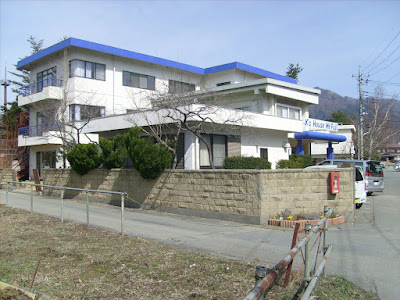
Though I had to forgo the traditional aspects due to most of the hostels and hotels still being closed for the winter and many of the rest pretty full up, I had managed to get myself into the local K's backpack hostel, a small friendly stopoff a stones throw away from the lapping waters of Lake Kawaguchi. Fujikawaguchiko - the town that circled it - seemed to be the most suitable of the towns around Fuji, the rest of them seeming a little bit remote and thus as Japan was just emerging from its winter ice-fest, were perhaps not the best of ideas.

Today's journey would be based on the email I had received from K's about the best way to get to Kawaguchiko from Osaka. It would involve my final Shinkansen ride around the south coast of Honshu until I arrived at Mishima, and then a bus journey all the way to Fujikawaguchiko Station, where I could ring them for a free lift.

Hamamatsu felt a little dull, despite the clean, fresh air and so I decided that even though there was much to explore of the city, I wanted to satisfy my itch to get to my next destination. I checked out about 10am and got the next train out of Hamamatsu. Although the scenery to the south should have been of equal concern, my face was pressed firmly onto the north-facing side of the train so I could catch my first sign of the mountain. Sure enough, once we'd got past Nagoya and through a long tunnel, the iconic shape rose out of the hillside. Even from many miles away it looked enormous, probably because it was the only major mountain for miles around.

Mishima station followed soon after. I got off and after a little trouble working out which way to the bus stop (including slipping through a cars-only tunnel) I paid my 2130yen (about £12) to the woman through the ticket hatch (who probably had seen a thousand confused foreigners go the same way and had shooed me towards the bus stop without being asked) and waited patiently.


The bus, as with the trains, arrived dead on time, and after heaving my backpacks onto the seat next to me, it set off with me and a few other passengers. The bus headed through quiet, immaculate streets on a beautiful clear day, the ever present mountain peeking through the gaps in the horizon and getting ever closer. The bus spent a long time increasing in altitude as it headed through the beautiful mountain pass, and then as it descended down the other side, we came across the first of the Fuji Five Lakes - Lake Yamanaka. I could have got off at this point for a look around, but the buses were few and far between, so we carried on to Kawaguchi Station where the bus dropped me off. The station is a little different than many others in Japan, looking like a log cabin and having a large tourist shop inside. Here and there I saw fellow backpackers, heaving round packs the size of mine and often worse. They, like me stood transfixed at the sight of Mt. Fuji, now taking up a considerable portion of our peripheral vision.

Hearing the rumble of an impatient stomach, I went down what seemed to be the main street until I hit a 7/11 shop, and bought everything that looked recognisable, including an unexpected mini tin of Paprika Pringles, which my local back home had long since stopped doing. Because I had gone some distance, I decided to forget going back and proceeded onwards towards the hostel on foot.

This was perhaps not the best plan; my backpacks were heavy, there was a noticeable blast of fresh, chilled air, and the road ahead of me contained none of the landmarks that I could remember from the directions. I searched in my backpacks for my little black notepad and studied the map I'd biro'd down. Amongst some strange sights I had put down like the mysterious 'Herb Hall' was a little black dot that represented the hostel, and a load of other dots. An unmarked road heading to the right off the road I was on would take me directly to my destination. Problem was, I had no idea what the road was called, other than there was a closed gas station nearby. After some walking there seemed to be an intersection, and there was something gas-station-y across the road, so I took a chance. The road headed downwards and to the north (which was good because the lake was that way) but became increasingly narrow and twisty. At the point of giving up, I rounded the back of a house and emerged onto the road that circled Lake Kawaguchi.

I had my bearings now - the unmistakable Kawaguchiko Bridge was across the water in front of me, and all I had to do was follow the road around clockwise for a few hundred yards and I would be there.

K's was a welcome sight. As I approached, I made a mental note of the line of bikes for hire in the garage, as heading around such a large place on foot would not get me very far. It had only been open for a year and everything still looked new. A reception with a trio of Japanese teens eagerly helping fellow backpackers get their bearings, a couple of computers for contact with the outside world, and beyond a kitchen and dining room fitted out with numerous furnishings that would not look out of place in a style-conscious student dig.

I removed my boots at the entrance and sorted out my room, and was given a set of linen to make up my bed with. I had taken the cheaper option of a room sharing with 3 others (2700yen per night - about 14 quid), and it finally hit home as I entered the room that sharing with strangers was going to be a very new experience for me. Two cosy bunk beds took up most of the room, which contained little else other than a heater and a window that stretched from floor to ceiling. The bathroom was also shared but this time by the entire floor, and it was off down the hallway. Being the naturally distrusting Brit, my excitement and joy was turning sour at the thought of leaving all my worldly possessions in a room where three others could walk in and work their way through it. I wasn't anywhere near a set of train station style lockers, so what was I to do?

I had a bit of a think, and as I sat there warming up my cold feet on the heater it struck me that I was reverting to type, something that I was determined not to do until I set foot back on British soil. Japan and its people had universally welcomed me; people were kind and helpful and I had not once felt like I ought to get the hell out of a situation, or seen any evidence of petty thievery. Also, I was in a hostel, the people who stay at these places had a code of honour, you stay, you chat and make friends, and you leave. A hosteller doesn't rifle through unattended backpacks because one day it could be theirs that gets rifled.

Trying hard to keep this in my head, I turned the heater off and headed out of the room, sans backpacks. It was now mid afternoon, and the sun was a little past its best. Armed with this knowledge, I put my boots back on and headed out.

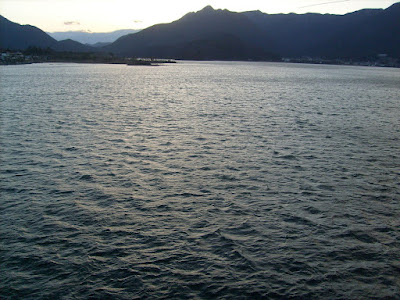
Lake Kawaguchi is split by the bridge into a big part and a smaller part. Since I would be on foot today, there looked to be just enough light in the sky to head round the smaller part and then back along the bridge. The other part could wait until tomorrow. Almost immediately on reaching the shore again, I came across an Italian restaurant, which I reckoned was a good candidate for tonight's nosh.

I rounded the back of the grounds and the lake behind revealed a shoreline with a mixture of small sandbanks merging into slippery rock formations. I headed down onto one of the banks to get a good view of the lake, the water was crystal clear but the banks were strewn with beached pedalos and tourist boats in the shape of whales, which if it had been running this early on I would have definitely taken.

The closed-ness of the place continued along the coastline. The nearby Kawaguchiko Gem Museum was open but deserted, and the far eastern side of the lake was flanked by a selection of hotels, each of which looked pretty full, except for a few which appeared to be derelict. One especially on a tip of rock edging out towards the shore looked in particularly bad condition, although someone had decided to paper over the cracks by edging it with party lights. Next door to that was the entrance to the Mt. Kachi Kachi Ropeway, a well-known pursuit for tourists to reach the Tenjō-Yama Park at its peak, and yes, they were both closed for the winter months as well. I was semi-consciously keeping my eye out for alternative eateries, as the tum was beginning to grumble again but, with the exception of a small saki bar, there seemed to be no food going other than that being served at the hotels.


My deflated feeling was given a boost partway round when instead of staring at the water and the hotels, I looked upwards a little and had my best view yet of Mt. Fuji, the ever present figure looming over the entire area. Doused with a generous capping of snow, the winds were high on the peak and great clouds of snow could easily be seen blowing off the peak. As I had left the hostel, I had overheard some mad people enquiring about trips to the summit, who were told that the stations to the mountains' peak had been abandoned for the winter. They were told in frank terms if they went up there unaided, the mountain rescue would not come to rescue them.

Passing the last of the hotels, I rounded another corner to find an outcrop jutting out into the lake, on top of which was a small shrine. Sensing a photo opportunity, I scrambled up the narrow pathway, a mixture of earth, slippy rocks and tree roots to the pagoda at the top, where - wouldn't you know it - a donation box had been placed. As I took my photographs in the failing light, fitting myself horizontally and vertically into the cramped remaining space not taken up with tourist milking machines, I felt chilled - the wind was howling and it had turned from fresh to freezing, and was gusting enough for my semi-kneeling body to not feel so secure perched up high on a rock. As I turned to go back down again I was surprised to see a Chinese guy eagerly staring back up at me. Shaking the chunky camera suspended around his neck, it was clear he wanted me to get a picture of him looking out to the lake.

So there we were, me trying to lean back on some old wooden fencing so I could get some distance between myself and the guy, who was now doing the same thing rather dangerously over the lake, whilst attempting to look like he was just relaxing in the breeze. He posed, I took a picture and handed it back. He posed again, not taking the hint. I took another. By the fourth round the chill winds had got the better of me, I placed the camera down on the donation box and scrabbled back down to the road again, not looking back.

There was little else to do once round the corner from the shrine, as I had reached the bridge. I headed over, braving the increasingly harsh winds and occasionally swapping sides to take pictures until I was finally at the other end. Heading back to the Italian, I was looking forward to some grub, but things did not look good. There were no longer any cars outside and the building itself had no lights on inside, and it was now quite dark. Unbelievably it had closed. I searched around for opening hours and found them - it closed at 6pm, and it was now half past. Suddenly a little panicked, I began to round the lake once more, but none of the places I'd passed were willing to take on non-paying guests, even the saki bar seemed to have shut up shop.

I headed back to the hostel, and figured that somewhere in Fujikawaguchiko there must be some district filled with restaurants serving food. I headed south, and after a fair amount of fruitless and slightly hurried night-time searching, returned to one of Japan's many streetside vending machines and got a choccy bar and a drink. It would have to wait until the morning.

I got back to the hotel and trudged in. One of the English speaking receptionists, just closing up the shop asked what was wrong and I relayed my lack of findings. She disappeared into the back and came out with a piece of paper detailing the restaurants no more than five minutes away to the west, the only place I hadn't been to. I vowed to make use of this information the next day.

I went up to my room. It was still pretty early (about 8.30) but I had been defeated and was tired. I spent a little time alone with the heater on my toes, and then headed downstairs to try and catch a session with the computer. People were chatting happily with each other about where they had been and where they were going, sometimes mentioning places in Japan I had stopped off at, sometimes mentioning places far beyond, it brought me back down to earth a little bit - I was not much more worldy as I had been a month earlier, and there was an awful lot more out there to experience, much of it proudly and excitedly relayed by these people, coming together and effortlessly making friends in an instant. This wasn't me - I can't just get chatty with people, the thought of it was incredibly nervewracking. Suddenly I felt very withdrawn from the people around me. I quietly took my turn on the computers and sent off some emails.

'I'm Dave', said a guy who had come quietly over and stood next to me. His name was Dave. Somewhat honoured that someone had taken the trouble to make contact with me, I made the effort to overcome my unsociability that so often strangle and we started to chat. He was Australian and had just come over from Tokyo where he was spending the most part of his holiday. We chatted about where we were going, and where we had been, where we come from, and it dawned on me as we chatted that it's not so difficult to do; that I might just be able to fit in with the crowds after all.

Eventually, I returned to my room, which was still empty. Someone had taken the bed opposite because it had been made up with fresh linen, as I had to do with mine, and there was a trustingly placed backpack on top of the mattress. As I had hoped, the code of honour was strong amongst my brethren and my things had gone untouched. I was miffed but also a little relieved that I was the least sociable and first to get ready for bed, I ditched the jeans and dived straight in, turning the heater up a bit to combat the cold from the outside. A little later, a Chinese guy (not the one from the shrine - that would have been creepy) came in, and a couple of girls entered later still and took the top bunks. It was all a little liberal for my delicate sensibilities, but I managed to catnap through the night until the morning.