Showing posts with label Luxor. Show all posts

A Holiday in Post-Uprising Egypt: Part 8

Hod Hod Ballooning, A final trip to the Bazaar, and the Winter Palace Gardens

We woke to the sound of our alarm call.  The sun was just barely breaking over the hills in the distance as I pulled back the curtains.  All was deafly calm outside, the Nile had the stillness of a pond and not a boat or fish or person stirred.  I dressed and went outside to experience the calm of a new Egyptian day one last time, and shared it with an inquisitive Magpie looking among the deckchairs for discarded treats.
Our final trip started early in the morning - very early.  We had a brief breakfast in before leaving the ship in the cool morning air.  The tour bus took us a short way to one of the piers, where a boat was waiting to take us across to the far bank of the Nile.  We descended the dew-covered steps gingerly and down a slippery steel gangplank to the ferry below.  One of our number at least measured their length.

It was early in the morning, so our skipper skipped the mandatory wearing of lifejackets, presumably because our lifeless corpses would have floated downstream and be someone else's problem should we all perish at this ungodly hour.
Tea and coffee sat on the tables in front of us, but as my hand reached out to grab the pot, the missus decided that food poisoning would not be so good where we were going.  We stayed thirsty, just to be safe.

When we reached the other side, the weathered little pleasure boat bumped and scraped it's way into a gap between several others, just a few inches too narrow to be comfortable. We got off, but we weren't there yet.  Some decidedly shabby-looking low-loading estate cars were on hand to take us the rest of the way.  The skies in the distance began to fill up with little balloons.

We bumped through the back roads of the west bank, the drivers explaining through the medium of cornering how these cars managed to get as worn out as they were, until we rejoined the main highway. A faintly familiar sight made stronger in our minds when we passed the Collossi of Memnon statues from the first day.  A few minutes later, the cars pulled off the road and made their way uncomfortably into a bumpy field where they eventually came to rest.
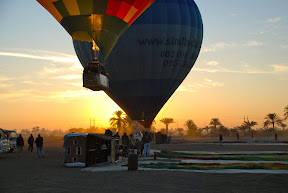
The most beautiful and majestic view greeted us.  Dawn was just breaking and the glow of the imminent sun made silhouettes of the palm trees in the distance, as the sky became populated with hovering, glowing dots. 
Milling out into the field randomly, our group of twenty or so sleepy-eyed tourists caught the fresh morning air - tinged with the smell of burning gas from the many giant balloons either being inflated or were disappearing into the sky.  As one balloon took off a group of helpers made up of young and old dragged the next one off a nearby truck and attached it to an overturned basket.  It was clear that today was Balloon Day and everyone was going up in them.

With little direction, our group stood and took pictures waiting for their turn.  Eventually part of our group containing us both were beckoned over to a newly righted basket, into which the apparent big boss of the group, an aging but spirited man with a mischievous smile and enough English under his belt to supply a range of anecdotes climbed in.  Then we were beckoned to follow.

The basket was split into eight containers, and people continued to get in long after we thought it would be comfortable (or safe) to fit in any more.  Trying to stay as a pair failed miserably as we ended up at opposite ends of the basket, but at least we were in the same one and would be able to compare views when we landed.

It seemed to take an age for the balloon to get enough hot air inside to lift our weight, an experience made slightly scarier as the top of my head began to feel very singed, something I had little opportunity to minimise as I was squashed up against a small Japanese lady who may have taken offence at us crossing knees.

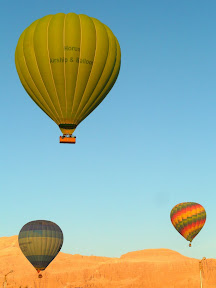
Eventually we lifted off the ground.  The assigned workers below us scrambled to pull us left and right so our path didn't get too close to the other balloons, and we ascended.

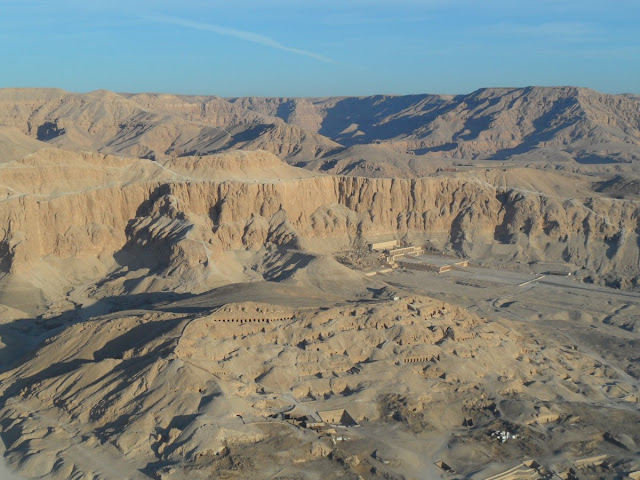
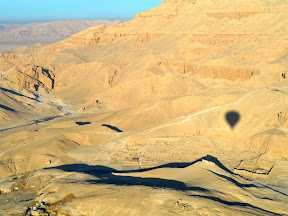
It was perfect, and beautiful.  We rose over the Valley of the Queens in the fresh morning air, the sunrise just beginning and the path ahead near cloudless and perfectly clear, though frustratingly the camera-shy sights of the Kings forever remained just over the hill. 
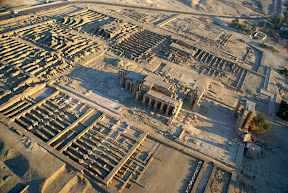
From above we could also see several other ruined sites not open to the public, and small children seemed constantly charmed as yet another balloon full of gawping idiots flew above their heads.  We rose higher and could see further; the banks of the Nile in the distance and the thousands of homes and buildings that made up Luxor city. 
Our view of the city until now was of a tired and run-down ruin, but in the bathing light of a new day Egypt was gorgeous.

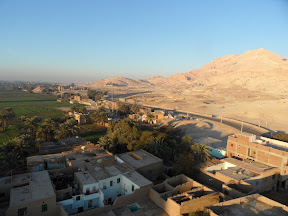
As our host made light of his loose interpretations of health and safety, and our little group did their best to laugh through his well-rehearsed smalltalk, we rode the wind with a small convoy of cars and vans following us as best they could through the dusty back-roads.  The tundra below was surprisingly varied, ranging from barren sand and rock one minute, to neat, cultivated fields of green the next, and both interspersed with box-like houses seemingly forever in a state of construction, providing a modern progression from the exclusive kingdoms of the ancients just over the road.

The sun rose still further, but we began to sink.  Our pilot, [for want of a better word since our journey was largely at the mercy of the winds], was looking to bring us down in an open area just beyond the outer perimeter of the village we had just passed over.  A trio of vans bumped over the dusty tyre tracks towards our intended landing spot as we were told to brace for impact.  Arms could be broken and worse if the wind caught us wrong and dragged the basket over on landing, so we assumed the position, knees bent and twisting our arms around whatever anchor we could reach.  In the end the landing was a bit of an anti-climax and even though we breathed a sigh of relief I felt a little disappointed we didn't have a moment of peril.

In a range of undignified exits, we all disembarked and waited for the cars to return, some way off down the track due to their lack of 4x4-ness compared to the pickups here to take the balloon away. The assembled workers got to work deflating and collapsing the balloon ready for the next trip, and as they did our pilot had a surprise for us in the form of personalised certificates made for the journey, of completing the 'Hod Hod Balloon trip' successfully (i.e. without dying horribly).

We bid goodbye to the ballooners and the small assemblage of children who had made their way over on pushbike and donkey, and waited expectantly for someone to point a camera at them, (at which point out came the hand for tips).  The return journey back to the bank took us through some lesser-seen back-streets of several interconnecting villages, winding between houses and down the sides of fields, the occasional local working through the dust raised by our vehicles and getting on with their morning duties.
And when we got back to the Nile crossing, we spotted a sight we were expecting to see all over the place - camels! - waiting patiently for their masters to return, tied to railings like we would do with dogs when nipping into the shops.

Once returned to the boat and pleasantly filled with our final main meal, we had a few hours to kill before setting off for home.  After the previous nights' fiasco with the photo album, and my Ibis statue hunt still unfulfilled, we decided to spend a little time braving the vendors for a second time in the bazaar.

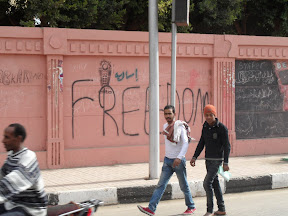
Since we had been once already, we took the opportunity to head out in another direction and try a few alternate shops to the main hub, according to our map.  However, due to the massive overhaul Luxor was getting (and the dip in tourists), many of these were now run-down and boarded up, leaving only a few tired examples containing nothing much at all and a smattering of political graffiti.

So the Bazaar it was.  Having the measure of the salesmen, we avoided eye contact and attempted some faux conversation which kept many of them at bay, whilst keeping half an eye on the stalls for potential bargains.  Our noses took us to one of many spice shops; a young man squeezed into a tiny shop, the shelves with many bottles and jars of spices of all colours and types.  He sat us down with some sweet tea brought by a youngster from across the way and we chatted about everything we had done the past week or so, as he shovelled quantities of all the spices we could name into little plastic bags.  The other half is a seasoned barterer, and her skills helped us get a lot of spice for our remaining Egyptian buck (we still have a lot of it).

Similar skills came into effect as she deftly brought the price of a leather pouffe down to less than half the asking price in another shop, and I was duly helped to get a small obelisk statue with a few remaining quid from a stall full of dusty relics (my favourite haunt).
With rucksack stuffed full and the missus lauding her superior bartering skills over me, we walked back past the entrance to Luxor temple and to the boat once more, stopping briefly at the Winter Palace Hotel, which just happened to be across from our jetty.

The insides were palatial and the Christmas decor was just starting to go up; the entrance hall dominated by a large tree currently being hung with tasteful ornaments.  Coming in from the hot sun and blue skies this felt pretty weird, especially as we had just been given a clean pass through some pretty big security at the start as if we were visiting dignitaries.

Through the air conditioned interior and out the other side, we found ourselves in a beautiful garden, and still unsure how we hadn't been charged some sort of admission we made the most of it and relaxed in the shade of the palm trees. 
A cage of cockatiels held my attention for a while (as did a passing Hod Hod bird that briefly swooped down from the trees) but it was eventually time to leave and ready ourselves for the trip back, noted for the scariest, bumpiest landing into Manchester airport I had ever experienced.

Egypt, for all it's run-down dustiness and it's still smouldering politics had a real depth and beauty to it; I wish I could have stayed longer, and I hope for one to see the eventual rebirth of Luxor as a prosperous city making tons of moolah out of western travellers.  The arab uprising seems to have come to a standstill, and for most people out there, life was going on as ever it did, for better or worse, only with less tourists around to help scrape a living.  I can only hope that the sea of change will not be set back again once the dust settles.

A Holiday in Post-Uprising Egypt: Part 7

Dendera Temple, Late Night Trip
Our time in Egypt was fast running out, but today had been promised to us as one of the highlights of the trip.  Our first and only destination would be the Dendera Temple complex, one of the most impressive sights in Egypt.  Given that we were already getting a bit of temple fatigue by now, this was quite a claim, but Hani's expressive wording as we sped along the country roads were very encouraging.
We were quite some time on the roads, and this gave us an opportunity to get a taste of the small towns and villages on the way.  Every so often the coach would slow down and the main Qena-Edfo road would be met at a crossroads with a smaller street, which would at one side head between stone entrance pillars, or maybe just some wooden posts, and beyond the dust track and the trees, a hubbub of individuals going about their daily routines could be momentarily glimpsed.  Typically the road in the other direction would pass over the canal that ran straight alongside the main road, and then off through the trees or fields to who knows where.  It all had a very straightforward design to it.
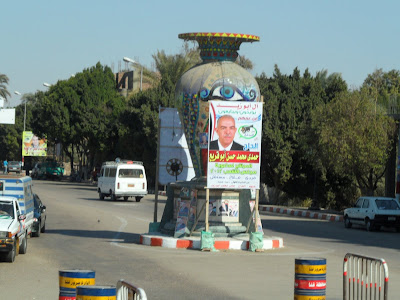
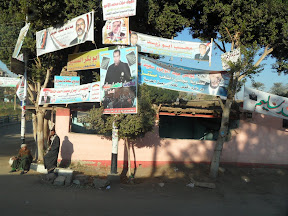
Because of the then-upcoming elections, these rural scenes were quite often peppered with the posters of hundreds of regional candidates, mostly but not exclusively men, although those that were women, in the more remote areas, would most often be veiled or in the most conservative districts, posing wearing a burqua.  One poster in particular lined up several female candidates in such dress, with their eyes the only distinguishing feature.  
All candidates were pictured next to a graphic of a recognisable household object - a ball, or a ladder - some simple symbol that allowed those villagers not blessed with a reading education to make the right choice in the voting booth without being able to read off the names.

Fields and villages briefly gave way to Qena, a large and modern-looking city in stark contrast to the lands we had just zipped through, and a little while after crossing the Nile on the eagle-themed bridge, we arrived at our destination.


Once through the ticket barriers, the complex makes you work for the views.  A considerably long pathway was interrupted only by 90-degree turns around large square areas of ruined foundations nestled amongst green scrub.  In the distance, a large and ominous trapezoid shape loomed up; a dark image contrasting with the bright and pleasant gardens bathed in the early morning sun.  The building was fronted with large, thick stone columns and something was odd straight away - all the temples so far had a light and airy feel; being in such a ruined state they had little above them for the darkness to hide behind, but this place - the void between the columns was eerily dark.  This place had a roof.
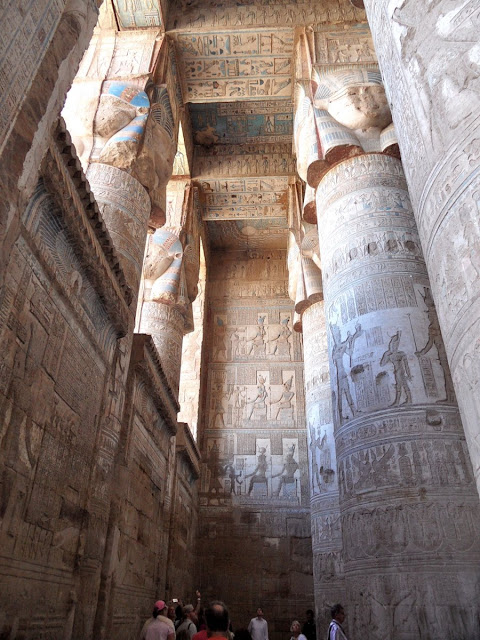
Once through the mostly ruined outer wall, you got a full appreciation of the size of the main building.  Small, ruined mini-temples to the side were dwarfed by the sheer size of Hathor Temple.  Wasting no time, Hani led us inside out of the blazing sun and into the cool, sheltered air of the Hypostyle Hall.

The first thing you notice is the decoration; a long while ago the paint used to bring life to the reliefs of the various temples we had visited, had been worn away by thousands of years of sandblasting, plus an element of human interference no doubt.  Only in relatively protected areas, such as the Valley of Kings we visited were there any traces of what Egyptian eyes would originally have seen.  Here was a rare glimpse of very fragile art several thousand years old.
The huge stone pillars sent your eyes tracing naturally upwards to the impressive stone roof, which looked pristine - in fact it had just been recently cleaned and restored, revealing the beautifully preserved artwork that covered every inch.  The face of the goddess Hathor looked down on us from four sides high up on each of the internal pillars but unfortunately even here the vandalism of religious zealotry was present, and most of the faces had been deliberately chipped off as beliefs were transitioned down the ages.

Hani spent some time explaining his take on the regal and godly scenes depicted high above us and then led us further into the temple.  We spent some brief time in some of the royal chambers, and I squeezed myself down through the narrowest of passageways into the intensely claustrophobic basement; a restricted storage room (or maybe hidey-hole), where the ravages of sand and time had not managed to dull some of the most perfectly preserved reliefs so far.

Then Hani took us where we least expected - up a set of well-worn stone stairs around a spiralling square passageway until we finally arrived on the roof.  We could see where we had just been, through the gaps in the massive stone blocks as we passed over them, the dim striplights below were dizzyingly far away and reminded  you that what we were standing on had been there an awful long time, long after many other temple roofs had caved in.

Still, it felt pretty sturdy.  The view over the sides of the semi-collapsed walls to the ruined temple grounds were otherworldly; a sea of millions of fragments of temple stone, shattered pottery and mounds of dry earth were punctuated by the foundations of buildings that were not as fortunate as Hathor temple when the revolutions came.  In the distance, the heavily battered and near-disintegrated walls did little more than mark out the boundary of the old palace.

The views were impressively dystopian but that was not the reason Hani brought us up there.  Taking us across the way we caught up with another crowd who were slowly dissipating under a covered area.  As they made their way down the exit stairway we shuffled into the claustrophobic room, barely tall enough for some of the taller members such as myself to stand up straight.  In my stooped position, I hadn't noticed the subject of Hani's latest talk - the Dendera Zodiac.
A large, bronze mural (or rather a recasted copy, with the real one safely locked away in the Louvre) covered the ceiling just above our heads.  We were actually inside a tiny rooftop chapel dedicated to the god Osiris.  The walls were heavily decorated with small, intricate carved reliefs, but it was the Zodiac itself that demanded the attention. It contained several of the well-known symbols of the modern zodiac, along with several others that were cast aside along the way.  Far from being simply a method of predicting how a person's day was going to go, it's original purpose was as a combined calendar and star map, detailing how the 36 periods of the original Egyptian year were split and measured as the days passed.

Down through a dimly-lit staircase that seemed to go on for ever, we arrived back on the ground floor; Hani disappeared and we were all allowed to explore for a half hour or so.  Dendera was an adventure playground of sorts, although with all sorts of health and safety violations.  Little viewing rooms at the top of ladders, huge open areas to run around and of course the entrance yard stacked with huge pillars to hide behind.  We admired the floor-to-ceiling murals and reliefs for a while until it all began to merge together and then we headed outside to get a closer look at the views we had seen from the rooftop.
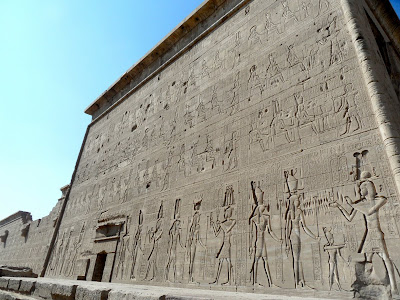
Hathor's temple was covered on the outside as well with godly reliefs, and these were sunk deeper into the stone so they were visible from some distance.  Ramesses in his usual combative pose could be seen the most often, taking up most of the height of the considerably sized building on all sides, letting those beyond the outer walls know that he meant business and they perhaps shouldn't invade.
We headed around the sides of the temple where blocks of carved stone lay on wooden blocks; as elsewhere it was not clear whether these were due to be put back in place (many of the ruined temples have been rebuilt to varying degrees) or were sitting in their final resting place so the tourists could see some inaccessible stuff up close.  The tidiness immediately around the building was helped by the well-preserved (or perhaps rebuilt) stone pathway, but beyond the stone blocks the otherworldly scene of complete ruin ruled.  As we rounded the far end, this was all that could be seen beyond a large outer building - an acre or so of undulating ground criss-crossed with pathways and covered with broken pottery as far as the eye could see.  How the archaeologists were going to sort that lot out we could only guess, although if they attempt to put the thousands of pots back together again they will find a bit missing, which is now on my computer desk.

All photographed up, we headed back, but not before a quick explore of the ruined buildings near the temple entrance.  Dendera earned a status as an ancient hospital of sorts, and the outer grounds were peppered with representations of Bes, a deity who watched over mothers during childbirth.  The buildings to the side were originally places where expectant mothers would be cared for, but during the Roman occupation they were damaged and eventually became some of the first chapels of worship of the new god on the block.  Walking through the ruins you can see blocks re-appropriated and re-sculpted with roman decoration, where the early worshippers would have sat and listened as the old gods died away in their memories.

We got back on the bus and after a little bit of worried headcounting everyone was eventually accounted for and we headed back on the long journey to the Nile.  Now mid-afternoon, the return journey took us down busier roads with individuals on either side of the pathless tarmac being brushed with vehicles of every size.  Still the driver did not slow, not even after we passed a bus similar to our own with it's front end smashed in, which must have crashed not an hour or so earlier.  We grabbed the armrests on our seats.

The early evening lights welcomes us back to the ship, and we had the rest of the day with no trips out planned.  We ate our fill and then stretched out like beached whales on the bed.  Ms. Plants was pooped but I was still in a shopping mood.  Our hurried look around a papyrus shop the previous day piqued my interest for something to stick on the wall when I returned, and all these photos would have to be put somewhere, so maybe a market stall or tourist shop could satisfy my requirements.
Promising to only be gone an hour or so, I went alone off the ship, confident of my ability to not get murdered or bartered to death.  Of course, not long after I started walking along the waterfront, I was spotted.  Two young men slowed their horse and carriage and called out to me, asking where I was going.  Simply going for a walk in the cool evening air wasn't something they believed a tourist would do for some reason, and so they pressed on, knowing my British sensibilities wouldn't allow me to ignore them for long.

I had gone my particular way to try out another shopping district, rather than visiting the market bazaar again.  At the end of the promenade the map we were given told of tourist shops aplenty, but when I got there it was a sorry affair.  A few tatty buildings - what looked to be the last of a line of shops that were being demolished as the Luxor refurbishments come in - were living out their swansong barely open and not containing anything other than a few faded postcards and some dusty ornaments.  Even the shopkeepers seemed to have given up on the idea of actually selling anything and were sat on deckchairs outside, lacking the enthusiasm to get up and try and bother me.

So I turned round and headed back.  And the horse and cart was waiting.  My enthusiasm for finding anything worth buying had pretty much ebbed away to nothing, so I resigned to getting back on the ship.  My guard down, I started to explain the situation to the men - who began talking enthusiastically of just the shop down the road, conveniently just too far to walk on foot.

So I bartered for a ride and, somewhat nervously, got on once we shook on a price.  The cart started away and the ship disappeared into the night, away from the well-lit main streets and into the parts of the city the tourists don't usually see.  We sided the body of the sphinx avenue and down dirt track roads, bustling with people getting the last things done before the night.   Eventually, and just too far from the starting point to be comfortable, we pulled up at a well-lit, white building.

Promising to wait for me while I was inside (I fortunately hadn't paid them yet), this was a 'government building', which apparently meant it was cheaper and better quality than one of the dusty old shops I had seen on the seafront.  Sure enough once through the entrance the building was transformed in much the same way as the Papyrus and Alabaster buildings Hani had shown us around earlier in the trip - clean, air-conditioned and tiled to within an inch of their lives, I had put my trust in the right people - it looked like the perfect spot for some tourist shopping.

On the ground floor was the Papyrus shop; paintings of all shapes and sizes on the walls; they all claimed to be half price in a sale which sounded a bit convenient, but the prices were pretty good so I wasn't about to complain, and since I was through the door and 'caught' now, the assistants new better than to badger me and kept back.

Eyeing a couple of possibilities I headed upstairs to the first floor, which was full of Alabaster and stone carvings, but no decent Ibis statue could be found.  The top floor was full of clothing and rugs, the latter was too big to hulk back and nothing in the former looked good enough to wear.  Somewhere along the way I managed to buy an overpriced photo album, with gold-leaf-style Egyptian artwork on a faux-leather cover.  The papyrus people were happy enough when I bought a papyrus/lotus painting for my parents and a 'tree of life' print for my own spot.

To my relief the men were waiting patiently on my return and to even greater relief they honoured my decision to return to the ship rather than their suggestion of an extended tour, and even though they moaned a bit when I gave them twice what we agreed (I was feeling generous and it wasn't that much anyway) I'm glad I stuck my neck out and braved a little of the unknown.  And yes, my inept bartering for the album was royally mocked upon my return.

A Holiday in Post-Uprising Egypt: Part 6

Karnak Temple, Luxor Temple, and the Market Bazaar

Early morning came. I was impatient to get back up onto the deck and taste the sweet morning air and for some reason the boat had dropped it's speed to a crawl. We were back at the Edfu Locks, following another cruise ship and waiting our turn.
When we passed this before, it was floodlit by powerful lights sending strong beams deep into the night air, but now it was a fine, clear morning.
Once again, the vendors who were most eager to make a few pennies were out with large rugs and sofa throws spread between their outstretched arms. As we entered the lock we were safely out of reach but they knew the trick; our large boat was manoeuvred gently into the narrow passageway with little more than a couple of feet each side, and before their widening eyes sank slowly as the water was pumped away, delivering us gently into the clutches of the men. I put away the camera and left the deck briefly to the few other passengers that had ventured out at 6am.
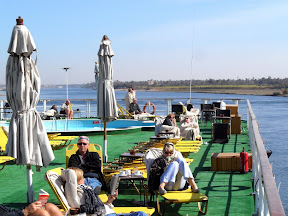
Free of the sellers, we spent a pleasant morning moving up with the current of the Nile.  The morning sun was warm and not too bright, and quickly heated the deck, burning away the mists on the water to reveal the familiar shoreside views; marred only slightly by the lead boat which had drifted too close to the side and appeared to have run aground as, when we passed it there was some frantic propellering in forwards and reverse gear, which was doing little more than spinning the poor ship about it's grounded point.  Putting out of our heads the thought of a similar fate, we headed down for some breakfast and waddling back upstairs we found the rare towelsnake on our beds.  By the time we had settled our food we were watching the boats pass us as we entered Luxor harbour, from our bay window.

Hani gathered us up and we headed up the gangway and past the sellers who seemed to have been waiting for us since the last time we were here.  Coaches were waiting to take us across the city to Karnak Temple, the first of the two great temples we would be visiting.  Our coach passed Luxor temple along the seafront and then headed inland, winding it's way through what must have been every back street through some semi-acknowledged one-way system before finally hitting a stride along the straights and heading to it's destination, deftly sweeping through chicane barriers and losing as little time as possible on the speed bumps.  Every now and then, a house or wall would flash by with graffiti or stencil art, invariably telling Mubarak where he could stick his regime.

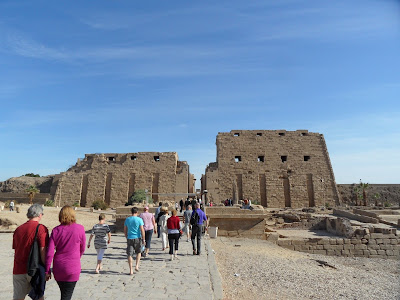
When we hit Karnak temple, the politics disappeared and was replaced with carefree tourism for a while.  The sun was at it's height but the open areas were fresh and a little breezy.  We moved as a group through the mini-museum and out across the pleasantly tiled west entrance court as the giant pylons of Karnak rose from the ground ahead of us.
The first thing you notice when you get close is the line of semi-ruined Sphynx statues, each raised on a plinth and pointed towards the visitor on either side as they make their way to the entrance.  Those that have them are topped with the heads of rams, rather than human heads, as a symbol of Amun himself.  Karnak temple is a huge complex - larger in landmass even than the pyramids at Giza, though much of the original layout is in ruin.  The entrance we were going through took us into the Amun-Re Precinct, a relatively new addition to the complex and thus more complete than others.  In fact, Amun-Re is the only section open to the public, representing a small proportion of the total area.

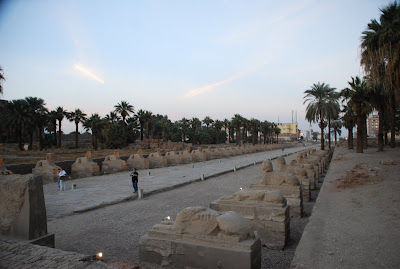
Hani gestured towards the south side of the complex and pointed into the distance.  Past the trees, roads, churches, mosques and assorted dusty buildings that lay beyond was the tip of the ruins at Luxor pointing out of the haze.  From the ruined south entrance, back a mile or so to that other temple, the Sphynx Avenue once extended, linking the two. And below the dusty roads and layer upon layer of earth, rubbish and stone, it is thought to still stand, largely intact.  Work is progressing to uncover the avenue and restore the hundreds of statues to their ruined best and this has been largely completed, although there remains a tricky issue about the remaining sections.  Several churches and mosques are situated on top of the avenue, and Egyptian policy is that they cannot be destroyed, and any movement must be universally agreed by all parties.  This is the main reason (other than regime change and a general lack of money) that the work is still not complete.
Amun-Re alone was large enough to command a good viewing.  Entering through the massive pylons, symbolically representing the 'feet' of the temple god, we saw a much ruined - though partially restored - line of columns that would originally have held up the stone roof.  One pillar had been completely restored, and showed the fluted lotus capital - the topmost decorative stone - to give a feeling of the common themes of the architectural artistry.
As work to restore the ruined temple progressed from the turn of the 20th century onwards, not only the stone structures were retained.  Behind one of the entrance pylons, in the shade from the sun stood a pile of earth and rocks, scaling almost as high as the pylon itself.  Far from being wrecked, the top of the pylon was missing because it had not been finished - as it's construction coincided with the end of the period of power and prosperity of the Egyptian gods.  The pile of earth buttressed the semi-complete structure and served to explain how the pylons were built.  On the way up, successive layers of earth were built up in tracks to allow huge stones to be lifted to the build level until the structure was complete.  Then, as the earth was taken away, the exposed stone was carved to create the murals.

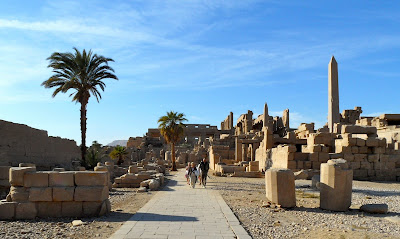
Karnak's next section was the biggest draw. The Great Hypostyle Hall comprises sixteen rows of huge columns, holding up the now largely missing roof many feet above.  Each column is intricately carved with the proclamations of high-ranking kings, who after Seti's original construction had murals depicting their power and deeds carved into any spare section of wall.  Walking into the sun-dappled room is a humbling experience in terms of the scale and effort that these ancients managed with just the grunt power of oppressed slavery to get the job done. The columns had been extensively restored, and in order to remain brutally honest with the viewers of their restoration, UNESCO covered the damaged parts of each column up with plain, modern plaster without attempting to copy the original style, so you could see which bits were authentic and which was a repair.
Beyond the relative order of the hall lay an inner area, made up of more ruinous structures and small theatres and rooms.  Huge and imposing piles of stone blocks shut out the sun above and looked in an ominous state of near collapse.  In among this random placing of loose jigsaw pieces sprouted large stone obelisks, their relative good condition making them appear to be new growth rising from the ruins of the old.
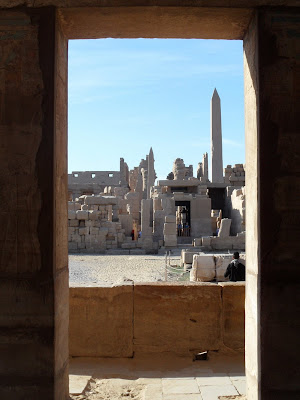
Our cameras were filled with geometric structures singed by the hot sun, and as Ms. Plants had had enough, she beckoned me back to the coach.  As usual, Hani's whistle-stop touring meant we couldn't dawdle too much.  As she quickened her pace I took a few final snaps and, on the way back across the entrance, passed a handful of tourist shops.  Always wanting a nosey but with a hurried sense of not wanting to walk back, I perused the wares of one whose owner assured me of no pressure to buy.  An assorted collection of polished black figurines covered a carpet under the shade of an erected canopy.  Pharaonic Gods mixed with sacred animals, pyramids and miniature obelisks were creatively mixed together, carefully arranged with the smallest at the front.  An Ibis statue, jet black and delicately carved, it's stick thin legs and slender beak threatening to break off at the slightest touch took my eye in particular, but the widening eyes of the attentive assistant and the thought of the revving coach engine and an impatient Hani (not to mention the other half) wrenched me away from any potential buying opportunity.

For the small coach ride to Luxor Temple, the thought of that statue on my mantelpiece simmered away, but any regrets on not shelling out there and then were tempered with the knowledge that these statues were ten a penny and for sale everywhere we had been up until now.  Another one was sure to surface.
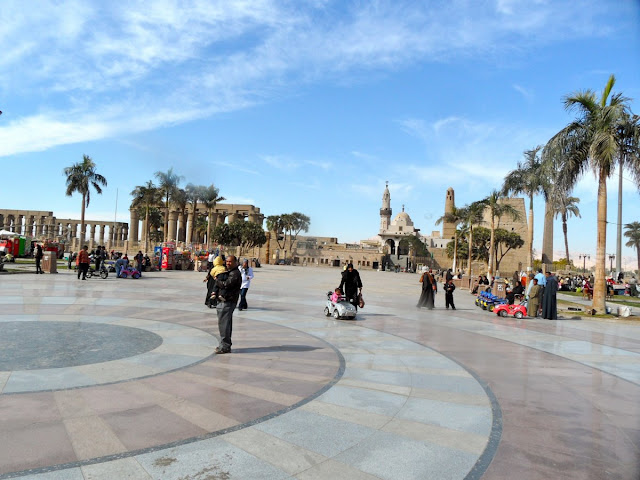
The coach pulled into a gravelled area and Hani took us down through some bushes where the other end of the Sphynx avenue greeted us at the entrance to the temple.  The straight road extended far into the distance before the first modern obstacle brought the run to a halt; a large Coptic church jutting out halfway into the walkway.
Hani gathered us at the entrance.  A pair of pylons were joined two statues of Ramesses II.  A single obelisk stood in front of one of them, and a plinth for a second sat close by.  In the 19th Century, the Egyptian governor gave it away to the visiting Frenchies, who duly gave them a clock in return, which as with many examples of French engineering, stopped working in less than a year.. It stands impotently in a once-ornate clocktower in the Alabaster Mosque in Cairo, slowly rusting.

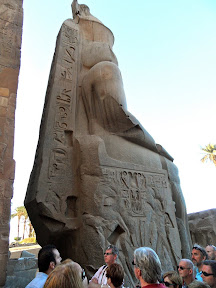
The statues were more interesting than first assumed; Ramesses II had his figure plastered all over the country in murals and statues, but these ones were slightly different.  As you entered the temple and saw them in profile it was clear that the rock from which one was hewn had an entirely different purpose.  A partial obelisk ran down the back of the right statue, suggesting that it broke as it was being carved and the huge rock was re-appropriated.
The Sphynx Avenue wasn't the only example of an ancient monument built over with modern structures; Luxor temple itself actually acts as the foundation to the Abu Haggag mosque, whose white and terracotta upper floors stare down at you as you enter.  Originally built as a Christian church, the builders used the innocuous stones jutting out of the hill as their foundation in the 12th Century, not realising until several hundred years afterwards that there was an entire temple underneath all that earth.  Initial attempts to have the mosque moved were resisted due to it's religiously intrinsic placing, and the merged structures remain to this day.
By now the sun was getting low in the sky, which made for some beautiful golden colourings of the walls and a pleasant cooling of the air.  The shadows lengthened as we headed further inside towards the sanctum, through beautiful open courtyards lined with papyrus-capital columns.  As we got further in, evidence of Romanic changes cropped up.  Alexander the great claimed the temple as his own and built a chapel, complete with a symbolic stone tablet announcing peace in the area.  Further still, the Roman empire stamped their authority, using the image of a carved stone eagle to represent their might and forced takeover of the temple, which still bears faint fragments of Roman murals, painted onto plaster renderings over the original Pharaonic ones.
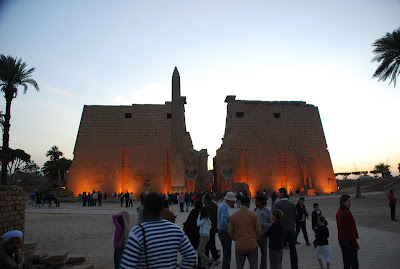
We wandered around for a while in the dying sun as the lights began to come on.  The temple was bathed in a blood-red glow as we left for the bus once more.  We were back at the ship before we knew it and more than a little hungry.  Our towels had morphed into a huge lotus blossom when we got back.

We had a bit of a think after the food and decided that it was too early just to kip on some full stomachs.  The paper map of Luxor we had lying around since day one mentioned a tourist area full of places to see and shop, and since I still had a bit of Ibis-searching left in me, we headed off by foot.
As is usual, we were mobbed as we rounded the side of Luxor Temple.  Young men in charge of horse and carts in varying states of repair shouted over, asking us where we wanted to go, in the hope of getting us to board.  It was annoying but these were desperate times and the tourism had almost dried up.  We carried on as the map suggested it was just around the corner.

The middle of Luxor was alive with lights and cars and noises, and the call to prayer of the nearby mosques had begun.  You might expect everyone to drop what they were doing and pray, but the roads stayed busy, and the market bazaar, when we got to it, was heaving.

Ah, a proper market street, and for the first time we had let ourselves of Hani's leash and were walking amongst the locals on our own.  And boy did we know it.  The market bazaar is a long, narrow covered street, branching off every now and again, and stuffed to the gills with shops on both sides, the wares spilling out of the shops and into the street.  And our western faces and clothes did not go unnoticed.  The other half was wearing a 'Canada' sweater, and our language was tested at every turn with calls of 'Hey, Canada Dry'.  If we turned around to the caller without thinking, they knew they had an English speaker amongst them, and would be in with a shot of taking our money.

Making our way through the street was actually pretty tough going with this happening every five seconds or so.  At one point, we exchanged understanding glances with an equally harangued pair of tourists coming the other way.  We were actually glad of the odd time when we were invited in by a shop owner, containing his enthusiasm enough to assure us of 'no hassle', which bought us a few moments of peace, due to the unspoken agreement between the shopkeepers that they don't nick each others' custom.  To my surprise, my searches in this most bountiful of places didn't turn up a single Ibis statue of any merit, being only the (in my mind) ugly looking flattened ones, despite having perused a good dozen shops and stalls groaning with figures of all shapes and sizes.

Eventually, we took a chance in a spice shop; we both wanted to get some authentic Egyptian herbs and spices to bring back to the west for cooking.  If you go shopping in Egypt, this is certainly one of the places to go - the colourful sights and smells of the many exotic spices mix well with the hospitality, and I made sure to get some of the sweet tea that arrived on a tray carried by an enthusiastic young lad shortly after we entered.  The shelves were groaning with ready-packed spices, but we knew better than to go for those, as they could have been there a lifetime.  Instead we bought cumin, coriander, chilli and paprika pods from the bulk bins, and Ms. Plants, who was in her element, bartered the price down from an initially hefty number down to something more manageable by the use of stern talking and a withering stare.  I was in awe.

Striding out into the meleé once more we turned back and made our way slowly through and back to the boat.