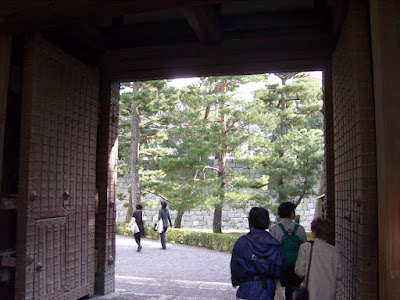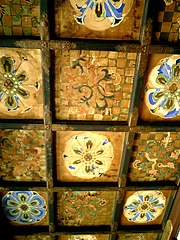
Japan 13 : Through a Long and Sleepless Night

I must apologise for the quality and quantity of the photos on this leg of my holiday. As you will soon read, there was a very good reason for that.

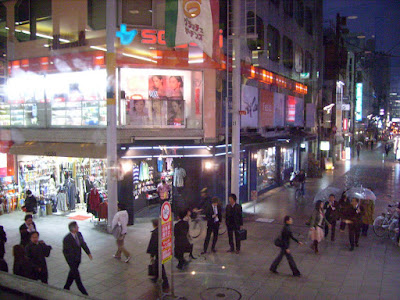
I remember little of my final night in Kyoto, except that I was constantly hot and feverish, unable to sleep, and constantly on the lav with terrible stomach cramps. The hotel which had looked like an absolute bargain when I had arrived, had turned out to be the most unbearable place I had stayed in - a hot, claustrophobic room, a noisy fridge and no reliable ventilation. Keeping the window wide open helped a little, but the air was stale as it was blowing up the narrow passage between this building and the next, and opened out onto a walkway, which I was none too keen to let people climb in whilst I tried to sleep.The switch marked 'air conditioning' I think should have read 'heater' because at all settings it proceeded to blow hot air into the already stifling room.
This could not come at a worse time on the journey. Although I hadn't realised it at the time, I was slowly losing energy day on day, thanks to a squeamish attitude towards the local delicacies, and concentrating much more on what to see and lugging my heavy backpack everywhere, rather than how to keep myself properly fed. Ever since the incident back in Abashiri, I was also nursing round a digestive system that meant I always needed to know where the toilets are.
By early morning I think I must have slept perhaps an hour, and I was pretty sure I had come down with a fever. On the way out of Nagano, I mused, I had to sit near some guy who spent the entire trip snooking snot back up his nose and sneezing everywhere. If I knew where he was then I would have summoned the last of my strength and shook him warmly by the neck.

By 6am I was just waiting for the day to start, rather than trying to get any more sleep, and it was becoming clear that I would have to change my travel plans a bit. My planned route was to take the northern train lines from Kyoto up to the north coast of Honshu, and before going back southwest to Hiroshima where my next hotel waited, stop off at Tottori, where I had read about an enormous beach with massive sand dunes; since I had been told by one disapproving friend that Japan would not be a good place to go 'because it had no beaches on it' I was interested in not only having a relax by the sea, but also proving him wrong and getting the pictures to prove it. However, since the leg would be using the local trains, (not all of them JR lines) it would take most of the day, and the direct route to Hiroshima was by Shinkansen and took about 2 hours.
I figured I could gingerly walk to the station, get an early ticket to Hiroshima and be within a safe distance of the train toilet all the way there. Once in Hiroshima I would find my hotel, which I prayed would be more bearable than this one and I could recover and plan my remaining routes over the two days scheduled for that city.
So after a protracted time on the toilet giving my lower intestines every opportunity to do whatever they wanted, I set off for the station. The cold air on my clammy face, mixed with the early morning crowds and the heavy packing took their toll and by the steep escalator of the entrance I was feeling the strain. I got a ticket for the 8:02 to Hiroshima in the booking office with merciful promptness, and after a number of careful lower back muscle contractions, headed slowly to the platform.

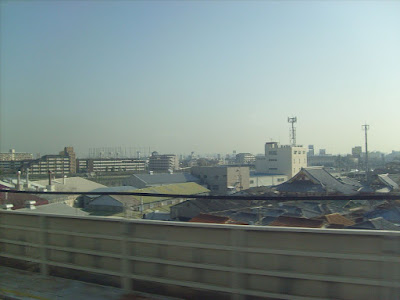
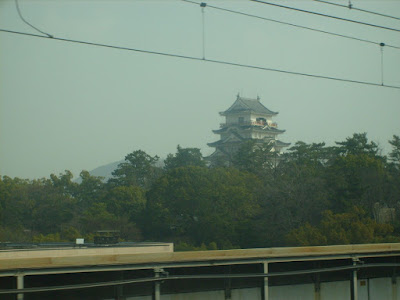
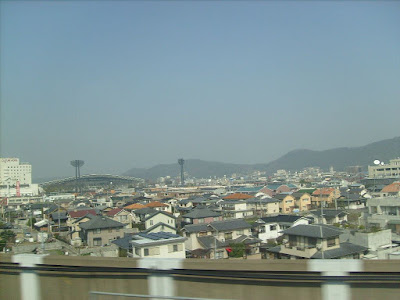
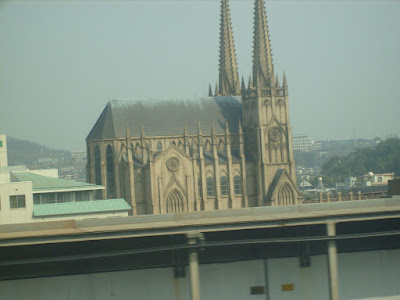
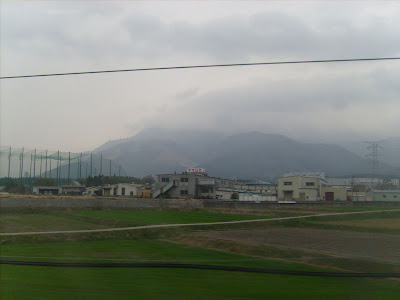
I don't remember much of the journey, though it was pleasantly air conditioned and reasonably empty, so I ignored my reservation seat and stuck myself near the end of the compartment near the toilets. What few pictures I took were between bouts of nodding off and I took advantage of the window sills and the ultra smooth ride to steady my aim.

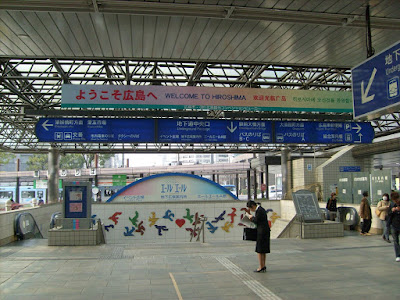
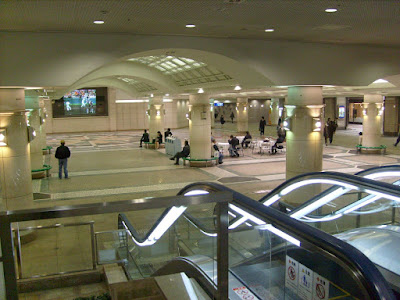
When I arrived in Hiroshima at about 10am, I was still faint and weak on my feet. Immediately outside the station is the entrance to the underpass, decorated with tiled images of paper cranes (more on that later) and beyond that the Hiroshima Tram system end terminus. Not knowing where I was, I tried to pass the tramway and over the main roads beyond, but they were pretty impassable, so seeing the underpass exit over the other side I tried that route, but got rather lost as my sense of direction was down. Eventually I managed to climb the steep steps on the other side, and according to the map my hotel would be nearby. Fortunately it was just around a corner, but it took long enough for me to find it. (I staggered into what I believed was a hairdressers up a few flights of stairs, and they took pity on me and guided me into the lobby of the hotel.)

All my problems should have been over, but not quite yet. I had banked on paying for the hotel with my card, and it was not working on their machines, so I had to find the nearest post office and get some yen out from there. Fortunately it was just to the side of the train station, and the hotelier let me keep my bags behind so I wasn't lugging them again. To be sure I was OK financially I got out 15000 yen (about £75) and cashed my remaining 20000 yen travellers cheque.
As I was returning, I happened across a JTB travel centre, and feeling a little more able, I decided that it would be a good plan to sort out some future hotels, so I managed to book for Matsuyama, Takamatsu, Himeji and Osaka, because to be honest I didn't know when I'd be able to do it again.
Relieved that I had managed to secure things for the following days, it was then up to me to get myself able to make them. I returned to my hotel, and after paying and retrieving my things, I ignored the slightly downmarket nature of the interiors (I had realised that it was no measure of how good your night was going to be) and got straight into bed.
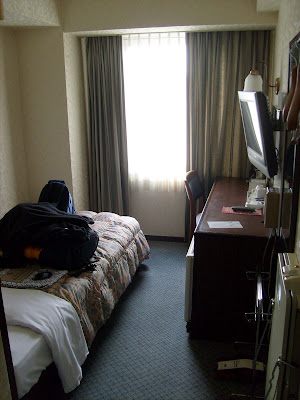
Even though the room was modest compared to the supposed plushness of the Kyoto place, it was a thousand times better (and about 25% cheaper). A fully openable window allowed the fresh air in from a warming day outside, and the room was silent, no buzzing or humming or strange feelings to it, so my body slept soundly until about 6pm. By then it became clear that in order to not slip further into my fever I would need to get some nutrition. The thought of food made me retch, but I knew I would have to have something for my body to work itself out.
I left the hotel and took the tram into the centre of Hiroshima, which despite its notoriety looked like any other town I had seen in Japan so far, except that some of the more elderly passengers riding with me were clearly some of the survivors of the bomb that had virtually wiped the city out. I resolved there and then that I would not let the fever take up all my time in this city and would visit the memorial sites tomorrow.

My JBR book had told me that there was an Italian restaurant in the central area. I chose Italian because it was recognisable and the Japanese seem to like Italian meals as there are plenty of such restaurants around the country. I couldn't find the one in the book, but eventually found another one which seemed good enough. I started with some french fries (for a salt kick) and then a margarita pizza (for general stodge), and finally some apple pie (for sugar).

I had to force it all down - not because it was bad, but because my stomach hated the inclusion of anything new at the time. I finally managed to work through most of it and then took myself straight back to the hotel at about 8pm, where I sent off my much-needed laundry bag and slept soundly until the morning.

Japan 12 : The Golden Temple


Today, more than any other so far, would be Temple day. There are many, many temples and palaces and things to see in Kyoto, and I had one full day to see as many of them as possible. At one point. Kyoto was the imperial capital of Japan, but it lost that title to Tokyo (though there is no legal definition of this). Tokyo grew into the modern metropolis it is today, whereas Kyoto, whilst still embracing new culture and technology, stuck more to its traditional roots and today has much more of an authentic air about it.

Unfortunately, things were not looking too good. My energy levels had taken a battering as the first night in the swanky Apa Hotel had been a bit rough. I had spent most of the night awake, my stomach feeling more off than before, and there seemed to be something about the room that wasn't quite right, like it was on top of a huge electromagnet or something, a strange low-level buzzing kept me from a peaceful snooze.

Whatever it was, that night was a hot and restless one, and by early morning it was pretty clear that I wasn't going to get any more sleep. Still groggy, I decided to leave at 7.30 am after tracing a route around central Kyoto that would take in as many of the main shrines as possible. In one day, there was no chance whatsoever of getting all of them, but I'd give it my best shot.

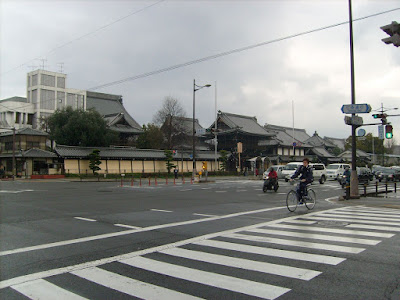
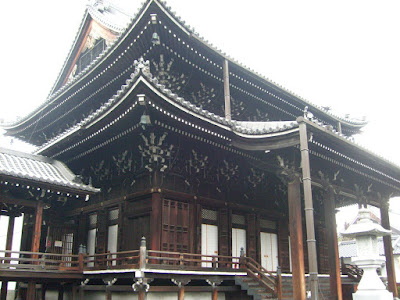
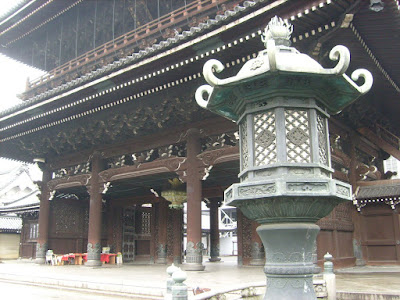
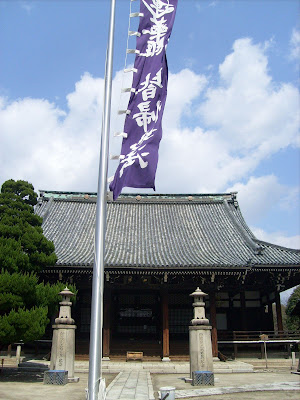
At that time in the morning, there tends to be not so many things open so eschewing a bite to eat (as I really didn't feel capable) I started out down the back streets towards the first temple, splashing through the dampened streets that had clearly seen their share of showers overnight, I shared the narrow streets with the cars. Compared to the lush, modern facade that had greeted my entrance to the former capital, it only took a couple of hundred yards for that to be replaced by much more mundane, inner city sprawl. Nishi-Hognan-Ji was the first temple I came across, and predictably it was only partly open. Located on a busy road, it comprised of a courtyard surrounded by a high wall, with a moat around that, and a couple of highly ornate entrance buildings which gave access to the several shrine buildings within. I looked around the available areas, and bumped into precisely no other tourists, because sensibly they were still tucked up in bed. The style of the temples and outbuildings would turn out to be quite typical for Kyoto, especially the black and white square effect on the roof ends and the intricate woodcarvings that decorated the outer walls. After seeing an open shop outside one of the entrances I decided to feed my now rumbling stomach, I went down a side road where I consumed it in relative peace, sat on a post outside another temple building next door, which looked very closed.

Heading over the road once more and under a promising-looking temple gate, I trotted through the narrower streets and eventually arrived at Higashi Hongan-ji. I initially saw the enormous structure from the back, a large, cubic building made of scaffold with white wooden cladding over it, broken up by tall, narrow windows. As I went round perimeter of the moated area, complete with beautiful white frontage surrounded by a koi-filled moat, I was able to peer into a couple of the areas through what looked like minor entrances. Eventually I found the main gate, and going inside, found the ugly cubic structure in front of me where a temple should be.

Thing was; this was March, so not really tourist season, so the curators of such places (I had guessed by this time) use these quiet months to perform any restoration work that is needed before the flocking crowds they get in April to June, before the sun goes a bit mental and decides to fry everyone at a heady 45 celcius. Higashi-Hongan-Ji was one place going through such an upgrade; the main temple building was cordoned off with 6ft high wooden boarding, and sat within the aforementioned scaffold structure being meticulously cleaned and restored to its former glory. It seemed to be inaccessible, but on closer inspection, the adjoining Amida Hall was still open.

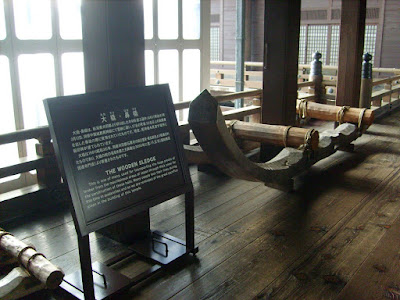
Kicking off my shoes again at the entrance, I padded through the ice-cold building, which was full of square rooms kitted out with tatami mats and bordered with sliding wooden doors, painted with spirits and deities and depictions of battles of old. Following the linear path actually took me over century old creaking wooden walkways into the main building, which was, thanks to the outer shell, pretty dark. Still, you could just make out the various carved sculptures and murals and exhibits of rope made from the hair of the followers who built the halls, though to be honest, my main concern was that I could no longer feel my toes. It was like walking on ice.

After a while I exited, gathered up my shoes and moved on. The Shosei-en temple gardens were next on the map, but given they charged a hefty entrance fee and it didn't look so special from the outside view, I gave it a miss. At least it was a temple - the next place in the book was Hakosen-yu, which despite being depicted as another tourist spot, turned out to be just some modern building down a back alley, as I found out after pacing up and down through several back streets, asking many slightly confused-looking residents if they had seen it.

I was feeling a bit beaten at this point, the initial enthusiasm on going through the temple capital of the country had waned significantly and so I decided that a quick subway ride to another part of Kyoto was in order; perhaps things would be different there. Gojo was the nearest stop and took me northeast to Imadegawa, which looked like the the best stop given its proximity to the other sights on my map.

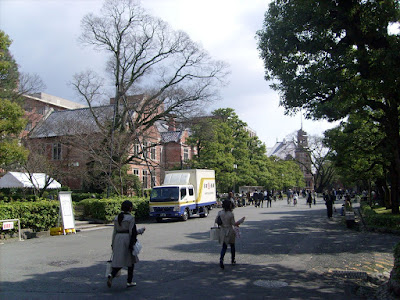
After negotiating the exit machines and getting back to ground level through a narrow, twisty tunnel, the harsh sunlight faded to show a set of unremarkable streets. A quick detour south took me to nearby Doshisha University, whose campus could have come straight out of the UK or America, and was filled with a mixture of older and newer western-style architecture and a lot of intelligent-looking students taking in the late morning sun between lectures.

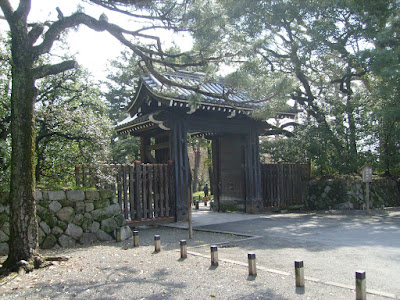
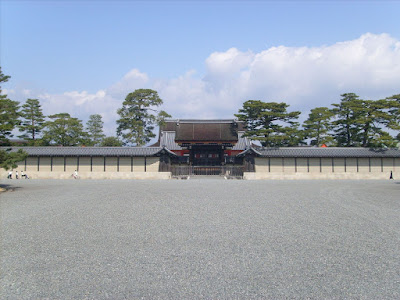
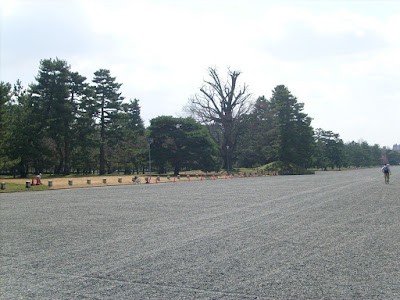
After a brief stroll, I headed back out of the gates and further south until I came to a multi-laned main road, across from which was the corner of a very large, walled set of grounds with a thick skin of trees to block out the sound of the everyday. This was Kyoto's Imperial Palace, a massive rectangular area containing a patchwork of gardens each surrounded by wide expanses of gravel road. The scale of it all was quite dizzying. In the centre of all of this stood the inner grounds of the palace, which were themselves pretty massive. It was all designed, quite clearly to show off the power and riches of the imperial family as was, but was now lightly peppered with sightseeing tourists, or local keep-fitters or their daily run.

Unfortunately, the inner sanctum was all closed up, and the grounds were seemingly endless, so after a bit of walking, (and seeing the first of the Sakura blossoms for this year) I decided it would be best to move to the next and most anticipated place on the map: The Golden Temple, located at the north-western corner of Kyoto. This involved heading back north west, over a network of small roads through a small, cramped residential area (in which I was warned about spooky cats). Looking at the map, it looked like about 2 miles to get there as the crow flies, so after getting an energy drink, a donut and some choccy from a nearby shop, I set off.

Along the way, there were plenty of smaller-scale temples and shrines, but none of them looked particularly appealing; they were all beginning to look very alike by this point, and my confidence about my sense of direction was being put to the test. Eventually, the overbearing buildings relaxed their grip on the streets and I was on a main road once more, each side lined with small shops selling vegetables and household stuffs, with the odd trinket shop in amongst, suggesting I was quite near something. By now, there should have been some sign pointing to the Golden Temple, but there was nothing leaping out from the various signposts. Just at the right point, a couple from London happened to pass by. (no, really; I couldn't believe the convenience myself)

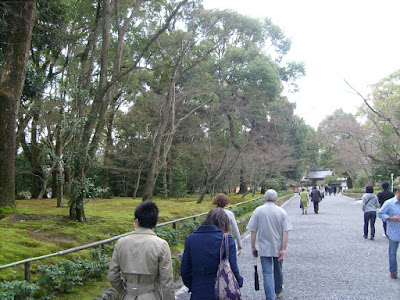
John and Joanna were also looking for the Golden Temple, but they had a better clue of where they were and were following with confidence a route layout that I'd long since given up on. I gladly let them show the way as we headed uphill and eventually ended up at the entrance to Kinkaku-ji, the famous Golden Temple. Unlike Ise-shi the previous day, the temple is located in quite modest sized grounds, so there is only a short stroll through a garden before the pathway opens up to reveal the main attraction.

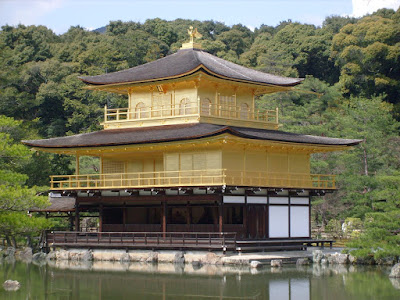
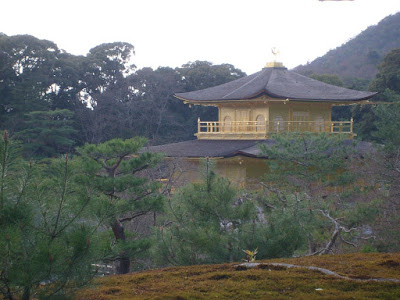
Most people will have seen the temple in pictures, if not heard of it outright. It is one of the most iconic images of Japan, a beautiful, 700-year old Zen temple clad all in gold, floats on a wooden island in the centre of a large pond, called the Mirror Pond, because on calm days it is perfectly flat mirroring the temple and the forests around it without imperfection. To look at the pictures, you would think it is deep in the forests outside of Kyoto, but in fact it is about a half hour on foot from the central train station.

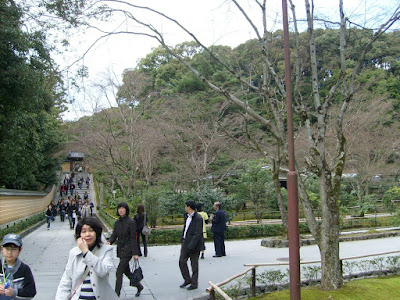
Aside from a rather cheeky crow who decided to perch on top of the phoenix weather vane on the top of the temple, it was a perfect photo opportunity, and despite it still being outside the tourist season, the crowds had come en masse to see it, and the weather dutifully let out a few rays of proper sunshine from between the clouds. It was nearly perfect weather, though the slight breeze was spoiling the mirror lake a bit. I lost sight of John and Joanna some way in, probably with a mixture of gawping at the splendour and making faces at the Koi (who had learned all the best places to congregate to get fed), and made my way around at a leisurely pace, exploring the understandably less popular buildings within the gardens, trying to get a ding with my few available 1 yen coins by flinging it into a pot, buying some more postcards from the obligatory souvenir shop, and avoiding paying a few hundred yen just so I could sit in the special area designated for people to drink green tea. I was that carried along with the crowds (and it was a one-way system), that I went back to the start and went through again, fortunately my ticket hadn't been stamped so it was probably OK.

I met briefly with the saviour couple, who had chosen to have a breather at a picnic area, and we carried on a brief chat that had begun on the way to the temple, about what they had done and where they were going next, and my mixed bag of temples and sore feet. We parted ways shortly after, but not before Joanne made a suggestion about my next stop: Nijo Castle, which they had been to and really liked. I left the temple grounds and retraced my steps to the main road where I had met the couple, then headed downwards until my now retrieved Kyoto map told me there would be a bus stop. Kyoto buses work on a colour system, but the maps on the bus stops were still a little confusing, but again help was on hand by an elderly Japanese gentleman and a New Zealand student who was just finishing a year in Japan, who between them managed to get me on the correct bus.

It felt good to get to Nijo with something else taking the strain, and for a flat 220 yen fare (about £1.10) it was worth it. The bus dropped me off a block away from the temple, and from there I was able to trace around the perimeter moat to get to the entrance, where even the adjacent pathways were intricately paved and the hedges meticulously neat.

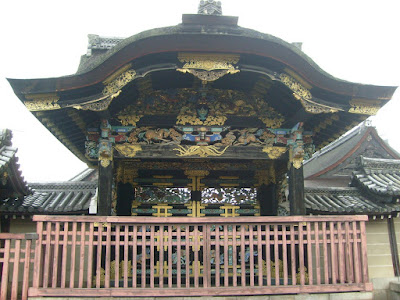
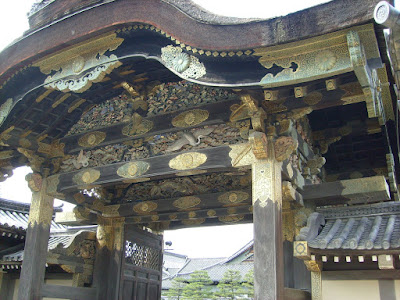
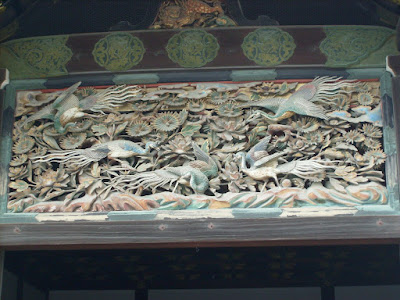
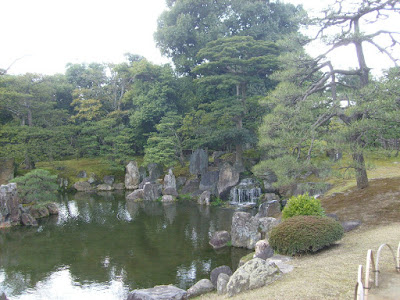
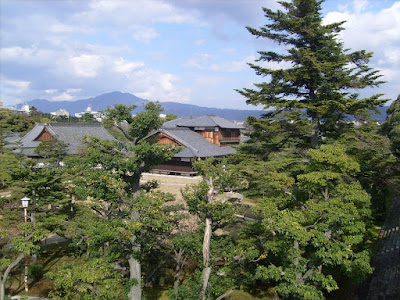
Nijo castle has seen many changes due to feud and fire during its 400 year history, and its grounds contain two single-storey palaces and no actual castle; the Ninomaru Palace in the outer, larger main section, and then the Honmaru Palace behind a second level of walls and moats. The Ninomaru Palace, which is known for its intricate wood carvings on its outside, the best example being the Kara-mon entrance, which was right in front as I went into the main area. Above the entrance is a fantastic carving of cranes and peacocks on a lily pond. Inside, those pesky no-camera signs were in force again, although this time they were joined by an explanation board that in broken English warned that flash photography would harm the already fragile paintings inside. I tried to get some non-flash pics but they were far too dark. The insides of the temple were covered with partially faded designs of horned beasts and wars and skirmishes, plenty of gold leaf, especially on the ornate ceilings, and as you went through the five sections of the palace, it became gradually more luxurious, suggesting that the riff-raff at the time would be kept waiting in the first bit, whilst those with riches or respect would be invited to the inner sanctum. Exiting the palace, I walked around the pathways through the gardens as the mid-afternoon sun shone gently down, and then after seeing all that I could, including the koi ponds and water gardens, intricate rock gardens and beautifully cared-for plants and trees, and the Donjon viewing platform of the central Honmaru palace, (previously a defensive turret or keep which had burned down some centuries previous, and the stone platform all that remained gave great views of the grounds) and then left by bus for the centre of Kyoto once more.

The reason for my hasty retreat was because my future hotel bookings were catching up with me, and the day after tomorrow I would be in Hiroshima with no place as yet to stay. Despite swearing blind that I had seen a JTB near the station I could not find it second time around, and so returned to the expensive internet cafe and booked over the internet. I tried to book for the intended stops on Shikoku Island (ideally Matsuyama and Takamatsu) but I was too late on booking those, so would have to rely on finding a JTB in Hiroshima.

After getting a small meal, (I was not feeling so good) I went back to my hotel and got my laundry sorted out, then went back to my overheated room after chatting with a few friends on the pay-as-you-go internet in the lobby. It was only 8pm, but I was beginning to feel that I couldn't manage any more of Kyoto, so I had a long soak in the Japanese-style sit-down bath in my room (the water comes up to your neck) and then got into bed. Little did I know at the time, the next 24 hours would be the hardest of the holiday.

Not Angels

RekiThis post is a tribute to perhaps my favourite series of all time: Haibane-Renmei. Now over 5 years old, it still continues to fascinate and affect me each time I watch it, and have felt the need for some time to put my feelings into words. Sure, I love to watch an action flick like Indiana Jones, or something satirical or scathing or just plain wrong like Family Guy, but this answers to a different part of my brain.

Haibane-Renmei was created originally as a self-published manga by a rising artist called Yoshitoshi ABe. More a light-hearted comic strip back then, the only similarity was with the angelic-like creatures that inhabited the world. Abe decided that he would make a 13-part anime using such creatures, but would set the mood to be darker and deeper.

Synopsis

It follows the story of a young girl who in the opening minutes of the first episode falls to earth. At the same time, a woman discovers a giant cocoon in one of the rooms of a run-down old school building. Dressed in second hand clothing, and spouting charcoal grey wings and a halo, she readies the room for the hatching with the help of similar beings. These are the Haibane, people born into a town with no idea why they are there, and only the most fleeting memories of who they used to be.

Once hatched and awake, the new girl is introduced to the group and asked about the dream she had. As is the custom of the Haibane, each one is given a name according to their dream; In the case of the new arrival, she is named 'Rakka' meaning 'to fall'.

And so the series charts Rakka's first year at Old Home, the name given to the semi-collapsed building that the Haibane use as their 'nest'. If it stayed as just that, the series probably would not have been very special, but its beauty comes from the relationships that develop between the Haibane, how they fit into the world and have to bend to the whim of the rules laid down by the Renmei, a sort of governing body of people whom the Haibane may only communicate via a designated intermediary.

In particular, the bond that grows between Rakka and Reki is the strongest. Reki is the 'house mother' to the younger Haibane due to her length of time in the world and her take-charge nature. As the series progresses we see that it is in fact Reki that is the focus of the story. Her mysterious cocoon dream was almost entirely wiped from her mind and the small subtle clues given in the dialogue of the first episodes only hint about the mysterious and deeply troubled past she keeps so well hidden.

Yet neither Reki nor the Renmei are 'baddies' - in fact there are no western-style 'baddies' in the series; it concentrates purely on the interactions and development between characters, wrapped in a storyline so tightly woven that it gains that often credited but rarely deserved simile of an onion, where you can peel back successive layers of story to find deeper threads in the narrative undercurrents. Despite being animated, the characters through their actions and reactions to the story become fleshed out, believable, complicated human beings with an admirable 'make the best of it' approach to their aimless situation - they come into being, spend an amount of time in Glie (the walled town containing Old Home) as poor second class citizens, and then mysteriously and without warning take their Day of Flight, where they leave the world forever.

So we get to see lives in miniature, where people are born, live, grow and die within a short time frame, and we also get to see the consequences of this overlapping and repeating cycle on the lives of the other Haibane, who build intertwining relationships that are then without warning cut apart without explanation. It is more than just 'following the adventures of someone adjusting to an unfamiliar situation' and instead provides a peek at a recognisable and repeating, replaying cycle of events. Centering in upon a crucial period in a story that could stretch thousands of years in either direction, it molds itself around the experiences of the viewer, and in doing so, encouraging them to reach their own conclusions as to what happened both before and after, rather than taking the approach of saying 'this is what it all means' and attempting to explain everything. Such themes cannot be easily fit into words and the interpretation of what happens will be different for everyone.

I should note that even though the series uses symbolism from various religions, these are only used to give a feeling to the show, and the story itself is not religious in tone or meaning, it is more a collection of themes revolving around spirit, loss, redemption and the threads weaved between people that are worn and snapped on the sharp edge between life and death. I certainly wouldn't have liked the series if it attempted to preach any religious doctrine - my personal attitudes towards organised religion are short-fused, yet the series still managed to grab a tight hold of me.

Reception


Unfortunately, Haibane-Renmei has been largely overlooked by the general public (mostly down to zero advertising, and there being no particular pigeonhole to sell it through in a western market), and has little to no chance of ever being shown on television, but has nonetheless affected an increasingly large group of people who have experienced it. Despite being quite abstract and occurring in a fictional world, the series touches such raw emotions because its themes can be universally understood and empathized with.
The group heading into GlieBut don't just take my word for it - a quick google search comes up with considerable interest on the net; both from anime sites and other people who have no interest in anime, have by chance encountered it, were moved deeply by it, and felt the need to show their appreciation. Just a few quotes:

'Beautiful, engaging, haunting and unique'
Anime News Network


'..to refer to it merely as anime seems somehow inadequate. It is a something delightful and moving, subtle and sweeping, humorous and unsettling, and begins speaking on a level not entirely visible of things not yet seen.'
Heroic Cinema


'It is much more of a spiritual and emotional journey that artfully plays on timeless themes of salvation, meaning, purpose, love, loss, and trust. In many ways it is a metaphor for our own experience: We come into this world from some unknown place, and try to figure out why we're here. Along the way, we have to say goodbye to people we love, knowing not where they are going, but certain that soon enough we ourselves will be following them, and having never really understood what anything was all about. And yet, we somehow find a meaning in all the confusion and sadness. I think that's what this series is about.'
Amazon.com Review


'Can a television series qualify as great literature? In principle I don’t see any reason why one couldn’t, but few of them have any such ambitions. In any case great literature has to pass the test of time, and perhaps the medium hasn’t been around long enough. If one ever does qualify, it might well be this strange haunting story about people who have wings and halos, but who are not angels.'
Funblog


'I usually don't like TV-series. I also don't really like anime, except for the films of Miyazaki. But Haibane Renmei is hard to classify as a standard anime.' ... 'On the surface Haibane Renmei seems like a fairly simple drama. This is because it's the impression the series tries to give us. On the first couple of episodes, there is an underlying uncertainty and darkness. As the series progresses in its 13 episode span, it becomes deeper and more thought provoking. It never spells out things clearly to the audience, and never answers all our questions. It remains wonderfully subtle, and after I finished watching it I thought about the series and its themes for several days.'
Review on IMDB


There are many more. Something intangible about the series has the power to grab the soul, but there are those who would watch such a series and be thoroughly underwhelmed by it. No guns, no explosions, no sex or violence, and none of the typical anime cliches like pneumatic flying robot women. Also, many people in the west still hold the opinion that something animated cannot possibly live up to such praise leaving it purely the domain for children and 'geeks', and maintain a safe distance from it. The series has to negotiate its way through all sorts of hoops just to get put in a DVD player.

I truly believe that this story should be experienced by as many people as possible; it was the first story in a long while to make me seriously think about what it was I was watching, and changed my opinion about Anime as a medium capable of telling as emotional, mature and beautiful a story as any example from literature, film or television.
The groupIf you have the time and the patience, do yourself a big favour and watch it.

Offical Site
- the english-language site by Geneon

Wikipedia entry
- a more in-depth synopsis

The Charcoal Feather Federation
- if you want to read further into various theories inspired by the series, this is a good place to go. The bulletin board is still abuzz after 5 years.


All pictures are acknowledged as copyright Yoshitoshi ABe.

Japan 11 : No, I would not like to marry your daughter.


Today brought a lesson that a week and a half's worth of train journeys should have spelled out pretty comfortably - don't rely on train timetables that were out of a book rather than those from a station. Doing so might make you a bit late.

So it was that my train out of Nagoya to Taki was at 8:08 rather than 8.15 as I had presumed, and consequently at the point I was heaving myself through the labyrinthine maze that was Nagoya station said train was leaving. The next train along would not be until 9.30.
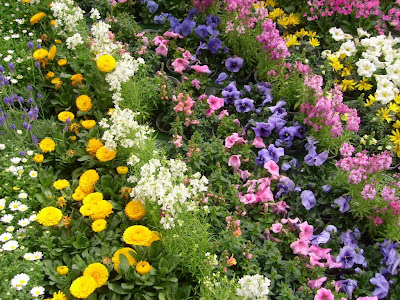
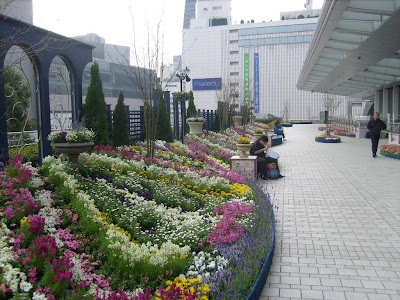
I spent the intervening hour or so making up new swear words and trying them out in the hidden flower garden that I had accidentally come across (up the escalators located in what appeared to be the central station plaza). It was quite nice there, in fact; the insane bustle of a thousand hurrying feet blended into the background and was replaced by the cool morning air of the outside. The beds themselves shielding the smattering of other fellow commuters from the hubbub going on outside the station too. A small tranquil oasis in the middle of the insanity of a busy Japanese arterial node.

As I sat there munching a sandwich and swigging a drink, I reviewed my decision made whilst in bed - instead of staying in Nagoya (of which by now I had had my fill), I would use the time today more wisely and visit Ise, and the great Ise-shi, what is perhaps the most popular of all the shrines in Japan, and one of over a hundred in Ise alone. Hugely frequented year round by many Japanese, who if were going to visit one shrine per year, would make it that one, Ise-shi represents a spiritual pilgrimage for six or so million Shinto-worshiping visitors per year that has survived in a society which increasingly has not had the time to fritter away on such things. The train journey times suggested there would be plenty of time to get there, look around and head back to Nagoya, then take the bullet train direct to Kyoto.
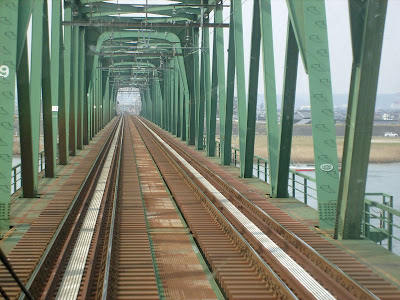
The journey to Ise-shi involved travelling into Kansai round the Ise Bay to Taki, then a change to the Ise-Shi train that would take me to the outer gate. Fortunately, now and again a Mie train departs and this goes direct to Ise without having to change. A slight pain on the journey is the stretch of track between Suzuka and Tsu, which is privately owned by the Ise Railway and anyone who travels on it has to pay an extra surcharge of 800 yen (about £4). The train inspector was pretty uncompromising as he went down the carriage and made sure no-one was hiding in the crapper at the time, so there was nowhere around it.
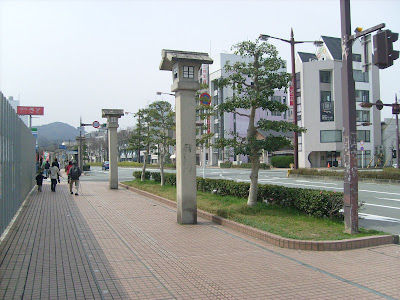
Once past Tsu, the landscape once again started to improve as the high-rise residences and industrial buildings petered out and the hills and valleys and the Ise bay showed itself now and again. Once at Ise, I put up my large pack in one of the station lockers and walked down the main street. Even though there weren't many signs, it was quite obvious which direction Geku (the outer gate) was, given the paved roads lined with faux-traditional lanterns.
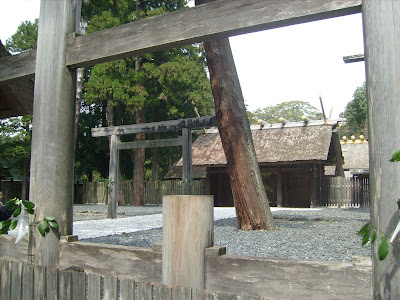
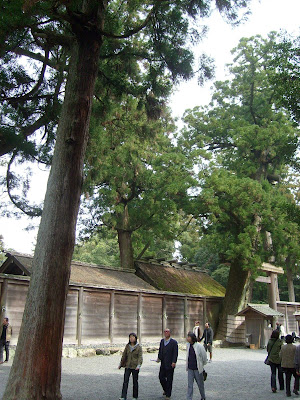
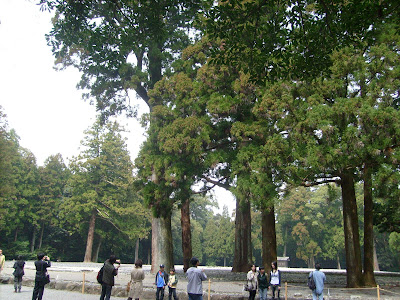
Geku outer gate was more of a woodland walk punctuated by shinto shrines than a gate in itself, and once past the gravelled car park area, became a relaxed pleasant walk along dappled dirt paths. Every so often there would be a building or shrine, often accompanied by 'no camera' signs and an ever-alert guards, but I did manage to get the odd pic, so a few souls stolen there and squeezed onto my SD card.
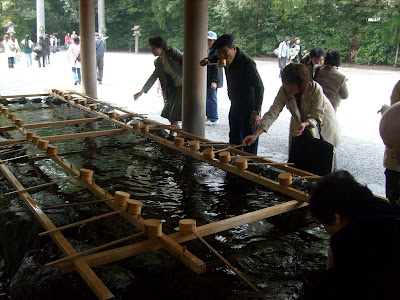
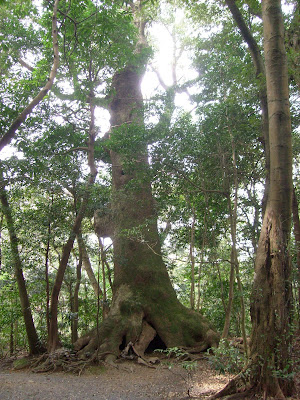
After following all the paths around that I could find, (including an overlooked one that ended abruptly at an ancient tree with a miniature shrine at its base) I exited at the other side and joined the increasingly large bus queue to Naiku, the inner shrine. Buses arrived every few minutes and had as many people squeezed onto them as was physically possible. Quite aware of how my clothes had become well worn in by now, I was not enjoying the claustrophobic ride there hanging onto the straps above me whilst keeping my backpack between my feet. Mercifully, there were not many tight corners and the journey was not long.

Alighting at the other side, the amassed rabble of worhippers carried me along to the entrance, which was surrounded by row upon row of motorbikes, some of which still had leathered-up hairy Japanese bikers on them. Working my way through those I arrived at the entrance gate, a large wooden Torii guarding a large, ornate Uji bridge that spanned the Isuzu river.
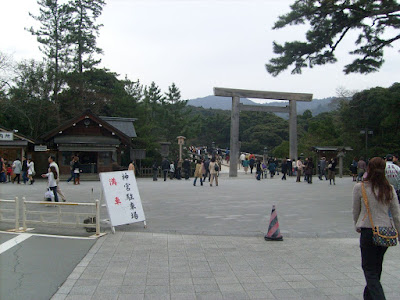
Between the gate and the shrine area itself was an open stroll garden made up of a wide central path with grassed areas either side containing trees, shrubs and typically well-maintained hedges. Here and there were cockerels scratching about for food, ignoring completely the steady influx of people. Fortunately there were also plenty of seats, and still craving a sit down from the bus ride I took advantage of the nearest one for a quick breather.

No sooner had I sat myself down was I approached by an eldely gent whose self-imposed job it seemed was to show random people around the area; he wore no uniform, so I guessed he did it to get out and about and enjoy the company, and given that I was the only westerner around for probably 20 miles, I might have stood out a bit. Though my feet were complaining, I felt I couldn't refuse the opportunity for a personalised tour and so we set off at a gentle pace towards the inner area.
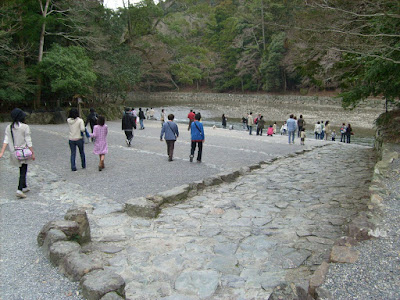
Toshiro could speak a little bit of broken English, and me a little broken Japanese, and as was becoming the norm, a combination of that and some exaggerated hand movements meant we were able to have a conversation of sorts. The first place he took me to see crossed the river once more (the river wound itself around the pathways of the shrine area, or perhaps the other way around) and he explained that the water of the Isuzu River is the purest in the world, that it goes by his house, and that he uses it for all its needs. (I declined to point out that he's affecting its purity by doing that.) It certainly looked pure; the water was crystal clear even from up on the bridge as if you could just go down and drink it. Heading over to the other side took us to an unremarkable-looking shrine building, though he explained with great reverence that it was a memorial shrine to the invasion of China 700 years ago. We approached the shrine and had a moment, me trying my best to look like I knew what I was doing, and then we went on our way.
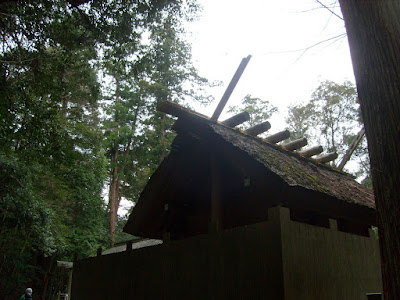
As we rejoined the main pathway and entered a wooded area, I could tell there was something on Toshiro's mind - his talkative self so evident for the brief period I had met him had gone and nothing I could say would get much of a response.
Then he turned to me and asked me if I was married.
Quickly hiding my shock, I explained that I wasn't but that there was a Ms Plants back home, to which he looked rather disappointed and seemed to lose interest in his tourism job. As we started to hit the crowds near the central section, he bade me farewell and said he would wait for me there once I had been to the shrine. Taking the opportunity to split while I could, I bowed and disappeared into the melee.
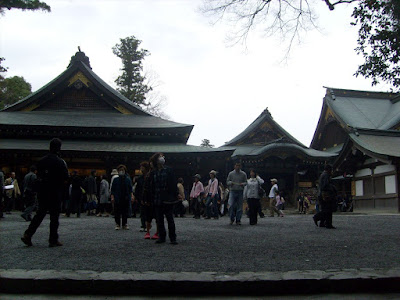
I moved with a sense of relief away from the situation and with the flow of people past the trinket shops on the periphery and through the woodland trail to the Kotaijingu Shrine entrance which stood at the top of a long stepped area. The entrance itself punctured a high wooden fence you could not see through, bar the little bit you could see between the crowds who both entered the sanctum and exited shortly athrough it. I was at the bottom, and the line of people ahead of me must have numbered a few hundred. Surprisingly, quite a few western faces were dotted here and there, mostly groups of young travelers who had, like me come to see what all the fuss was about.
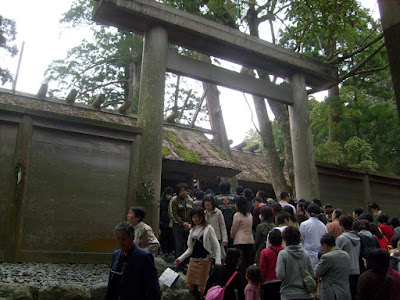
Maybe it was the length of the crowd, or how fast it wasn't traveling, or perhaps just the shouting that was coming from my feet to find a place to sit, but the prospect of going into the shrine was becoming less attractive by the second, and eventually I decided to move on. Moving forward at the side of the queue, and trying not to make eye contact with those people who guessed I was pushing in, I made it to the front and joined the slightly more fluid outgoing queue as it made its way to the left and rejoined the main area. Reluctant to bump into Toshiro again, I took a right up another trail which took me past an open area behind the shrines which would probably have had performances taking place in it had I been there at a different point, but it allowed me to see some of the tops of the golden grand shrine buildings from a distance.

The trail eventually brought me out at the trinket shops, and like a statue in the middle of the crowds, Toshiro was there waiting for me. It was pretty clear I had not gone into the shrine itself, and he had masked his disappointment with a smile and a wave before he turned and left to play matchmaker with some other poor guy. I chalked that down to good fortune.
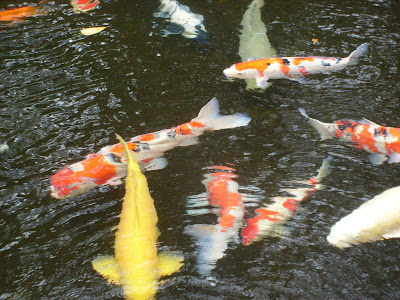
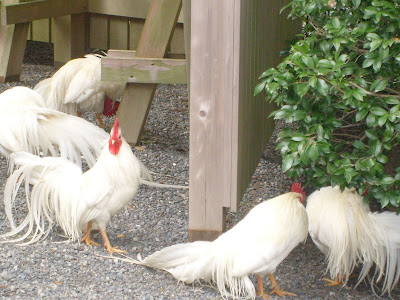
Since time was a little short, I stuck a nose into the souvineer shops, then headed towards the exit, pausing for a little while at a koi pond flanked by more cockerels that I had nearly missed on the way in. I then went back over the bridge and instead of passing through the sea of bikes, headed up the very busy Okage Street, a narrow road flanked with shops and eateries that follows a sweeping left curve into a market area. Grabbing a Kushikatsu (A battered... something on a stick - seemed to include cheese) from a stall for sustenance, I headed out to the roadside and found myself a bus stop.

The map that I had picked up part way round pointed to a cluster of museum buildings not too far away, and by taking the Chokokan bus from Ise-shi I would be able to go see them en route. By now it was 2 in the afternoon, so time was starting to become tight, but I went for it anyway. Getting off at the stop outside the museum area (and passing under the biggest Torii I had ever seen), there were two signposts, neither of which were in English. One pointed along a road that winded upwards to some sort of manor house, while the other one headed down a woodland trail. In hindsight, the clues were there, but downhill probably sounded better than uphill at the time so I took the wrong one and ended up on a leisurely stroll that turned into a hurried backtrack a mile or so along.
The main building looked very western in construction, and it and the surrounding grounds could have come straight out of an episode of To the Manor Born. The grounds in total contained 3 museums, but I decided there was only time for one, so I chose the main one - the Jingu Chokokan Museum.
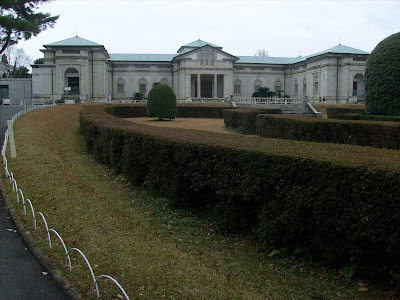
Once more, the no-camera signs were up in ernest, and plenty of museum guards were present so no pictures unfortunately. The museum was dedicated to a selection of ancient clothing, statues and other religious artifacts from the Meiji and Showa eras of Japan, at which point, they had been moved from the shrines as they were being rebuilt. It was all quite dark inside, relying only on what little ambient light could make it through that far and some fancy back lighting from the exhibits themselves.

Leaving the museum, I trotted back down the driveway to the bus-stop just as the next bus arrived. By mustering 'sumimasen, Ise-eki?' and getting a nod, I was relieved to see it went to the station and so hopped aboard. Just hitting 3pm, the next train left at 3.07 with the next one an hour away. I rushed to the lockers, picked up my big bag and just about got onto the train before it left for Nagoya once more.
Nagoya's familiarity was almost welcome as I passed through to the outgoing station to Kyoto. Ise was quite an intimidating place, not just because of the Toshiro's of the world trying to hitch up their daughters with potential suitors, but because it was off the beaten track, which meant no English, few people understanding English, and lots of bus routes that might not take you where you want to go. This handy PDF shows the layout of Ise and I wish I'd had it with me at the time.
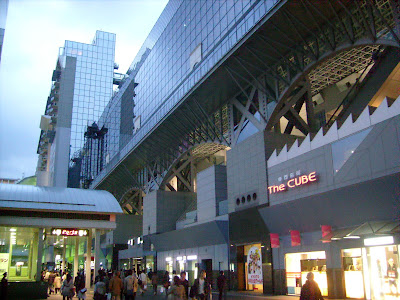
The station bigness continued when I got to Kyoto - a huge black-windowed monster of a building rising perhaps 30 storeys high. The station levels themselves are a few levels up, and are accessed either side of the structure via long, steep escalators. On the levels below and to the side were the now-familiar department stores and shops, and the whole thing fit together like a giant block puzzle. First stop - find the hotel. Fortunately, the Apa Hotel was just down the road to the left of the station, and considering the location and size of the thing, was pretty cheap (7700 yen - about £38) per night. Very plush, and with some useful 100yen/10min internet kiosks downstairs, I reckoned I'd done pretty well for myself. I even got some paper cranes left at my bedside.

I'd over-compensated with getting out of Ise, and this left me with a little bit of time left in the day. It was 5pm, and there was only one place to go - Osamu Tezuka World. For those who don't know, Tezuka is the granddaddy of both manga and anime, best known for the long-running childrens series Astro Boy (otherwise known as the Mighty Atom) and Kimba the White Lion/Jungle Emperor Leo, which has often been cited as the inspiration (some would say more than that) for Disney's The Lion King), but was also responsible for a great many other characters both in manga, anime and live action form (such as the unofficial surgeon Black Jack anime, and the gritty, sometimes sexual Buddha manga), showed that he was more than a childrens storyteller. Also, its location was ideal - actually in the station building itself, and would just remain open long enough for a decent visit.
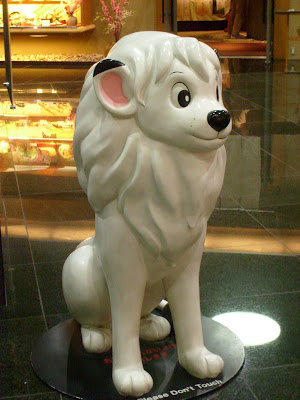
Now free of both backpacks, I trotted light-footedly back to the station entrance where I had seen a statue of Astro Boy, which thanks to several such characters, pointing, flying or walking in the general direction, was not hard to find. Inside the plush building was an open-plan sort of affair, consisting of a few life-size models, the predictable souvineer shop, and a film room which opened every so often and showed a cross-section of the films. Since that was about it, I decided to bide my time in the shop for a little while until the next screening. The shop was predictably stuffed with all sorts of tat, such as Astro Boy cups and keychains, BlackJack cards and various sweet tins with an obscure Tezuka character on them, but also one or two things that would have been more worthy of purchase: DVD boxsets of some of the more obscure works (unfortunately English not catered for) and some artbooks, including one particularly thick one chronicling his entire works, a dogeared copy left for people to leaf through.
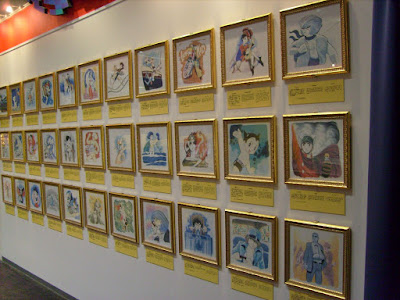
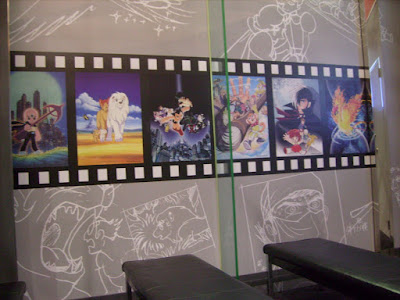
Heading back to the cinema section in time for the final screening of the day, I was surprised to find no queue whatsoever inside, and was ushered into a small room containing comfy backless seats and papered with mock-filmstrips. At the front was a large flat screen monitor, which after a short while boomed into life. First up was (predictably) a 20 minute section of an Astro Boy film, followed by some of his live action work, and ending with one of his more mature works, a realistically depicted period piece about a samurai swordsman in the midst of a burning town fighting against his enemies. For its age, it was very fluid animation, and though the clip was only about 10 minutes, demonstrated the range of the artist.
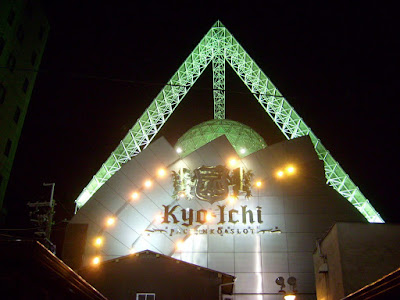
I left, and consulting my trusty book, decided to scout out a free internet cafe that was listed at the other side of the station. Heading through and out to the other side where it was much quieter, I headed through the car park and over the road to Shiokoji-Dori, the street it should have been on. After considerable searching I could not find it, only a Tops Cafe. However the robbing baskets charged a fortune to stop there (200yen membership, then 120yen for 15 mins!) so I made it brief. To round off the day, I went into a nearby fast food joint, this one serving cheap, quick Japanese food in a McDonalds stylee. I opted (read: pointed at) a bowl of pork with rice and spices (I believe it was Tonkatsu), with some green tea to finish with. Despite not using chopsticks for several years, some of it did go in my mouth and it was pretty good.
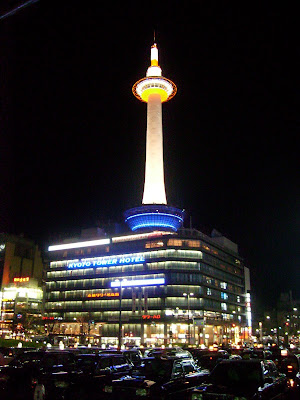
By the time I had finished my meal, it was late into the night, I was tired, my tum was still doing somersaults, and tomorrow would be a big day: I was in the shrine capital of Japan, and I was going to see them all, so I ambled back to my hotel for some much needed sleep.