Waking in Kyoto, there was really only two things I could do. One was to visit a load of temples, since this is the city of a thousand or so of them, and the other, since I was starting out in the
Gion district, would be to see if I could find - and snap without them hitting me - a real-life and rarely occurring Geisha. Japanese women still consider this status to be highly worthy of respect, enough for them to come from miles around to learn the intricate rules and traditions, and to be subjected to a massive amount of make-up, tightly fitted garments and a fair degree of discomfort. However, it's highly unlikely that you see them parading up and down - even in Gion, which is the Geisha district - firstly because it's pretty difficult to walk when in the full get-up, and secondly, because you'll get gawpers like me sticking cameras in their faces at every turn.
So while in Kyoto I would tread the manicured boards of a few temples (a
handy guide) and keep my eyes out on the streets, until it came to the time to head north-east to Matsumoto where I would be settling down for the night.
Preparing for the limited time, I was out before 8am and on my way. I'd do a trot around Kyoto and then pick up my things before the 11am checkout time. First stop - because it was quite near - was to pop to
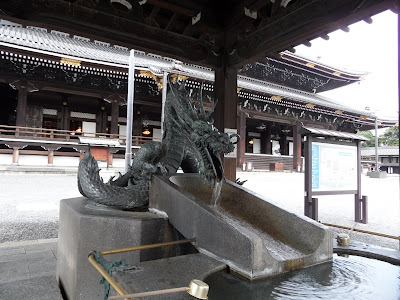
Hongan-Ji.
This massive temple complex had been
partly covered two years earlier as it was being repaired; surely by now it would be completely open again. Sadly no, instead of the
right building being covered by an outer structure, the left side - the
Amida-dō - was now being restored. A quick peek through the windows of the larger Mie-dō structure - one of the largest wooden structures in Japan revealed a Buddhist ceremony taking place, so I left quietly.
I rejoined Kiyomizu-dori and then Gojo-dori, the road I had travelled along the previous night.
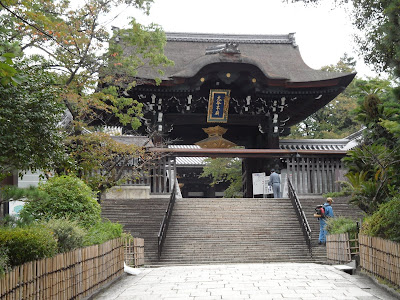
At the end was a large and unwieldy intersection, with cars and trucks negotiating several directions of traffic at once. Behind the overpass was the entrance to a quiet little temple. Across a pleasant bridge I was suddenly out of the city and into the calm. This was the Nishi-Otani Mausoleum, a relatively small but picturesque
gathering of buildings at the base of the hill as it rose up to the main event. I sat and had my rice triangle (which unfortunately was full of fish eggs) on the steps and had a pad around while it was quiet, and then headed out to the main trail.
The gardens exited onto an unassuming back road that had a sign for the
Kiyomizu temple, one of the most prominent temples in the city.
The road became steeper, and the tourists increased in number, several times during my ascent I had to abandon the climb and half-ambush the nearest tourist shop (of which there were many) as another car tried to squeeze its way up the increasingly narrow road. Fan and parasol shops were conspicuous in number on the way up, every second or third outlet full of them. No half measures either; some of the fans were particularly beautiful and large enough to give someone a good enough whap round the head, should you want to.
 |
 |  |
 |
Eventually, I made it through the commerce assault course and the view opened out to reveal the garish red of the Niomon gate that guards the entrance to the Kyomizu temple. And it was popular too. Even at about 9.30 on a Sunday, most of Kyoto had risen from their beds to come out and make sure it was still there. The trail heads still upwards past beautiful pagodas and ancient buildings, graveyards and large tracts of unspoilt wilderness. No camera signs are dotted about the place, but no-one was taking any notice of them, so I took a couple of sneaky pics too.
 |
 |
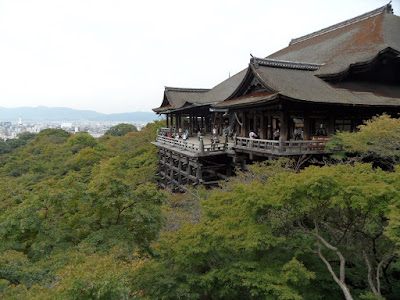
At the summit is the temple. The views up until now were free, but just as things start to level out, there's a ticket booth to negotiate before going any further. Time would be a bit tight, but I paid my 300yen and went in. Alternating between covered and exposed areas, the wooden gangway works around the main temple for a while and then down into the valley below for a walk through the forest, before surfacing at the Taisan-ji temple at the other side.
Taking the high path, the view becomes instantly recognisable. Kiyomizu looks out over Kyoto nesting in a beautiful tree canopy, the bustle of the city seemingly miles away. It's an
iconic view that has graced many a Japanese tourist brochure.
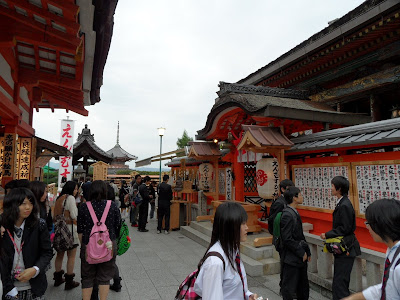
After spending a little time admiring the views, I headed back between the popular buildings behind the temple. Temples melded with shops, and were all painted in the iconic garish red and white that typified the Buddhist and Shinto buildings throughout the country. They seemed of particular interest to the teens in the group, who had detached from any parents and buzzed around excitedly in pairs taking pictures of each other and chatting. It seemed that the spirits that inhabited the temples helped with the course of young love.
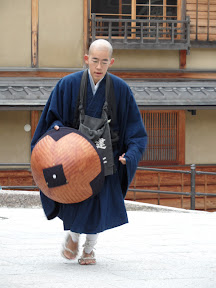
Heading back, I noticed a pagoda sticking out of the residential houses from the top of one of the side streets. It wouldn't be a large detour and it was still a little early, so I headed towards it. The streets quietened off from tourist traffic and became calm and silent, I could almost hear them sigh with relief in the morning sun. I arrived at the pagoda to see a train of Buddhist monks trotting quickly by, followed by some other men
dragging large rickshaws behind them. They passed without comment or incident.
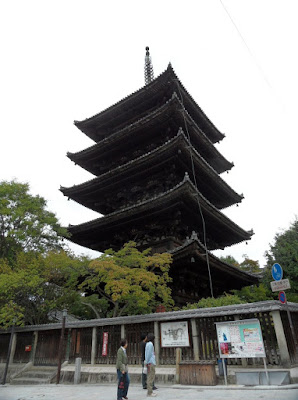
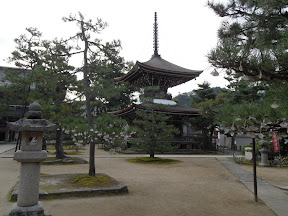
The five storey
Yasaka pagoda was a landmark for the Hokanji temple. It was clearly showing it's age and was playing second fiddle to Kiyomizu, which looked in peak condition. But this one felt more like it was in daily use by the Gion district people, rather than as a constantly tarted-up tourist spectacle, and thus was more satisfying.
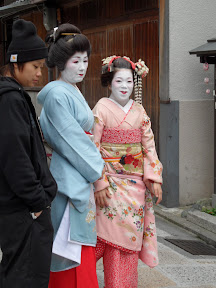
Heading back down the paved road, at around the same time I had forgotten that I was looking for any, I happened upon.. a pair of Geisha! They were just outside the entrance to a small Buddhist shrine, and were posing happily for pictures with a professional looking cameraman, and when one of them gave me a cheeky wink as I raised my own camera - well I could hardly turn them down.
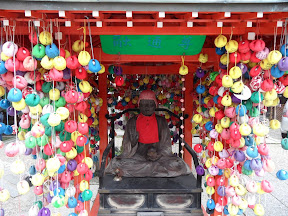
I took a quick look in the shrine courtyard. A small Buddha statue was sat in a little shrine, decorated to excess with little squidgy balls of all different colours. I chuckled at the thought of the Archbishop of Canterbury plonking himself in a similar structure to 'connect with the people' and not look like a wal. Somehow, Buddha was managing to pull it off where more pompous religious icons might struggle.
I popped a couple of coins in the box, waggled the rope and clapped my hands, and then left, saying goodbye to the Geisha girls who were still being photographed. The road came back out at Higashi-dori, so I followed it back the same way as the night before and ended up back at the Hana hostel.
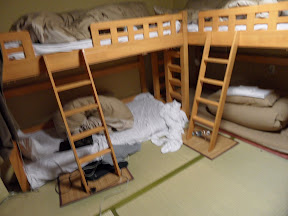
Hotel Review: Kyoto Hana Hostel (2800 yen/night, 1 night)Described as a hybrid between a Ryokan and a Hostel (although it just looked like a hostel to me) this was pretty easy to find and right in the centre of Kyoto. The staff are friendly and speak pretty good English and the rooms are cheap, clean and plentiful, although you do have to sleep 4-6 to a room and the price can mount up depending on what you use while you are there. 1000yen key deposit, wash/dry clothes 300yen, towels 300yen, internet 100yen/30min
7.5/10 Because it was close to check-out time, I sorted that out and after a bit of internetting (which gave me a bit of time to recharge the camera) I left for the station. Looking at the timetables, the trains to Matsumoto left hourly at quarter past, passing through Nagoya. The next train was due in about an hour as I had just missed it, so I got hold of the ticket, and then decided to - in the absence of a spare locker to stick my stuff into - have an explore of the industrial cavern that was the breathtaking
Kyoto station.
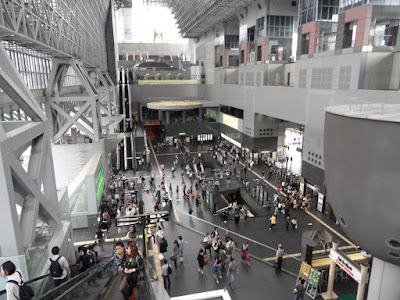
It has an unusual structure, a particularly modern looking build for such a traditional city; aside from the labyrinth of paths and walkways beyond the ticket barriers, the main feature is a sprawling main hallway with the roof a hundred or so feet above; a subterranean maze of shops below and around it. The main concourse has a cathedral feel, the light and airy greenhouse structure using tinted glass to give it as open air a feel as possible.
Over to each side as you come through the entrance are stairways, the one to the right in particular seems to carry on up into the heavens, which fortunately when you have a heavy backpack on, also includes an escalator. Having never been up it before, I decided to take a look after getting myself a sarnie at the Vie de France below (no the coupon didn't work).
At the top is a simple
rooftop garden (although it's more concrete than plant), with a few viewing windows to look out onto the Kyoto cityscape below, to give you an idea of the prevalence of temples and monuments. A detailed map to the side highlighted many dozens of such places for the tourists. A cool wind refreshed me as I downed my food, and I mused at a curious glass tunnel suspended high in the rafters, not very noticeable on the ground, but now was just a few feet below my line of view.
The entrance to the tunnel wasn't obvious but through some trail and error I managed to find my way in. Descending one of the escalators to 10F, there was a door into a fast food restaurant, at the end of which was a set of doors that led onto the 'Sky Ramp'.
Not seeing any signs to suggest a fee to pay, I headed in. Beyond was a glass and metal walkway that maintained the lofty view of the city below. The top of the station curved above us and a light stream of similarly minded people passed by, alternately admiring the view and studying the accompanying information boards on the opposite wall. Occasionally, the narrow pathway opened up and allowed you to get closer to the outer glass structure, and also
look directly down into the concourse many feet below, which puts a lump in the throat.
At the other end, a set of escalators started to bring me back down towards ground level. To the side was a similar open communal area strangely bereft of people, with one end cordoned off by partition walls which seemed to house a show area. At the time, a film club of sorts was gathering, with many
posters and leaflets on the walls and a couple of studenty-types sat behind a desk chatting with some interested punters.
The train was due shortly, so I made my way back down the remaining escalators and back into the crowds, heading for platform twelve where my train was waiting. The journey required two stops, changing at
Nagoya, so I would be travelling between the second largest station in Japan, and the
largest. Once in Nagoya, I had about 20 minutes between trains, so the best I could do was head to the flower garden from before (which was now filled with
trees covered in fairy lights which probably looked better at night), and peer over out to the familiar city below. I managed to find the next platform in amongst the huge building with reassuring ease and carried on my way.
Nagoyas' concrete outer limits were left behind and were replaced by forested hills through which a river had worn out a deep gash through the middle of a valley, besides which many communities were existing comfortably. After a short while, I realised that I was taking the same mountainous route as I had on
my trip to Narai last time, so enjoyed the pleasant views of the valleys once more, although the more massive boulders carried down from the mountains that I had managed to miss with my camera lens the first time, had managed to evade me once more.
Arriving around 4pm into a quite rainy Matsumoto, I was immediately very aware of the chill in the air brought about by having travelled further north, and landing right in the mountains. The clouds overhead were grey and wintry, and it was clear that I had passed through the receding summer weather which was now heading further south with every passing day. Taking a map from the tourist booth in the station and comparing it with the contents of the book, there was not an awful lot of things that I could see before the cutoff-time of 5pm when pretty much everything touristy shuts it's doors (especially at this time of year). The only place that sounded plausible and in the vicinity was the
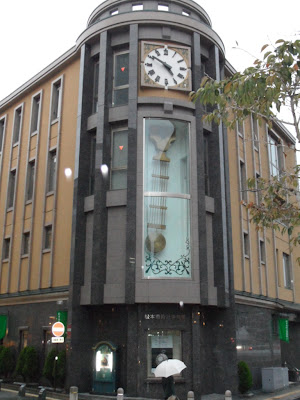
Matsumoto Timepiece Museum, a small building off the main streets that apparently had the largest working pendulum in the world in it. I must confess a clock museum didn't exactly cause my trousers to combust with excitement, it was better than nothing.
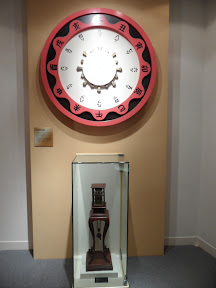
The rain started to beat down heavier anyway, so when I eventually found the museum, it had come as a relief. Inside, I clumsily untangled myself from a mixture of backpacks, soggy maps and an umbrella and asked the woman behind the desk for a ticket and if she would take care of my various things while I had a look. As you would expect from the time, season and weather, the museum was pretty empty. Split over three floors, the museum started with a large, flashy circular room with lots of coloured walls and rolling video footage to get people in the mood for the rest of the place. A
spiral staircase took me up to the second floor, which was much more in the vein of your standard museum;
several exhibits on plinths and a load more inside glass cabinets. Generally the contents exhibited the technological leaps of classical (pre-electronic) Japanese timekeeping technology, and strangely included some records and gramophones, which I suspect may have been there to make up the numbers. It was quite interesting (boosted by the fact it was all dual-language), although I must confess I was getting a bit bored ten minutes in, especially as I hadn't seen this massive pendulum.
Heading back out to pick up my things, I asked about the missing highlight, to which the woman smiled and pointed outside into the continuing rain. I looked at the clock, it was nearly closing time, and the skeleton staff were making various paper shuffling and tidying up movements as to suggest I should be making my way, so I reattached my backpack and followed the lady's finger.
Sure enough, the outside of the building sported the clock in question. A large-faced analogue with a 20-foot pendulum swinging slowly back and forth. Whether or not it had any bearing on the actual timekeeping was another matter, I could not hear the expected low klunking of gears you would expect to hear from such a large structure.
Anyway, the museum was nicely placed to get me onto the landmark I would use to find my stopover for the night. The river through Matsumoto crossed east-west under the main street north from the station, and at the east side, curved northwards towards the outskirts. Down the east side of the river was a small back road which, at some distance not discernible from the map I had, was my hotel. The instructions that I had received from the booking suggested I take the bus from the station, which would stop somewhere close. However, rather stupidly I decided since I was already close to the river and all I had to do was follow it, what would be the harm in just walking there. Ten or twenty minutes journey tops, through the rain, with a heavy backpack.
 |
I was going to find out. The journey was initially not too bad, I got onto the right hand side of the riverbank, where there was a pleasant enough road that followed it quite closely. Shops and temples were set off to the sides and across the river, and even that was quite picturesque, a wide, shallow basin designed to hold a much larger flow of water should it be needed, which for the moment had only a relative trickle snaking down it's middle, around reed beds and clusters of large rocks.
A little way on I happened upon
Frog Street, a locally famous market street running parallel to the river with a froggy theme. A large statue at one end depicted several frogs going at each other with swords, on top of another frog that didn't look too happy about it. Unfortunately all the shops had closed by this point, but it looked like a nice place to stop off tomorrow if I had time.
I rejoined the road, and by now it was getting darker. My camera had just about died, and the rain was getting heavier. Finally the river started to bend to the north, which meant I was about a third over with the travelling. Frankly I couldn't be sure which direction the bus route was in by this point as I had lost my bearings, so I just had to trust in the river.
The evening drew in. I was on the lookout on the road for a blue sign, which was pretty much all I had to go on. It was too dark now to be able to compare the Kanji on the now soggy printout with that of the sign, so blue was all I had to go on, unless I was lucky enough for the owners to have put up an English sign.
I had been walking through increasing rain and decreasing visibility for about 45 minutes when I happened on a young woman going home on her bike. I guessed that a large, flustered and soggy yorkshireman suddenly coming up to her out of the night and talking English may cause her to run for the hills but to her credit she listened to my plight and tried her best to give me some direction. When we didn't come up trumps on the name of the hotel (she thankfully had a smattering of English) she guided me to a nearby convenience store, where she talked intently with her friend behind the counter as they attempted to decipher the soggy and almost unreadable map. Eventually they pointed me pretty much back in the direction I was headed. I thanked them all and carried on my way - at least I was now reassured I was going in the right direction.
At around the hour mark, a small blue sign (one of many discounted small blue signs by that point) emerged out of the darkness. My backpack straps were digging deep into my shoulders and my legs and feet were aching badly, but I took what last ounces of energy I could and headed to the door. There was indeed an English sign at the entrance, which removed the last of my doubts this was the right place, especially under that, was my name!
The kindly woman surveyed her new visitor. To my intense relief, she spoke perfect English, and after some puzzled questions about why I just didn't take the bus (quite rightly suggesting I was being a silly sod) she took my details and helped me to my room with my things, and offered to take me to the station the following morning, which I immediately accepted, figuring I could take my bags and leave them there, and then head into town and see the sights.
Bedraggled, I stood in the small but pleasant room, which was a very welcome sight. I changed my wet clothes and laid down for a while on the futon, reading the photocopied guides that the owners had made for English-speaking visitors. One detailed the things to do in Matsumoto, while the other highlighted the places to eat that were near the hotel. Feeling the rumble of hunger I concentrated on the second one, and after a bit of a rest, headed back out with my umbrella.
The rain had eased slightly, and I joined the main road on which the buses travelled. I knew this as just as I turned onto the road, there was one such bus at a stop no more than fifty yards from the hotel. Bugger.
My first choice of eatery was very much closed, so I took the next choice up the road somewhat, the Oniyan Ramen restaurant, a traditional place in an old-fashioned wooden building, with a sliding door entrance and a care-worn interior, packed with people slurping away at their food. I asked for some pork ramen, and was given a choice of soy, miso or salt style ramen (I went with soy) and then plonked myself down at the bar, one of the few seats left unattended. Several chefs from different generations busied themselves in the steamy kitchen area just beyond, and soon a huge bowl of ramen, beansprouts and cabbage came out, with small strips of pork in for good measure. It was very welcome on a cold evening and pretty cheap at 680yen.
I noticed from the map there was a 7/11 nearby, so got out a few more yen from the cash machine, and then - rather greedily but because my stomach was still growling - I headed back down the road I had just come up and went through the sliding doors of '
rugger alice', another highly recommended place that specialised in omelettes. I rationalised my greed by arguing with myself that I wouldn't be able to try these restaurants tomorrow as I'd be off in the afternoon and they only opened at night.
Not sure quite what I had chosen, and quietly bemoaning the lack of a rugby theme, I was presented with a reassuringly safe choice of ham and cheese omelette with a large splat of tomato-ish sauce on top. It was pretty good and filled up the corners that the ramen didn't for 1050yen.
The rain had stopped by the time I was ready to waddle home, so I took a slow walk back, checked my email, and went to bed.