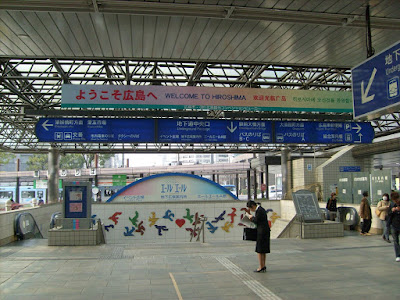
After the relatively sedate pace of yesterdays walk around Hiroshima, I felt refreshed, although now the fog had lifted on my bodily state, it was clear I had picked up a cold from somewhere. Not good for the upcoming task. I started out by getting to the local JTB to sort out a few more places to stay, but it wouldn't open until half past ten. I sat in the bakery/cafe at the entrance to the railway station munching on some pastries for breakfast and pondered whether to wait two hours or get going. In the end I decided that two hours were not to be squandered today, and I would risk trying to find the JTB in Matsuyama tomorrow.
My first destination today was the summit of Mount Misen, the mountain on the island of Itsukushima, commonly known as Miyajima (shrine island).
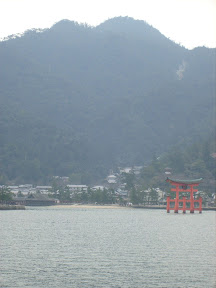 Japan is known for three beautiful views, of which this island is one. I'd narrowly missed one of them as I'd passed Sendai, so I wasn't going to let this one get by me, regardless of my personal state. Once I'd made the summit, I'd cross onto Shikoku island to get to my hotel in Matsuyama and get down for the night. Given the amount of distance to cover, it was clear I couldn't be hanging around, every second counted today.
I got back to the hotel and checked out. Taking a final look at my emails, K's Backpack Hostel at Mt. Fuji had got back to me with directions from Nagoya (near to Osaka, one of my upcoming stops), so I noted them down. K's was the only place I had pre-booked before coming, and it was a bit of a mystery how I was going to get there from just looking at Google Maps. Now everything had been made clear.
I went through the subway with a feeling of clarity in my head and hopped onto a #5 tram. We clattered merrily through the slowly swelling lines of traffic, past the stops for the peace memorials and on towards the port. However something felt wrong. I checked my book to be sure. Hiroshima has two ports - the main one that serves ferries from Shikoku and beyond, and a separate one down the coast that handles ferries to and from Miyajima.
I was on the tram heading to the former, not the latter. Checking the coloured charts above me I got off at the next intersecting stop and switched to a #3, which took me most of the way there and then a #5 again (this time in the correct direction) for the final section. I had lost a half hour already.
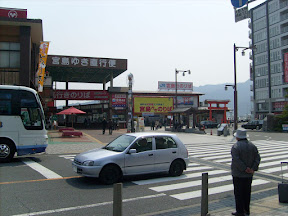 Miyajima-guchi, where the ferry port is located, is full of signposts and mock O-torii's advertising the place in typical excited cheesy style.
  This was deliberate, since no such things are allowed on the island to keep its traditional look so they were making the most of their last chance. I stuffed my large backpack into one of the available lockers and then hurried aboard an outgoing ferry that was just on its way. The ferries are actually owned by Japan Rail, which means the rail pass was valid for them and I travelled for free.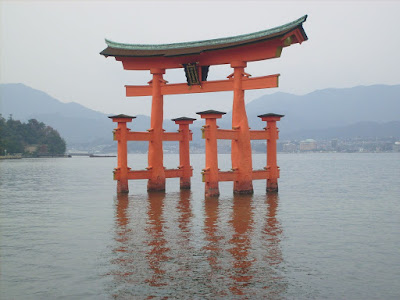
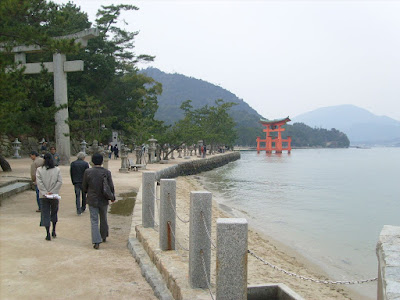
The seas were calm and the ferry glided its way out of the port. It wasn't long before the slight mists lifted and Mt Misen emerged. From mid-distance, it looked quite imposing, and I was beginning to doubt my ability to get to the top, but I would give it my best shot. As the ferry got closer, the O-Torii, one of the major attractions became distinct from the island. A huge Torii gate, bright scarlet red, built out of the sea a few hundred yards from the shore. The Torii gate acts as a presentation to the Itsukushima Shrine, a building sat square with the torii on the shore.
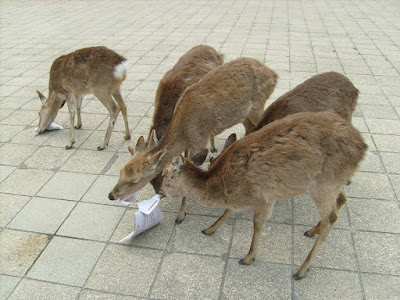
Once I'd got off and made my way through the crowds to the welcoming plaza, I got myself a hot chocolate and a bottle of water, and was about to head out when I came across some well-known inhabitants of the island. Very tame, very curious deer. I had been warned about these - they look harmless, but if you take your eyes off them you are in trouble. I saw a good example of this when one woman, taking pictures of the Torii forgot about the map hanging out of her back pocket. One deer pounced, then several others swarmed, knowing full well that their sacred status meant no-one would touch them for it. I decided to zip up my pockets and move quickly on.
Checking the welcome map, I decided to look around some of the artefacts available in the shopping district. They were clearly souvineer shops, though their looks had to be tempered to keep them in line with what the authorities considered 'tasteful'. This was a good thing, as it encouraged less plastic trinket makers and more wood carvers, fabric makers and the like to show off their wares. Working my way through the streets, which were peppered with deer going about their business as if the humans didn't exist, it was a very backyard affair. All the lower streets had become a mix of traditional Japanese houses mixed with an open ground floor containing goods. One in particular contained massive wood carvings of gods and deity's, made more special knowing that the wood had to be imported from the mainland, since no trees could be cut down on the sacred island.

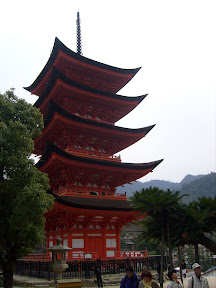 There were also a few other Shinto structures to look around while at the base of the mountain, and curious looking stairways and paths led to the beautiful 5-tier scarlet pagoda that is visible as you head to the island, as well as a couple of very old and wind-weathered temples which I must confess I spent a little longer inspecting than was necessary - the mountain behind them was rather large.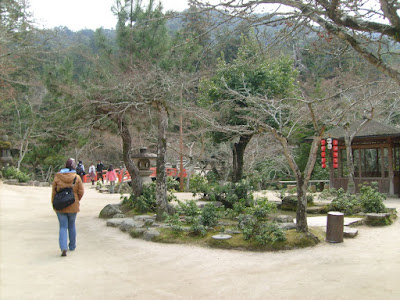
It was time to make a start, so I headed upwards. There are three trail options to take if you want to climb Mt Misen; the longer, shallower incline through Momiji-dani Park
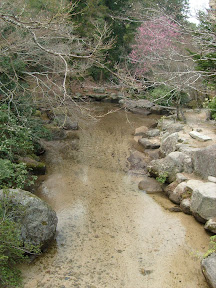 (and optionally take the ropeway to get you part way to the top), the Daishoin course, which at the time had been closed, and the shorter but steeper Omoto course. I decided to give myself the best shot at things and took the Momiji-dani course, figuring I could use the walkway if I was flagging. As the beautiful forest began to dominate my view, the wide smooth pathways and picnic areas petered out and were replaced with trails with gorgeous bridges over crystal clear waters. Heading higher, the trail steepened, and I came across more deer, though these were more wary of humans, probably not part of the group that regularly eat maps near the shore. I arrived at the ropeway but I felt as if I could make it, and besides, it cost money and I'm a tightarse, so I carried on on foot.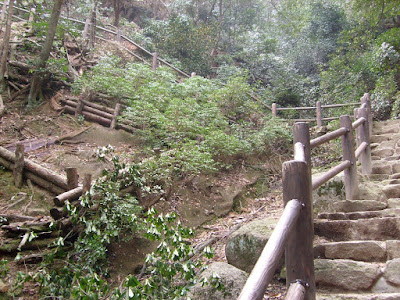
The trail got steeper and narrower, but it was at least pretty clear where to go. There were plenty of signs dotted about, along with 0.1km markers showing how much you had done and how much there was to go. At some points, the trail got so steep that they put rails up, and in others it was clear just how ancient the trail was, with well-worn steps threatening to bust an ankle at any moment.
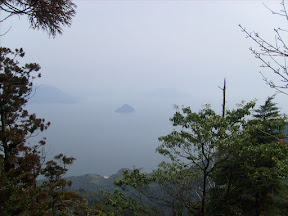 At the 2km mark, (and after several rests, the cold being sweated out of me) just as I thought it couldn't go up much further, the forest opened up suddenly and I was on flat, sandy ground. I looked around to see my first glances of the celebrated views, and I had another third of a kilometer to go. After pausing for breath I carried on up along with some other sightseers and after a while came to a pair of Shinto shrines, near but not at the summit on a flat piece of land surrounded by large boulders. Both structures were achievements in themselves, being not a trivial task to cut and lug trees from other islands all the way to the top. The Misen Hondo Main Hall was full of golden ornaments and plush, shinto-red decoration. The other, the Reika-do Eternal Fire Hall was smaller and contained several lit candles, which you could add to for a nominal price.
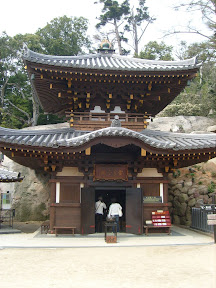 Sat between them rather uncomfortably was an empty hut, besides which was a fragile little cabinet containing bottled drinks, and an honesty box. The box was full of coins and notes, and no-one was around to oversee whether people actually paid (or snaffled off with the cash). It may have been the intimidatory nature of the shrines and the sacredness of the island that did it, but it was so refreshing to see the trust that was placed in the holidaymakers, and seeing it returned so positively. If this were the UK, the cash would be nicked, the drinks cabinet emptied and kicked over, and someone would have rolled one of the large boulders down the hill for a laff.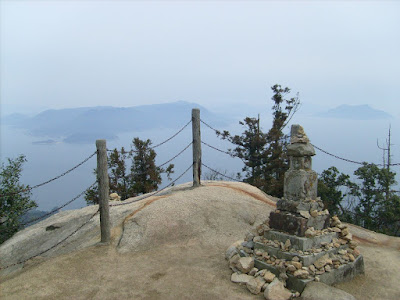

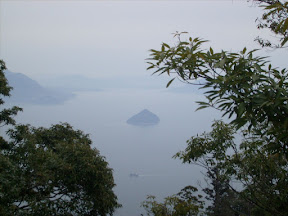
Carrying on up the steps, I passed Sankido Hall, some massive rocks, and a reminder that these mountain things are finite and a bit dangerous, before eventually reached the summit, where you could see everything and for miles. Amazingly, and disappointingly, someone had decided to stick a building at the top; the Misen Observatory, a shop with a lookout tower above it. It was looking well past its best (it seemed to be made of the same sort of materials you make greenhouses out of) and was an ugly eyesore in an otherwise completely unspoilt area. Under duress, I walked in and put myself down on a rusted chair and looked through the dirty window for five minutes to catch my breath. An old guy sat behind a counter containing another drinks cabinet stuffed with drinks that may have been there for a while. I declined.
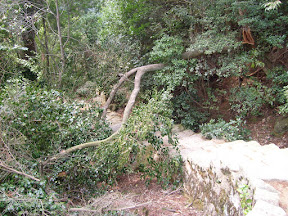 Once rested, I took the steps to the roof for a little more view taking, and then looked for my way back. Not wanting to go the same way I had come, I looked round for alternative ways, and after a while found a not very well-worn trail that headed back down. This seemed to be the Omoto course. After a little uncertain walking down a steep path (it wasn't clear at this point whether it was made by the feet of man or beast), a sign and a deserted temple helped to reassure me. A crossroads would have allowed me to take a detour to the Daishoin Course, but it had been closed due to some of it falling away.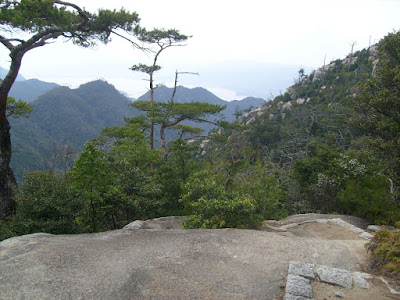
My heart sank when the downhill started to become uphill again. I was now beginning to be unappreciative of the beauty around me and was wanting to get to the bottom once more, my ferry would be leaving at 5pm and it was already after 3 o'clock. The Misen trail was moving onto the nearby summit of Mt. Komagabayashi, which was taking far too long to even out. Worse still, there was no-one to be seen for miles. I just had to trust my instincts and keep going. Now and then there were signs of life, such as a baby Shinto shrine, or a stone shrine covered in coins (I left a 1 yen piece there) which reassured me, and eventually the trail started to head downwards. Quite quickly in fact, through wooded canopies and down ancient crumbling steps which again threatened to do my ankles in even more so than coming up their cousins on the other route.
After an hour of nervous trail walking, I started to see signs of modern construction again. The trail widened and open areas sprinkled with picnic benches appeared, followed by huts and roads and eventually houses. It was all pretty nerve-racking at the time because I was completely trusting of the trail - the ancient undergrowth and no other signs meant I was unable to get my bearings relative to the shore, but looking back I wished I could have spent some time just taking in the place, it was beautiful, ancient jungle with the sort of Laputan-style overgrowth you just don't see down the local woods, and there was talk of monkeys hanging about somewhere (but I didn't see any). I recommend downloading or buying a decent trail map and taking it with you before going. I breathed a sigh of relief as I reached the shore once more near the Miyajima Aquarium, but there was no time to visit it, (the best I managed was hearing a sea-lion bark through the railings during a show). I was now running late and would have to hurry to catch the ferry which I could see was on its way from Hiroshima to the terminal.
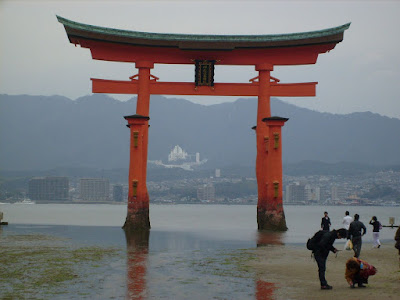
Fortunately, the tide was out, so I was able to cross over the section between the shrine and the Torii, taking the opportunity to take a picture of it close up. Several people were wading over to it to push coins into the cracks in the wood, a traditional tourist habit. I rushed back to the ferry terminal as quickly as I could and caught it just before it left at a dash before 4pm. At the other side, I got my backpack and took the train back to Hiroshima station, then the #5 tram like I did before (doh!) to Hiroshima Port.
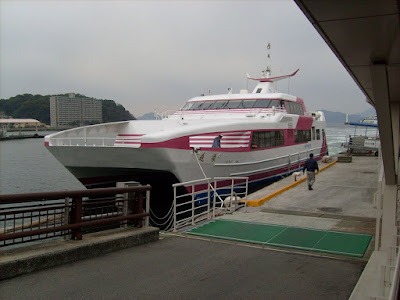
I arrived at the port at 5.15, which meant that the last of the cheaper ferries had gone. The only ones leaving now were the luxury ones at 6100 yen a pop. I could have stayed the night in a decent hotel for that! It was getting dark now, and my feet ached as we waited for the incoming passengers to disembark and my little queue to be allowed on. I slumped into the luxury seating and had some shut-eye as the engines idled.
 Eventually we set off and rounded the cape and a few more islands on the south side of Western Honshu. The journey included a few interesting sights, but was generally just water in what remained of the daylight, so I took the opportunity for some more slumber. I was finally heading back towards Tokyo, which at the time came as a psychological turning point - I was heading towards the place that would take me home (and it had to be said, at this point on the journey, that felt good).
Arriving at Matsuyama Port, I realised that I had made a little mistake. When I got the hotels booked, out of habit I had asked for one close to the train station. Unfortunately the port and the station are across town from each other, and thus my first task was to find the station and walk from there.
Immediately as I arrived, it seemed that Shikoku was different. The number of English signs dropped dramatically, and those who spoke it were rare too, as if Shikoku was often ignored by the tourism trade. Arriving outside into the rain, there was by good fortune a coach waiting outside, and asking the driver about 'Matsuyama Eki?' resulted in a nod and a smile. The coach made its way around Matsuyama in a roundabout style, and eventually the station appeared through the raindrop-blurred windows. It was then just a case of heading up the main street and to the hotel.
 As was traditional with the maps that came with the hotel reservation, someone had got feet and inches mixed up, and the relatively simple task of looking for the hotel was made more difficult than I was hoping for, despite receiving help from a couple of friendly passers by. At 7.30 in the evening I checked into the hotel that ended up being about 500yds away from where it was advertised.
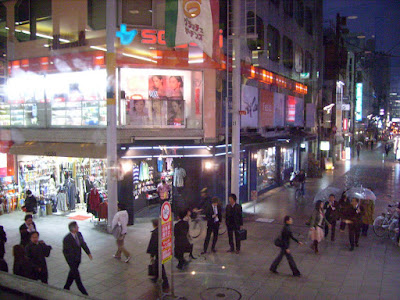
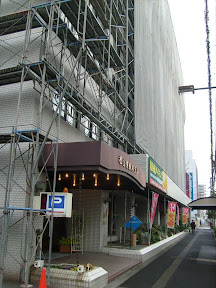 After getting my breath back, I headed over the road to a shopping arcade (sorry - 'gourmet hall'), inside which was - to my relief - an Italian restaurant called Capricossa. I was still feeling a little guilty about not trying some more regional cuisine, but since my holiday was very nearly cut short by such experiments back in Kyoto, I decided to sod it and stick with something recognisable.
Garlic bread, chicken and hot chilli/garlic and spaghetti were accompanied by ice cream with hot blueberry sauce. They even had tea - not the Japanese type of tea, but normal English tea - with milk! It cost a bit per cup, but I had two because it felt so long since I had anything close to a proper cuppa.
I waddled home tired but happy at about 9.30, wrote my diary and went to bed. A whole new island was ripe for exploration in the morning.