My first train direct to Nagoya was at 9am the following day, so after a bit of a snooze, I got up and ambled over to the station, my tum still not feeling too great. My trusty guide book mentioned a small town named Narai en route that was a famous tourist spot, partly because of its location in a beautiful valley, and its history as a 'post town' - one of 69 towns used as a stopover on the journey between Edo (Tokyo) and Kyoto in the days before the railway, but mainly down to the long main street through the centre of it, flanked on both sides by perfectly preserved Edo-period houses and shops. Since Nagano to Nagoya was quite a short hop, this sounded like a good way to spend the day.
 Getting there wasn't quite as simple as it could have been. The rapid train leaving Nagano only stopped at a handful of stations between Nagano and Nagoya, and Narai wasn't one of them. The only way to do it was get off at Shiojiri, then take a local train along the same track to Narai, then another local train when done to Kiso-Fukushima, which was the next stop along that the rapid trains stopped at and finally a quick blast along to Nagano, where I had a room booked for the night.
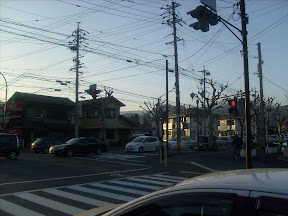
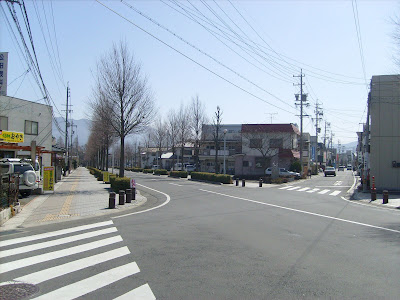
The mountain pass between Nagano and Shiojiri was as nice a view as any of the train legs I'd encountered so far, plenty of woodland and steep drops into rural areas, with the train track carefully tiptoeing its way around the rocky ledges of the hills either side. Alighting at Shiojiri, I had a half hour before the local train arrived, so I headed out to what reminded me of the freezing, deserted streets of Hokkaido, except this time, the sun was out and it was pleasantly warm. Feeling too scroogelike to dump my bags in a locker for thirty minutes, I lugged them around with me on a circuit of the nearest block.
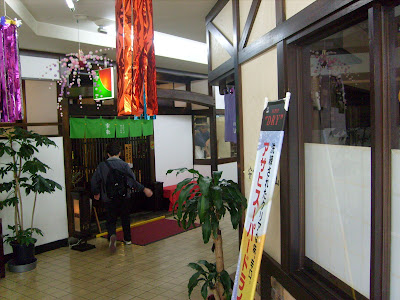 As I walked, it didn't look like your normal ghost town - everything was clean and well-maintained, but it looked as if the air-raid sirens had finished blaring just as I had stepped off the train and everyone was peeking out from their concrete bunkers waiting for the all-clear. Feeling the weight of the packing, I decided not to stray too far and rounded the nearest right hand bend to the lights outside the station. A small shopping arcade including a pastry chef making his wares in the window for precisely no-one to see held my attention for a short while until it was time to move on.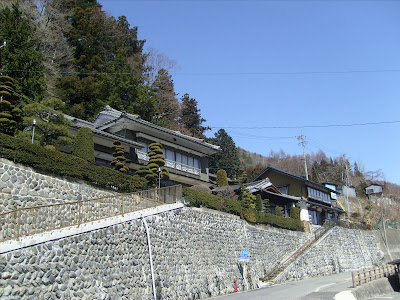
A short train ride later, through several local stops (with someone helping me find the right station once more) had me finally in Narai. The clock said 11:30, and the next train would be at 1:00, (with the one after hours away) which left a short amount of time to peruse the streets at leisure. Opposite the station (which was officially closed by Japan Rail some time ago, but was re-opened and staffed by the locals) is a giant map of the place, and while the much-lauded street was to the left, my eye was drawn to the curious pathway heading out to the right, into an area with decidedly non-traditional buildings jutting out from the steep hillside.
I headed upwards. The views event from the lower levels into the rest of the valley and beyond were beautiful, a great place to live, I'm sure, and the air was super-fresh like on a mountain-top, and after a slight accosting by an angry dog (fortunately tied to a post) the path joined a road on a shallower incline, until I hit upon the curious entrance to a Hachiman-jinja Shinto shrine. One of the many things in Japan that has captured my heart is the countryside, peppered liberally with small pathways and trails, at the end of which is usually a muted, subdued and wonderful piece of Japanese engineering or craftsmanship, usually constructed in reverence and respect to a local deity, and the nature around them. Even to a religion-weary old cynic like myself, the desire to explore these places brought back the energies I once had as a child.
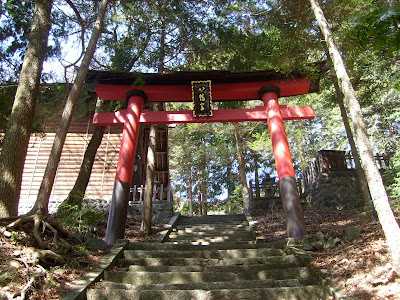
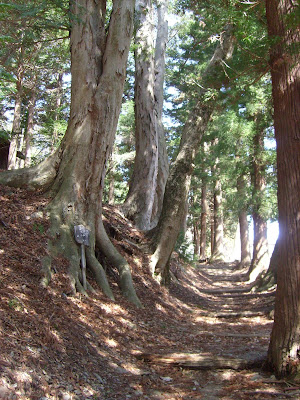 This place was no different. The pathway led to a set of steep steps, and at the top, just past a Torii gate, (angled forwards so you could see it properly as you ascended), was a large log cabin and a hidden shrine. Throwing in a few yen and doing the hand-clap was now becoming second-nature and just seemed the right thing to do regardless of there being anyone else there or not. Coming back down, a further pathway led through the pine trees to an opening, and following it brought me to an area called Narai-Juku full of small bib and clothes-wearing statues called Jizo. Following the path along, it returned me to a more modern Japan, where the tarmac returned and the uglier contemporary houses became prominent once more. Gathering my breath, I followed the winding road back to the station.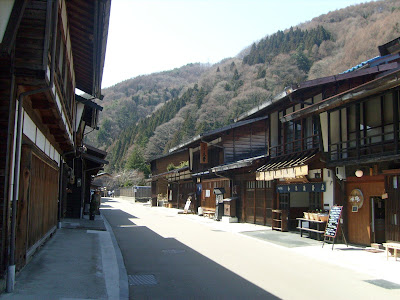
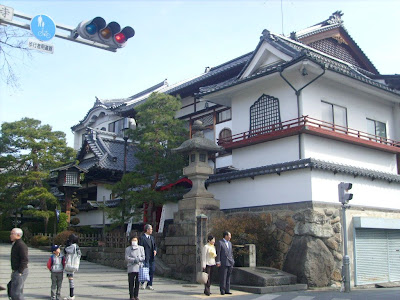
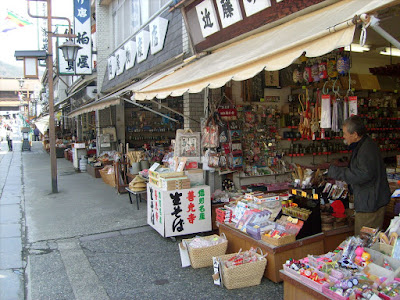
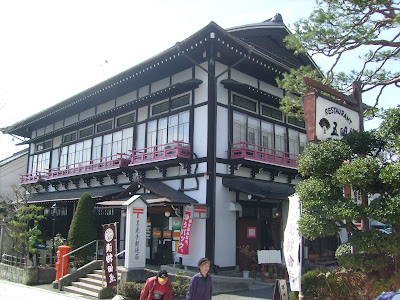
The Edo-houses must have been freshly creosoted now that winter was pretty much out of the way (bar a few drifts of stubborn snow here and there), because they had a bit of a smell about them. Sticking out directly onto the main road, (that looked out of place because someone had decided to tarmac it) they lent at obscure angles to each other and no two were the same. Some had been converted into restaurants, others were ryokan or shops (many shops) or museums to the history of the town, but most seemed to still function as houses for ordinary families. Tanuki statues were placed here and there outside some of them to greet the weary traveller.
At several points along the length of the street were signposts for a number of shrines, and various pathways heading right between the houses and up into the forested hillside above, and if time and energy would have allowed, I'd have stopped and explored a few. However there was really only time for one, so it would have to be what seemed to be the main shrine at the end.
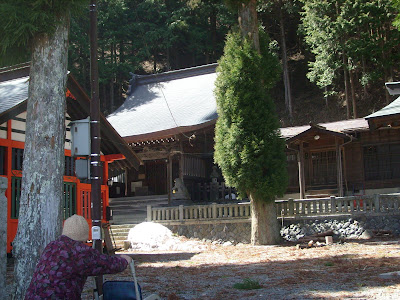
Tucked away in the woods behind a modern-looking building stood a pair of structures, both looking very old and in comparison to the buildings on the street, not very well maintained. As I got nearer, an old woman who had beaten me to it set aside her wheeled-basket-cum-zimmer and picked up a stick. She turned to smile at me and then headed slowly up the side of a small ravine that was home to a trickling stream of water. I winced and tried to call her back as she shuffled up the hill negotiating the rocks and branches along the way, until she sat herself down and started poking the stick into the soft ground around her.
 With her back to me, I couldn't tell what she was doing, but at least she had made her journey and seemed happy, so I switched focus to the shrines. Perched up the side of the steep hill and surrounded by fir trees and gravel, they looked like they were part of a central gathering place that the imposing structure in front of them had now replaced. One shrine looked newer than the other, and had a large, curved roof like a ski jump, while the other was a very basic structure, little more than a shed. Each of course had the obligatory donations box, so in went a few yen, and after a bit more hand clapping and a little sit down I moved on. The woman and her zimmer by this point, had disappeared so what she was digging for would remain a mystery.
On my return down the long road, the side roads to the right connected this side of town with a few structures at the other side of the train tracks (and the valley river), which thanks to the dozens of ancient roads criss-crossing it, had more than its fair share of level crossings.
 The main area was a car and coach park, now quite empty but would probably be pretty full during the main tourist season. One vehicle going nowhere though was yet another steam train stuck at the side of a touisty log cabin at one corner of the car park, consigned to looking bored just temptingly next to the tracks it once used to travel.
Heading back across the tracks (the car park was about the only thing over there) I headed pretty much straight back due to the time, pausing only to trot down a side road, at the end of which was a traditional Japanese Temple Bell in an open area with kids playing. It looked a bit of a private area (for quite a rich-looking household) so I left for the train.
As I boarded the train, I saw a non-Japanese guy for the first time since leaving Europe, so I sat down and we started chatting. Richard was from New Jersey and was spending some quality time setting up camp around the area, (including Narai) on a trekking holiday. As if to prove what a small world it was, when I told him about my little part of it (Yorkshire, UK) he said he had done some work teaching at Bradford University (where I had studied) and had even been to nearby Hebden Bridge and Skipton sightseeing not one month before. Quite taken aback with the worldly knowledge of the guy I was quite struck dumb for things to say (and actually found it difficult to not immediately start my sentences in Pidgeon Japanese), but got my voice back and spent a little time with him exchanging stories about the holiday so far, until Kiso-Fukushima rolled up.
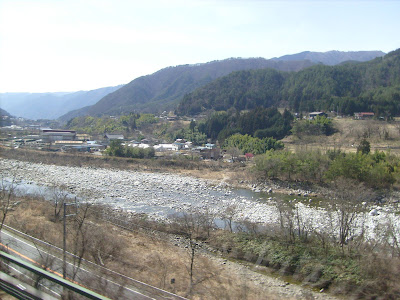
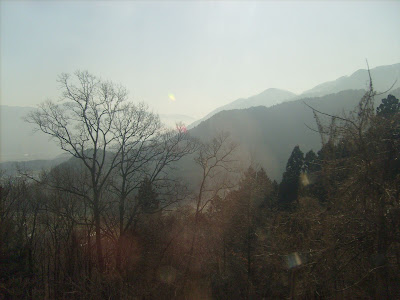
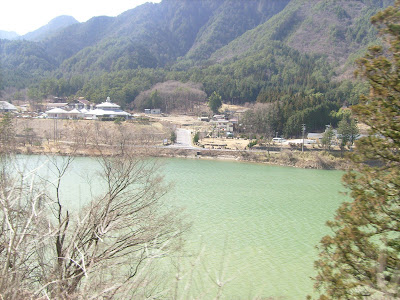
Rejoining the Nagoya train immediately as it was still in the station, I continued getting some pictures of the valley that the track descended and went on its way to Nagoya. A mixture of sunlight, batteries and a bad seat meant that unfortunately some of them didn't come out too good, but the valley itself was beautiful almost all the way into Nagoya. The track was part way up one side of a large and winding valley, covered with trees and fields on both sides, and the bottom of the valley was home to the stretch of water responsible for carving it through the centuries. The river was not deep, in fact at some points it was barely a river at all, and for much of the trip it was filled with chalk-white boulders worn smooth with the flow, some of them as big as a house!
As Nagoya came close, the naturalistic views petered out and were replaced by the scars on the landscape of industry and commerce.
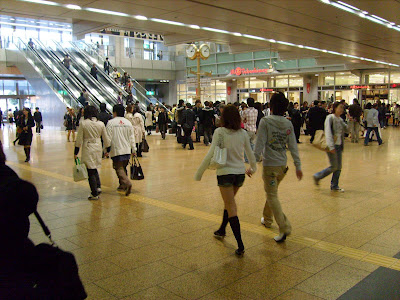
Nagoya is the fourth-largest city in Japan (besides Tokyo, Yokohama and Osaka) and has the same sense of hurry to it that Tokyo has, though without so much of the buzz that went along with it. Nagoya station itself was huge (the largest in the world), and not like any other station so far; a series of open areas containing shops and department stores, connected by a network of wide, pillared tunnels. To complicate still further, the station also connected to the Nagoya subway system and each area was packed with rush-hour wall-to-wall commuters. Wherever you stood there were bodies zipping by in every direction trying to get to their station before the trains went. Stopping off for breath in a Kiosk, I watched the world go by and realised that I had no idea in which direction to go. Fortunately the river of people I decided to join washed me up at a large open area containing a massive board of train departures and an information desk staffed by an english speaker.
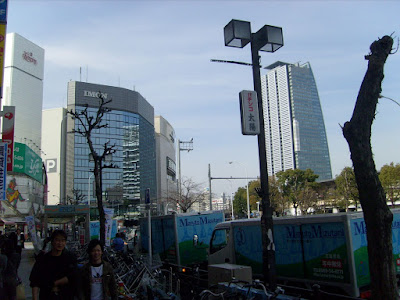
After showing them my map for the hotel that was printed out for me back in Nagano, they were able to point me at the correct exit and I was able to find the correct hotel. Fortunately, not too far away, (and next to the biggest panchinko shrine I had seen so far) the Chisun Inn was a cheap and cheerful affair shaped like a cylinder. The central lift took me up to my floor, where I chose my room from a circular corridor with a door to each room every couple of feet. Entering, and knocking my head on the low door, it was the very definition of 'compact and bijou', more so than any other I had been to so far, but it was clean, had all the amenities, and would do just nicely for the night.
Dropping off my packs, I decided to use the remainder of the day (it was about 4pm) to explore some of Nagoya. Even though the city had the smack laid down on it by some of the tourist sites I had visited, my travel book did outline a couple of places that sounded half interesting. Studying the maps showed me that I could visit a few in a streight line and be back at the hotel before nightfall, so I headed back to the station to catch the subway train.
Subway Tips
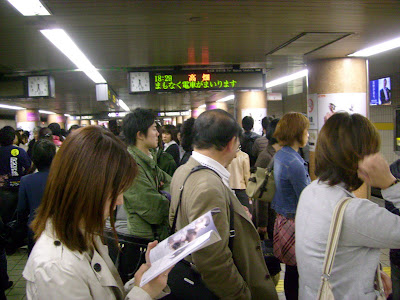
The subway was not covered by my Japan Rail pass, and so I had to do something not encountered before: buy a ticket. And that meant the automated machines. Armed with my book I cross-referenced the required station name with the japanese symbols on the giant subway map above me, which told me the going rate. Approaching the machine, a nice 'In English' chunky button stood out, and pressing it brought up an almost completely unhelpful screen telling me things in engrish that I couldn't work out.. so I did the only thing I could do - pump 100yen coins into the machine until I hit the amount I had guessed I needed, and see what happened. Fortunately a button flashed for me to press, and my ticket was spat out at me. So that's my 'tip': throw money at the machine and eventually it will be happy.
My first destination was the Nagoya Robot Museum, which was located a few minutes from Sekae station. After braving the subway crowds (both off and on the trains) I eventually managed to make my way back to street level and found myself slap bang in the middle of downtown Nagoya - massive multilane roads in a grid system, with huge department stores anywhere you could fit one in. Fortunately, next to the bus stations were city guide maps. Unfortunatly they were all in Japanese and didnt tally with the map in my book, but eventually after some asking and showing a cubic building with a silver sheen hoved into view. Excited that I'd made it before the described closing time, I arrived at the door, complete with a 'Robot Museum' sign on it. I tried the door, which was locked. I looked around the building. There were no other doors. It took me a full minute of searching around and arriving back at the entrance to realise the sign was actually telling me what I didn't want to know: the museum had closed down the previous year.
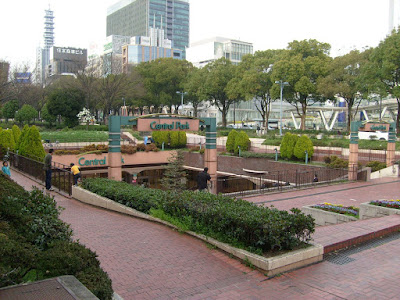
With the wind out of my sails, and not actually remembering the direction I came from, I slumped down on to the steps outside and had another look at my book. The next thing along was the Nagoya TV Tower, situated in the middle of the Hisaya-odori Park, a long thin stretch of parkland running down the middle of the main Hisaya-odori road. The tower itself used to be the tallest structure in Nagoya, but has long-since been dwarfed by the buildings around it.
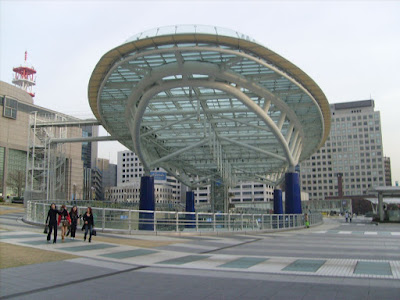
Once I'd had my fill of the park, my eyes glanced east to a strange structure that resembled a spaceship across the road. This was the 'Spaceship Aqua' a huge Voyager-shaped structure held up by steel pillars. Its purpose seemed to be primarily as an extended covering to the subterrainian bus terminal you could see below, but it was also open as a free exhibit to the public.
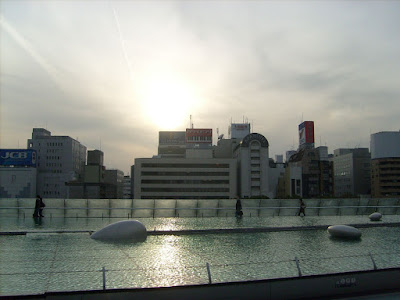
When you got to the top of the stairs, the oval section turned out to be a walkway with a misted glass bottom, and in the centre was a 'lake' of water no more than an inch or two deep. Around the edge were seats, so you could sit and look at the sunset over the lake and pretend you weren't in a city at all. It was all quite pleasant and calm up there, so I decided to stay a little and admire the sights until the sun was low in the sky.
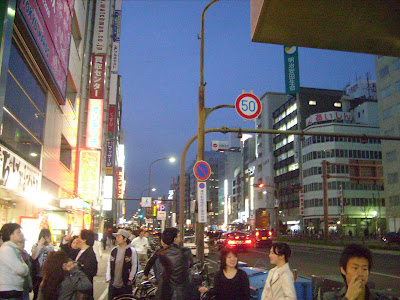
After making my way back down, I looked back at the map. It was clear that the remaining sights would have to wait until tomorrow as most attractions had by this time closed, so I walked some more around Hisaya-odori park and some of the shops that were still open, and then began to head back to my hotel, which was by now a welcome sight.