Showing posts with label Ueno. Show all posts

Japan 2010: 22 - Where I Make the Long Journey Home

The little resurrected alarm clock beeped into life at 6.15am. I dispassionately rolled over and looked into the gloom. It was still pretty dark, and the discoloured grey-cream walls around my head merged into the darkness. I stared at my toe in the reflection of the little TV in the corner. It was time to begin a long journey back home.

I had taken the wise decision a couple of days previous to buy the Narita Express ticket, although my optimism that buying it with the soon-to-expire pass didn't work out. I had to pay the going rate of 3310yen, which got me from Shinjuku to the airport. Now all I had to do was get there.

I washed and clothed, and packed my remaining things into my bulging bags, and after checking and re-checking the room for items that I'd forgotten to pack like some sort of loony, I finally took the psychologically important step of walking out of the door and locking it behind me. I had a standard sized small satchel, a large 35-litre backpack, and a wheeled luggage case, care of Don Quijote. They were all full to the brim with things for friends and family to open when they got home, and for me to remember my time here. Volcano dust from Kagoshima. Coral and seashells from Okinawa. Obscure games and treats from Akihabara. Volcanic rocks from Aso, and precious stones from the Akiyoshi plains. These and so many other things from my last three weeks held within them a thousand memories. I had no idea where it all was in the mass of taut fabric, or what I was going to do with it, but for now, I just had to worry about getting it the 6000 or so miles back home.

The first job was to get to the station. I checked out about 7am in the hope of missing the morning rush. No chance. When I reached the station it was already home to an efficiently moving weave of people going about their business; most of them going on the train. I stopped off for a last munch of that excellent bacon bread and then put myself on the train.

I was already sweating from heaving round my own weight in tat, but the discomfort got worse when I boarded. I had no way of removing my backpack and the train was standing room only. I could feel a dozen or so eyes burrowing into the back of my neck as I stood there gently crushing a young woman's face against the doors behind me, something that went doubly so as the train lurched between lines and came to a halt at the stations.

Mercifully the journey eventually ended at Shinjuku and I could head off to platform 5 where the Narita Express would soon be appearing, at my own pace - there was for once plenty of strolling time.

I wrote a bit of diary during the journey and had a check through my flight details once more, but made sure I spent a good half of it gazing out of the window at the final view of the country. I'd seen a lot of Japan through train windows but this time it had been tempered and replaced by spending a little more time actually out there. I was contented with that. I still had many places I wanted to go, but they could wait a year or so.

The greenery slowly replaced the built-up urban views, and aside from a second glimpse of the Tokyo Sky Tree in the distance dwarfing everything around it, my final views of the country were non distinct houses and scrubland, which though plain, felt like a gentle way of winding down after the visual assault I had just experienced.

Working my way through the passages in the bowels of Narita airport, I was stopped politely but firmly by a security guard, just outside the office where I had got my rail pass when I arrived. The sudden jolt out of the rhythm of my journey put me a little on edge, and I was reminded of how nervous I was - although for different reasons - the last time I was stood there. It was a 'security check' and he asked me where I had been. Well, I had to indulge myself, didn't I? I rattled off the list of places I had been on my journey round, and my visible enthusiasm must have had a positive effect, as he loosened up considerably after that. I got a couple of questions about who packed my bags, and then he let me go.

Up a few floors was the huge room containing all the flight service desks, and the large F board held the Virgin check-in desks. Predictably there was quite a queue for cattle class, and I had arrived about 1.5 hours before takeoff, which by plane standards is cutting things a little fine. After a little while the queue began to move and I snaked my way slowly to the desk.

Virgin did a lot of things better than what KLM/Air France did (my choice for the first trip). They had better food and service, and seemed to be generally a bit more competent; however, my opinion of them took a battering when I handed over my checked luggage and was told that the extra suitcase I'd bought would be charged extra - right there and then I had to leave the queue and pay 5000yen (about £40) with my debit card to get it on board. Air France had no such problems before. Grr.

I didn't let it bother me. I rejoined the queue (thankfully allowed to push in) and then finally boarded the plane. I got an aisle seat next to a middle-aged American woman who didn't seem to talk much (although we shared an amusing moment over the squid dinner). Frankly this was okay by me, as my eyes were getting heavy.

But I couldn't sleep, so the enticing allure of complementary films won me over. I watched the last half of The A Team movie (meh), then Toy Story 3 (again, because it's excellent), and finished off with Kick-Ass, which I really wasn't expecting to enjoy half as much as I did. I must remain on the lookout for more films where a small girl with purple hair swears her head off and kills people with impunity. It's a much under-represented genre.

The plane was about fifteen minutes late taking off, which was of little concern. However by the time we reached the shores of Blighty and came into land at Heathrow, the healthy buffer between setting down and getting on the connecting flight to Manchester was almost completely gone. It was pretty clear by this point that even if I would make the transfer, my luggage would not, yet again.

This is where things went a bit wrong. I don't find it coincidental that it happened as I stepped back on British soil. Out of the influence of the far east, things just stop working, and people begin not giving much of a crap. It happened on my last two flights back to Blighty, and it was about to happen again, although this time it would be more convoluted.

'This is your captain. We are sat on the runway awaiting permission to taxi in. Those passengers who are taking a connecting flight will be pleased to hear that I have radioed in to have them hold on for you until we get you disembarked and on your way'.

Bollocks.

I disembarked with about a half hour before the plane to Manchester left. I was at Terminal 3. I had to get to Terminal 1. This involved a lot of pacing round passageways and up and down escalators, plus some outside running between buildings and a bus ride that was far too 'sunday drive' for my current state of mind. It also meant an unwelcome baggage search and sweaty rub down at a bank of scanners. I say a bank, there was four, but only one had anyone manning it. The huge queue was achingly slow to move. Next to me was an equally exasperated man who I recognised from the flight. Howard was a high-flying although weary-looking German businessman on his way to a meeting in Manchester. We'd sort of acknowledged each others' presence on the bus between terminals but now we had got some quality time next to each other in the queue, so we got talking. He was reasonably suited up whereas I was less than smart, with a few days of beard and probably a little more body odour than was polite in company. Nevertheless we helped pass the time as we neared the front of the queue, until an angry storm of arched-eyebrow Russian womanhood came pushing through the queue and in front of us.

'Let me through, I'm late for my flight', she said as we sensibly got out of the way. She worked the metal detector in double-quick time and was through the next bit before we could blink.

Once through the gate, it was a mad dash - with all my remaining energy - round the passageways and predictably right out to the final bloody gate in the building at the far end. Had we made it? Had the dulcet words of the pilot worked to keep that gate open just long enough for me to make it through the assault course?

I trudged back from the gate, which had closed only a couple of minutes before. 'You'll have to catch the next one', the oh-so helpful steward said from behind the desk. When I asked when that was, she gave me the words that made my face fall. 'About 9.50pm', she said.

If the plane set off at 9.50pm, that meant it would land in Manchester about 11pm. The trains stopped running about that time, and as I recalled from last time, there was a lot of 'delayed baggage' form filling, metal detector-ing and, running over blue escalators before I would be allowed out into the open air of the train platform. It just couldn't be done.

Howard and the nameless Russian woman met me coming the other way. She was stomping, and had made her presence further felt by complaining loudly to an unfortunate lackey behind a nearby service desk, which by coincidence was the one I had been directed to go to to get an alternate flight. Russian woman immediately went on the offensive again, kicking off about the delays and the treatment, and where she had to be. The stewards had heard it all before and knew which words to use in response. Unsurprisingly, the angry Russian woman left us in a stream of incomprehensible words trailing off, never to return. I wouldn't have wanted to spend much more time with her, although if I'd have pushed through that huge queue like she did, maybe I'd have just made my flight.

Howard and me talked at a more reasonable volume with the steward at the desk, reviewing our options. We could transfer to a British Airways flight if we wanted which left an hour earlier, but it would mean we would have to go to Terminal 3 where someone behind a Virgin desk would be able to do the necessary key tappings. I asked about my bags, wary of my outward trip, but was assured that due to the delay they would both make it up with me to Manchester.

So we went. Howard lent me his mobile so I could ring my parents as I would be spending the night at theirs, if I was ever going to make it home that night, but there was no signal in the airport buildings, so we pressed on. After a lot of explaining at the Virgin desk (Howard had clearly done this before, and he shared a few stories of such cockups as we went) we eventually managed to transfer our flights for free, and then got the lift down to the shiny new Heathrow Express underground train to Terminal 5.

About 10 minutes wait and 10 minutes ride, and we were there. As well as the seats, Howard managed to wrangle for us a free pass into the 'North Lounge' - a business lounge filled with free coffee, soft sofas, nondescript pictures on the walls.. and free grub.

It was like a mini version of one of those buffet restaurants, with a selection of complimentary nosh and a few drinks to choose from. Having just come from the country that cannot do Indian cuisine for toffee, I eyed up the Tikka Masala with slavering lips, although I did eventually plump for their very European beef goulash which was close enough to being a traditional British meat and two veg as made no difference. I wolfed down a couple of platefuls as Howard more sensibly chewed his Korma.

Full up, we went our separate ways and passed the time until the gate numbers came up. I stuffed a few complementary biscuits into my backpack and tried to sit somewhere that was not so comfortable that I would fall asleep. Eventually, Gate 9 flashed up under the Manchester flight, so I wasted no time in heading off.

I spent a further twenty minutes sat in the gate lounge next to a man who reeked of pipe smoke, which helped me to stay awake at least, and then we all filed on. The journey started pretty much on time, but my now full stomach was sending messages to my brain that it was time to shut down for the night, which in an off and on way, did until the skyline of Manchester caught my attentions.

It was after 10pm now. I ran to the luggage area and - well, the backpack had made it at least, but the souvenir-packed case could have been anywhere. Fortunately I had pre-empted the situation and wrote down a description of each of my cases so I wouldn't be taxing my brain too much when I had to describe my missing property. I filled out the appropriate form, hulked my pack onto my back, and ran along the blue escalators until they ran out and the railway started.

I made it in time for one of the final trains to Leeds, and fortunately there was little in the way of ruffians to bother me along the route. By half past eleven, I was in Leeds, which was close enough for a Taxi home. I stepped out into the cold air of a brand new day and climbed the steps to my parents house, said hello, slurped a cup of proper Yorkshire tea, and then collapsed into a newly made bed.

Final Thoughts
In some ways, my second jaunt around Japan was an improvement on the first one. I had managed to keep my innards from turning to liquid this time by being a bit more careful with my food choices (and not running myself into the ground so much - spending more time smelling the flowers instead of trying to cover stupid amounts of miles per day), and the pre-booking of all the hotels certainly freed up my time to go do other things. It felt like a holiday.

But there was still much room for improvement. I kind of liked the flexibility I had when there the first time because if the journey got too crazy or I fell ill, I could change the route. This was not open to me here, but fortunately I had planned things sensibly enough not to need it.
I guess the main problem I had this time was that the second half of the trip could not hope to compete with the first half. Weather played it's part, as things slowly became cooler the further north I went (Tokyo was a wash-out both times), but the killer was the time spent in each spot. In the first half - Okinawa, Aso, Nagasaki - these were my favourites, and coincidentally the ones where I spent more than one day at. After Nagasaki, it was just a single night's stopover at each location until I got back to Tokyo - and that meant little time to relax, explore or make friends with other people.

The Good Bits

  • Onsen -Relaxing and liberating!
  • Okinawa (even though it was blisteringly hot) - a beautiful place
  • Night-time Nagasaki
  • The people I met along the way, who were friendly and kind (and generous with the freebies!)
  • Many more beautiful sights

The Bad Bits

  • Feeling a bit vulnerable after the last night in Okinawa
  • The increased presence of western religion
  • Rushing through the last half and not really having time to enjoy the ride
  • Rain-soaked Tokyo!
  • Not sharing the journey with someone (aside from with this blog!)
What I would hope to include next time

  • A winter in Hokkaido - the wildlife, the ice festivals and the beautiful landscapes
  • A major festival - maybe the Nagasaki Kunchi festival which looked cool, (there are many others)
  • The Tokyo Marathon - can my legs take it?
  • Going with someone - maybe I can find someone mad enough to share the experience next time.
  • Hakone, just outside Tokyo
  • Taking a couple of days to climb Mt. Fuji
  • The third view of Japan (which apparently survived the earthquake with little damage despite being pretty close to it
  • .....
At some point after the nuclear problems die down, I'll be off once more to see what I can see. But for now, that will do me for a bit.

Japan 2010: 21 - Where I Philosophise with an Urban Poet

My last full day in Japan. I had left this day pretty unscheduled in my plans, because it was not clear what I would still have left on the to-do list by this point. The only thing that had stood out to me was on the plane in, the kindly souls of Virgin Atlantic - in between 'amusing' safety videos with Vic Reeves - had made some travel guides for the destination, with Hakone taking centre stage in their recommended sightseeing list.

Hakone is a small town that acts as a magnet for tourists during the summer months, although the route the tourists typically take is a convoluted one. Taking the JR trains out of Tokyo and heading to Odawara, then taking a mixture of private train lines, ropeways, cable cars, ferry boats or even the odd pirate ship, you eventually end up at Hakone. Though there seems to be plenty at the town for people to do, most of the enjoyment it seems comes from the journey there; the aerial sections giving beautiful views of Lake Ashi deep in the valley below, and often a good view of Mt. Fuji in the distance, perched atop a cushion of cloud. Needless to say, you would have to take a full day out to make the trip.

As I stood bleary-eyed at the hotel PC at the reception, trying to use google maps to work out the best route (a 4-hour journey minimum), the final nail in the coffin that contained my optimism that I could go appeared in the corner of my eye. A huge rumble came from outside as I turned to see the street outside become quickly drenched with a thunderous downpour. The early morning commuters scuttled briefly in and out of view as they headed generally towards the station.

I waited a little while back in the room, viewing through the grey windows the continuing downpour outside, in the hope that it would abate. 9am came and went, and so did 9.30, and still it rained. It was miserable.

This was ridiculous. I was not going to spend my final day moping around a dusty grey room, but my enthusiasm for the day was draining fast. I flipped through some flyers I had got from the lobby and came up with some sort of plan; Ueno Zoo was pretty close to where I had stopped on my first day there, and even though Ueno didn't exactly set my hair alight back then it wasn't really like I had given it a chance. Plus there were the nearby parks and gardens to enjoy. Maybe the weather would calm down a bit and it would be a pleasant relaxing jaunt. After that, I could circle around a couple more stops and head to Asakusa, home of the iconic Sensoji temple, known for it's large Kaminarimon gate, and the push-fest of tourist-shops on the way to the shrine. I could kill two birds with one stone and get my remaining souvenir pressies there too.

OK, so I had a plan that wasn't particularly daring - a bit of an anti-climax given the distance I had travelled to get back here; but it was at least a plan, and I had to make a decision soon or there would be no day left.
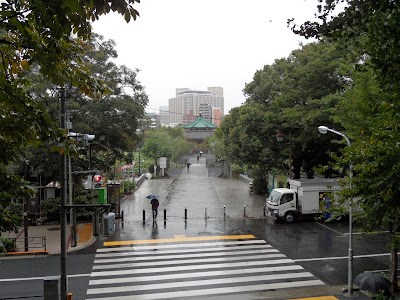
I took my small bag and my brolly and went on the train around the loop to Ueno. I paddled through the puddles in the opposite direction to where I'd been before, and cut through the outer paved areas of Ueno Park until a curious temple emerged out of a gap through the tree canopy.

The Ueno Benzaiten Shrine is sat on a man-made island in the middle of the Shinobazu Pond, a large stretch of water filled to bursting with umbrella-leaved lotus plants standing five or so feet out of the water. Benzaiten shrines and others like them are the result of Hindu religious influences that seeped into Japanese spiritual practices via a bit of renaming and reshuffling as the myths and legends passed through China. Benzaiten is the goddess of 'everything that flows', which thanks to a most basic interpretation, explains why an effigy of her was plonked in a huge pond.

The rain was beating down and had enlisted the help of the wind so as to make the use of umbrellas pretty much useless. I passed through quickly, and as I looked around to find shelter I heard a voice beckon me over. A man stood calmly, propped up against the side of a building with a generous overhanging roof. He looked dishevelled but dry, and seemed to have been stood there since the rain started. I went over and joined him in the shelter.

My head was dry, but my feet and the bottom of my jeans were being lashed by the rain, and there was little I could do about it. I looked over at the guy, who was looking back at me with an expectant face.

'What is your nationality?', he said with good English, breaking through the dripping noise of the rain off the roof.

I told him I was British, and that made him happy, it seemed. 'You are not American, at least', he said with a chuckle.

There followed an unusual conversation, the gist of it is all I have left now. He asked me how London was these days, although he had never been. Liverpool and Manchester too. I got the feeling they were just places he had heard of once.

'Why is the UK not doing anything any more?', he said to my surprise.

It was true to a degree; the industries of old had gone or were being challenged by foreign competitors - and we seemed to be topping the lists of 'worst places to be for..' pieces. And then I took heart as I recalled the British spirit..
'We brits like to take pride in being rubbish at things', I said sardonically. 'When we learn we are the bottom of the class at something, we give a cheer..' He smiled, but I got the feeling he was disappointed at my response.
'You have to have a sense of humour', he said. 'People will survive so long as they have something'.

He began what seemed like a well-rehearsed enumeration of the things going wrong in the world, 'the rise and fall of nations', and the harm caused by the west in the name of 'freedom'. There was little room for interjection.

When he came to the end of his speech, he rattled the handle of the trolley he had at his side, so as to catch it in my attention. 'I am a poor man, I have lived on the streets for a long time. I carry my possessions around with me'.

The man had lines on his face that misrepresented his years on the earth. He was dressed in care-worn clothes, but looked strong-willed and worldly-wise, and had a relaxed demeanour that suggested he had seen it all before as it walked past him. He wore a smile as he talked. But his voice changed from poor but contented, to adopt a more scornful edge; 'Why does my government bring in foreigners, giving them grants to live here, but there is nothing for me?'

I wasn't really sure what to say; on the one hand this sounded worryingly familiar talk, like that expressed by the average racist idiot on a typical British street, stepping dutifully out of the way as one of 'them forriners' comes by and sweeps the place clean of his discarded beer cans. But I could also hear a gentle sense of defeat in his voice, rather than the subdued anger and passive-aggressiveness whenever you encounter a sentence containing such words as '..our asian friends..' over here.

I tried to be diplomatic. 'Attracting talent from overseas is an investment for your countries' future,' I said with as much confidence in my words as I could. To be honest I had not come to Ueno tooled up for a debate on the relative effects of immigration.

'Well, it does me little good..',
We stood silent for a bit watching the lotus leaves drooping in the pond.

'I am a poet', he said after a moment, 'I write Haiku'. He fumbled around in his pocket and took something out.

'Would you like to buy some of my work?'. He passed to me a small, crudely made booklet. On the front, in Japanese and English, was the words 'Haiku by Hideo Asano'. Inside were a dozen haiku, each on their own page. I read the first one:

It is raining hard
The deaf wet selling flowers

Can anyone hear?


It gave me a smile as the rain continued to pour down just beyond my soaked feet. Unsure of how much he wanted, I fumbled through my pockets and took out a couple of hundred yen. He seemed happy with that amount.

'I come here to see the people that go by. It is one of my favourite spots. I travel all around Tokyo and see many things as I go.'

I smiled. At about that moment, the rain eased, and I took my cue to leave. It was 11am and I was losing the day. I thanked Mr Asano for his time and headed briskly through the rest of the gardens. (little did I know I had just conversed with a respected Japanese poet who has his own blog and several books.)

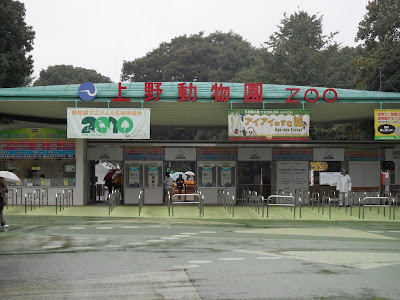
The park ended at Shinobazu-dori, and following it for a little while took me to the back entrance of Ueno zoo, the Ikenohata gate. From the outside, Ueno Zoo certainly wasn't trying to look very appealing, resembling the outer grounds of a large factory more than a place to house animals and take the kids for a day. The entrance stood open but devoid of tourists, the lashing rain beating most of them away for another day, but I was determined and almost out of days.

The entrance fee was 600yen, and it came with a decent English map detailing the area and where all the animal enclosures were. The zoo is split into two areas, and I had entered the west side; a monorail linked the two sections which were separated by a large wall.

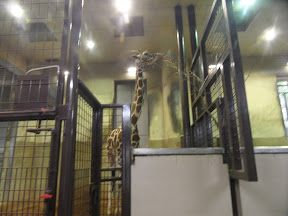
I began my trek; the first few enclosures were covered, and I was happy for some shelter as the rain began to beat down heavily on the corrugated roofs above me and the giraffes and rhinos who were regarding me as they munched on straw.
Across the way was a reptile house, which sounded like a nice retreat. Inside, the subdued light of the reception area hid a large circular tank of water, inside of which were a couple of rare Japanese giant salamanders. They were sat on the bottom, or posing upright against a rock and looked pretty contented, not that they were wearing noticeable smiles.
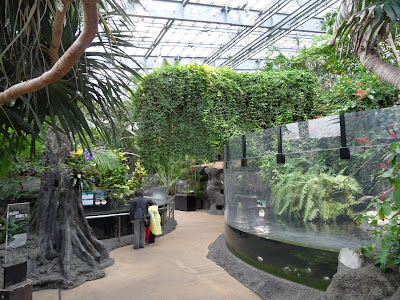
Through the plastic curtains, the main area opened out to a giant tropical greenhouse, with a handful of high glass-walled tanks surrounded by exotic plant life and pretend rock formations.
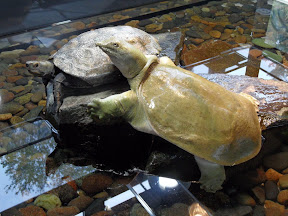
Turtles, eels and large fish swam about in some, and snakes and toothy crocs basked in some of the others. Small tanks built into the walls held immobile iguanas and multicoloured frogs.
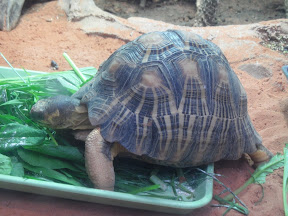
A turtle munched on leaves of some sort in a sandpit, and birds flew overhead through the vines and trees. It reminded me of some of the poor animals in Okinawa world, who were treated much worse by comparison.

In a gradual shift between sea-life and hot-house amphibians and reptiles, the tour ended with some details (in Japanese) about fossil histories, including rather impressively a copy of the Berlin archaeopteryx fossil find (although it seemed to be a mirror image of what it should be).
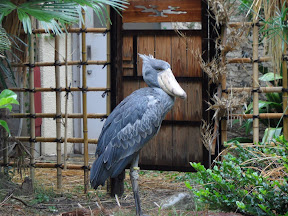
Outside it was still raining hard, so I quickly said hello to the flamingo herds and the slightly creepy-looking shoebill storks, the zebras and the elephants and hippos, a few of the smaller primates, plus a selection of penguins and other seabirds who looked a lot happier in the rain than many of the others. Most of the other tourists had holed up in the cafe, getting some green teas and watching the skies as their children ran amok between the seats.
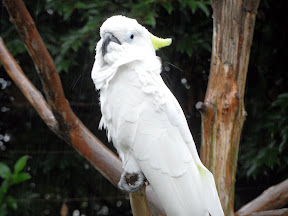
The monorail had a single carriage, and it had just left when I got there, so I took the east garden path instead; I had no patience for waiting in the rain. Over the other side, a large section of the zoo had been closed off for some reconstruction work, which included the main bird houses (boo). This section of the zoo seemed a little older and bedded in than the west side, and the trail past the elephants disappeared downhill under a large canopy of mature trees. The first floor of the bird house was closed off, but there was a second floor around the back. At the top of the hill a pair of cockatoos sat miserably as they waited for the heavy rain to stop. They weren't in cages, just sat on some tree stumps in a fenced off area, their wings I am guessing, were clipped. This also had a closed sign, but the door was ajar. I took a risk and headed in.
From what I could see there was no work going on inside. An elliptical room with enclosures around the outside and in the middle. Each enclosure had wire netting as a ceiling, so it was letting in a certain amount of rain, and disappeared down past my feet into the first floor room below, so there was plenty of space to fly. Every now and then strong netting was used to partition the enclosures off so birds that didn't get on with each other so well could play nicely.
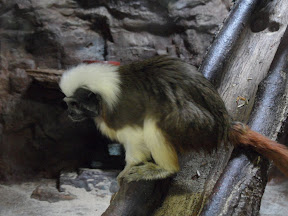
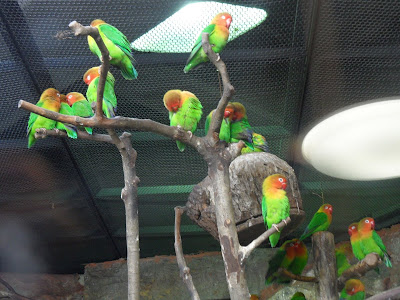
Beautiful birds of many colours, seemingly from tropical climates abound. An area full of pygmy parrots squeaking away to each other and darting around to each other as they hung like bats from the ceiling were funny, and next door to them were a whole slew of green lori chattering to each other and generally huddling up in pairs on every tree branch they could find.
The rain still hadn't stopped but I had to move on. I ran through to the big cat enclosures which had some covered areas for the tourists to see them up close on wall-high glass viewing areas. One tiger sat in the shelter from the rain, right up against the glass, and reacted with mild disinterest at me sitting right down next to him, he must have got used to the attention.
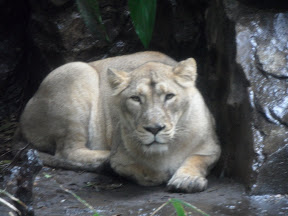
A female lion looked at me with considerably more interest in the next cage and so I moved on. The unending rain continued as I walked through the high cages of the birds of prey. Beady eyes of eagles, hawks and vultures watched me from beneath a tuft of large (and sometimes unexpectedly colourful) feathers, until I emerged out onto the square, a large 5-story pagoda in the middle of a pond staring back at me.
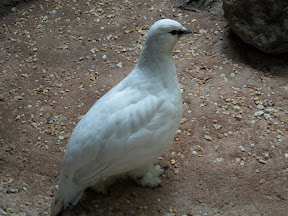
A raven sat shivering trying to get some shelter in a stone lantern at it's base. I took a little look in at the Japanese birds to the side (mostly Jays, but also a beautiful white grouse), and then made my escape as I had come to the main entrance gate (but not before I managed by luck to get a single picture of a red crowned crane before it disappeared inside.

I headed out of the park and to my relief it put me right back at the station. Inside the Ginza subway had signs for heading straight to Asakusa, so I took the tube for 160yen each way.

Three stops and I emerged back into the open air, unfortunately it still included water. Compared to Ueno which was fairly light with foot traffic, Asakusa residents were more resilient and were going about their lives in quickly flowing 2-way lines of people, or slowly shuffling caterpillars of umbrellas where the bottlenecks were.
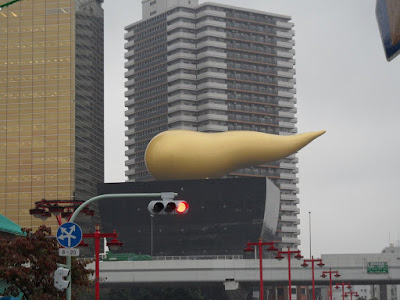
The weird gold cloud shape marked out the Asahi beer hall just across the road, but I didn't have much time or stomach for a tour. Instead, the steady trail of shops led me to the entrance to the Senso-ji temple.
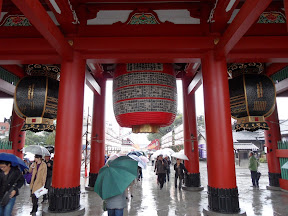
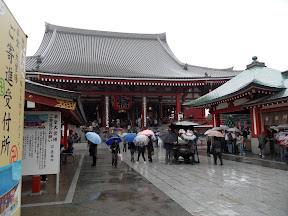
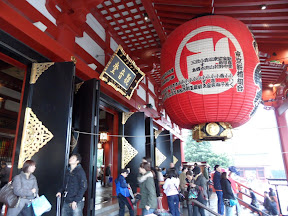
You can't really miss Senso-ji. For one thing, it's got a perpetually large crowd of people gathered around it, and for another, there is this dirty great lantern at the Kaminarimon entrance gate. Located under a sturdy sheltering roof, it was fortunately spared the indignity of going soggy that day.

People flocked around the gate, waiting their turn, before bundling up a few friends into the shot and taking a picture with the lantern as backdrop. As soon as I saw an opening, I took a quick pic or two and went through.
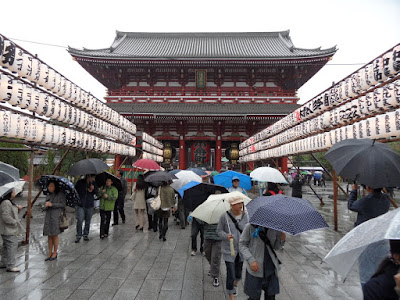
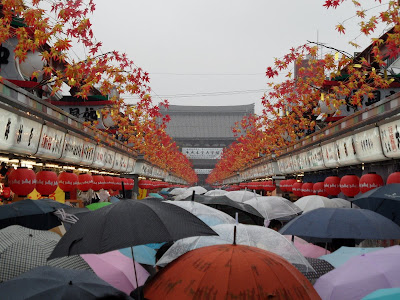
On the opposite side is the short Nakamise-Dōri. This street is a few hundred yards and stretches between the outer gate and inner gates. Unusually for the grounds of a temple, where this space would usually be filled with tasteful statues and gravel gardens, this one contains a line of shops down each side with aisles every so often down which are the more usual covered market. The main street was tastefully decorated according to the time of year. Since we were well into autumn, branches of golden-leaved Japanese maple hung over the massive pulsating outer skin of umbrellas, under which a thousand or so tourists moved as one between each storefront.

The shops sold everything under the sun and made a good excuse for darting between to get out of the rain; several eateries steamed with the output of fresh tempura or yakitori, while others sold a selection of traditional Japanese sweets, which I got a few bags of for back home. Between the food bars were clothes shops selling fans, T-shirts and kimonos, and many cheesy trinket places as well, although the things they sold were a little less mass-produced than what you might find down the average street. One place in particular (whose owner didn't approve of cameras) caught my eye - an art shop that sold wool-block prints of various traditional and more modern pieces of Japanese art in various sizes. Some were postcard sized and were quite reasonable, and the larger ones (about A3 size) were going for several thousand yen. You could get a standard print for about 3000ish yen of, say the great wave, with a cardboard frame, or you could go for a deluxe option - the same print but using much more vibrant colours and a proper frame, for about 13000yen. They made the standard ones look quite drab when you compared them, and anyway the chances of me getting it home without folding it or getting it spoiled by a thousand raindrops was frankly zero. Maybe next time.
The street eventually ran out of shops after what seemed like an eternity thanks to the slow shuffling of a thousand pairs of feet, and there was a short area just before the gate where two frames either side of the street sagged under the weight of hundreds of pure white lanterns. The large lantern in the beautiful Hōzōmon gate matched the other, but were joined by a pair of copper Tōrō on either side, each concealing a suitably angry-looking Niō statue behind them, recessed into the structure of the gate.
Finally, (past a couple more shops) the weakened tourist arrives at the temple. An absurdly huge roof slopes steeply down, channelling a final rush of water off onto the heads of the faithful.
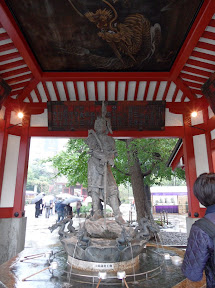
To one side was a shop selling traditional items for temple worship, including a thousand types of incense sticks to burn in the nearby Censer, round which were gathered a dozen or so people trying to waft the good fortune over themselves whilst trying not to pass out or catch fire. At the opposite side was another impressive-looking five storey pagoda, it's decorative metal spire finial seducing the lightening out of the rumbling skies above.
In front of me, a half-dozen steps took me up to a set of beautiful jet black lacquered doors, beyond which was the temple shrine.

The inside was - as always - beautifully crafted. The ceiling was covered with large pictures, depictions of wars and demons, dragons and swordsmen. Every surface was smooth and precisely crafted wood of highest quality, and the areas at the side were occupied by life-size stone statues of great men of the past.

Curiously, within the temple the shrine where everyone worshipped was usurped by a large bank of tiny drawers containing Omikuji papers. Related to fortune cookies, Omikuji contain good or bad luck messages; the idea being that you receive one randomly, and if you don't like what it says, tie it to one of the frame stands nearby, or take it home with you if you do. (That's why you'll often see thousands of little pieces of paper tied to frames, trees or anything else near a Shinto shrine.

Senso-ji's way of bestowing their Omikuji was via a variation of a straw poll. You paid your 100yen and picked up a metal tube about the size of a spaghetti jar, and shook it - 'politely', as the notice requested. A little hole in the side dispensed a chopstick-sized strip of wood, on which would be the symbol for one of the Omikuji, and you took the paper out of the appropriate drawer. Fortunately for the tourist they were written in several languages including English. Many people apparently try to collect the lot, but I suspect like football stickers it'd be pretty difficult to get the last few, so some sort of swapsies system must surely be in operation.

I headed back out down the side streets behind the main one, taking a look at some of the less attention-grabbing shops. Many were actually the quiet back entrances to the main fronts but others were quiet clothes stores and antique shops which were nice to browse through without the large crowds, although because of the perpetual rain soaking me to the skin and a general lack of shelter, I moved through them quickly as they had little suitable for my remaining souvenir-less friends and family.

I browsed through a dozen or so shops within the covered market and came up empty, although my rumbling stomach found me a tidy little cafe where inside I partook in some unexpectedly continental tea with jam on super-thick toast, with some slightly less continental egg and lettuce side salad to go with it.

Emerging onto the main street once more, a curious tea shop caught my eye. Stalls containing terracotta teapots and bulk bags of tea intrigued me. A mature-ish lady stood patiently looking at me awaiting eye contact, and when I inevitably cast them in her direction, she used her well-tuned wiles to lead me in and introduce me to a hundred different packets of green tea. She was clearly expecting a foreign contingent as each one came with a photocopied English green tea guide. I was reminded of my grandad's like of Chinese food, maybe he might appreciate a bit of proper quality authentic green tea.

Their main product was stacked up on the cashiers desk - green foil packets stood on their ends in lines, identical but for the small labels on their fronts and the increasing price card in front of them - ranging from about 500yen for the cheap stuff up to several thousand for the choicest leaves of the best plants. I fancied some myself to bring back home (green tea in the UK is just not the same). I got a couple of the 1000yen Sencha blends, one for me, one for granddad. The teapots were tempting, but they were plain and ugly, and too bulky to consider given my already bulging bag.

Yoyogi Park was on my list as a final stop, because it was the location of a minor disappointment on my first day in 2008, where I blearily headed off on the Yamanote line in a random direction and just went for a walk, saw a Michael Jackson impersonator, some people giving out free hugs, and a locked gate. The park had a reputation as a massive, vibrant coming together of people after a hard day, a green paradise in the middle of the metropolis. But it was still raining - as hard as ever - and it was half past four, and as I recalled it closed about five so I got the subway back with the intention of heading 'home'. To be honest, my enthusiasm had pretty much drained away.

Of all places to go, I decided that my final hours would be spent in Akihabara again. My third time of going this trip because (a) I didn't want to risk going somewhere I didn't know at such a late stage, (b) there would be plenty of places to shelter, and (c) plenty of stuff is open well into the evening.

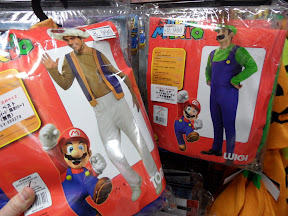
It turned out to be a good idea, souvenir-speaking. Videogame-themed sweet selections will always go down well with friends, especially if they are Megaman shaped, and the friend in question is an old git. Clothes shops selling overpriced t-shirts, knockoff Ghibli goods and an unhealthy selection of the usual dodgy stuff later, and I somehow found myself back at Super Potato once again, gah.

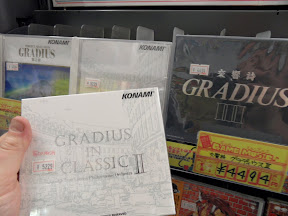
They were pretty quiet, but still open, so I spent some considerable time flicking through their obscure videogame music CDs, and then the thousands of unboxed Super Famicom carts, an action that takes up lots of time, in the hope of finding some bargain games that didn't contain too much Japanese text. In the end, my hands spilled over with what I reckoned were some rare or bargain items - some of which I'd be keeping for myself:
I could have kept going, but I was pushing my luck and my yen was running out. I had a few hundred spare, so went up to the top floor for a final play in their arcade. It had changed round a bit again, and some of the games I'd recognised from before had gone, but in their place were some 2000-in-one machines where you could choose from all sorts of classics for a hundred yen a pop. Good times.

At last, as the night drew in and Super Potato kicked me out, the rain had washed itself out. I looked through a couple more shops that were still open as I made my way back in the general direction of the station, and then went back to Otsuka.

At a quarter past ten, a small restaurant under the Royal Host called Pronto was still just about open, so I headed in and ordered some pork dumplings with some layered cream cake for desert. They cleared out my final 1500yen in return for a good feed, and then I reluctantly headed back to the hotel. The last day, though I had filled it seemed very much an anticlimax. Washed out with a perpetual downpour, and limited in excitement and exploration. I wrote my diary and munched on some miso noodles, and looked back on the better days of Okinawa and Aso. It had been a good holiday, if only the weather had held a little longer.

The next morning would be the beginning of a very long journey home - starting at 7am - so I squeezed all my things into my combined luggage (all three were now full to bursting) and went to sleep.

Japan 2010: 3 - Where I Turn to Liquid

I woke after a sleepless night, ironically worrying that I wouldn't get enough sleep and wake up too late for my plane. I bode my grey little hotel room farewell, and checked out at 6.30am. The plane would leave for Okinawa in a couple of hours time, and I needed to make two train journeys before then. The convenient little café was still closed and would not open until 7, so I made my way with stomach growling through the remnants of the rain back once more towards Ueno station.

Strangely, when I got to Shinagawa station, I must have got disoriented and took a different route, because the ticket booth was different to the one I had been to the day before, but it appeared to still go in the right direction. I paid my 400yen and went through the barriers. At the upstairs platform I stood and waited with the bags at my feet, and nervously checked with a fellow loiterer that it was the correct platform for Haneda Airport. To my surprise he responded in confident English. Jin was a 3rd generation Japanese guy who lived in the US, but occasionally comes back over for either business or pleasure. This time he was working and heading to Haneda to catch a flight to Osaka. We got on and chatted, and swapped stories, making the journey pass quickly. At the exit we went our separate ways as we were going to different terminals. ANA flights, of which mine was one, departed from Terminal 2.

I suddenly had a pang of doubt that there might not be ATM's that accept international cards in Okinawa, so on seeing a 7-Eleven with an international ATM next to it, I took the opportunity to get out a chunk more to ensure I made it through until Kyushu.

Getting Cash with Cards in Japan

Surprisingly for such an advanced nation, Japan lags behind when it comes to paying for things - people over there still use cold hard cash as their primary method. This can catch out an unprepared traveller, and there are two main places you can use your card to get cash; most branches of the Japan Post Office, where even the small ones will have an English language ATM available, and the 7-Eleven stores, which have recently been upgraded to service international cards. For both of them you need to tell your bank when you will be abroad so they can enable the card for you. (It's best to make doubly sure they do as well because sometimes they mess it up).

Note that 7-Eleven stores are not present in Okinawa. Also note that whenever you make a transaction, your bank will probably add an extra international charge on top of the withdrawl amount (in the region of $2).

If caught short for cash, there are a few more options when you need to pay directly:
  • If looking for accommodation, go to a JTB. They will sort you out a room and you can usually pay by card. The branches in larger cities are more likely to have English speakers and you can make bookings for anywhere from any branch.
  • Most tourist spots have souvenir shops that allow foreign travellers to pay by card.
  • If you have travellers cheques, larger Post Offices, Banks and some Hotels will cash them for you, but be prepared for a 10 minute wait.
The typically clinical tiled walls of the station fell away as we ascended the escalators to the upper floors where the airport began proper. The building resembled a fancy shopping mall with shiny metal cladding and a high, cathedral-style ceiling. The whole space was roomy as if you were outside. A long line of blue check-in desks began, each with a buzz of excited travellers queueing for their tickets. Not knowing where to go, I asked and was directed under the large signs into a queue to check myself in. I had not managed to do it online, and so this was my punishment. The queue slowly depleted and thankfully the rep took my details without me having to say or do anything. I received a little card with some writing on it and some flowers, and she asked me to go wait in line at the main desks.

Haneda airport check-in was mostly like anywhere else, but with no English, although with a little guidance, most people regardless of knowledge of the language could make it through so long as they left an hour to spare to do it. After checking in my baggage (which was a wrench because I had only just got it back!) I got my boarding pass and went through the detectors and into the waiting area. The whole effort took about 45 minutes, and wasn't as bad as I was expecting, but then I was used to the post-terror checking done in the UK.

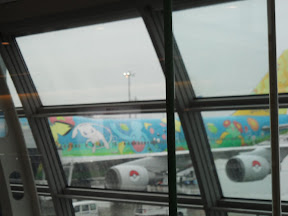
The waiting area was abuzz with excitement. I would be joined on my journey by several dozen excited teenagers. Quite why they were jumping up and down and making constantly altering little chatty groups I have no idea, but I guess this was the first time a lot of them had flown. I looked outside to see our plane. It was a small airbus, the sort of one reserved for domestic flights, but it looked a little different, a little jollier. It was covered from nose to tail with happy little Pokemon characters.

Things carried on a similar theme inside, where all the curtains shielding the staff areas were Pikachu'd up, and even the headrests had their own clique of excitable creatures bursting out at you. As the rest of the passengers filed in, a mix of tired businessmen slumping into their seats and the aforementioned superhappy schoolkids bouncing up and down on them, I looked out onto the wing and saw a pokeball and gave a little chuckle. Only in Japan would they launch something so twee into the sky where people would see it. If you were watching the Japanese Grand Prix on the telly, and heard a plane overhead, there's a good chance it was mine. I'm just glad the cameras were fixed on the track.

The damp streets of Tokyo faded into the distance and were replaced by fluffy clouds, and when we descended an hour later (to the excited screams of the kids) the weather looked decidedly nicer. When we got off the plane, we all sidled down the corridor and into the airport. The first thing that told me I was in a sub-tropical climate was the large number of beautiful Orchid displays all over the airport. Large circular raised platforms in the middle of the aisle contained a dozen or so plant pots, out of which flowers of every colour bloomed, clearly in their element. Lining the windows at each side were similar sights. It all looked very welcoming.

I breathed a sigh of relief as my backpack glided towards me on the carousel and I went through the exit door, only then realising that the checks we would have to go through if in the UK (even on a domestic flight) were absent; I was a lobby away from the outside. Come to think of it, no-one had even asked to see my passport.

I made a point of heading straight to the information desk and picking up as much free English literature as possible, of which there were plenty; several maps of central Naha, the capital city in Okinawa, plus a map of the whole island. There was also a sightseeing bus, a list of good scuba-diving sites, an advert for the Shurijo Castle Park, and most importantly, a flyer for the Okinawa Churaumi Aquarium. This was the primary reason for including Okinawa on the trip; a beautiful aquarium with a massive tank full of huge fish swimming so close to you as you watch, mouth agape. I have mixed feelings regarding the keeping of animals in zoos, but as soon as I had seen the now semi-famous video, I had fallen in love with the place. If the flyers and posters weren't enough to get me there, they had put a mini tank of fish in the airport lobby to whet our appetites.

But that would have to be tomorrow. The aquarium was placed on the northern edge of the island, past the town of Nago in the north. Since Okinawa has yet to get a train network (it has a monorail serving a good chunk of central Naha, and everything else relies on buses of taxi), the trip would take up a full day, and it would need to be an early start.

After heading up to the second floor of the airport building to access the monorail, I stopped briefly in the extensive souvenir shop, and sat in the café beyond, and watched the aircraft coming and going for a little while. Thoughts of whale sharks and large spiders, bus rides and wetsuits occasionally drifted through my mind; I had four days here and I would do as much as I could fit in.

The second indication that this place was semi-tropical greeted me as I left via the monorail exit. The deceptive air-conditioning no longer protected me and instead was replaced with hot, humid air. I reeled from the temperature change and within seconds was a ball of sweat. This was October for gods sake, but it was clear no-one had told this place. Removing all unnecessary items of clothing and putting them around the waist, I took the walkway to the terminus and after considering the options, bought a 3-day pass for the monorail. 1400 yen bought unlimited travel, which when you consider that an individual trip cost between 200-300yen a time, it would quickly pay for itself. The monorail glided into view, and thankfully had lovely cool air conditioning inside. I sat down and pointed the camera outside, having only recently got into a picture-taking mood given the previous couple of days. I could finally relax and enjoy myself.

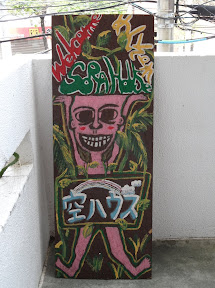
At Miebashi station I got off and studied the directions to the hostel. It was pretty close, but reviews of it had pointed to a few flights of stairs. True to the directions, the blue Sora House sign with its crazy earth logo on the front stuck out prominently in front of me advertising its.. less than inviting entrance; a concrete flight of steps below a ceiling that looked semi-demolished and was frankly falling apart. My heart sank.

Fortunately as I ascended, things looked much better, and the character of the place came through. The second floor was just a locked door, and the third just housed a trio of 'Sora House' rental bikes. As I scaled to 4F, I was greeted by the first of many pictures created by its owners.

Nori-san, the owner, was there on the fifth floor to greet me. It was half past one and check-in was not until 3. Fortunately I could store my baggage, so I removed the pair of shoe-sandal hybrids I had bought just for the island, put them on and headed out to until I was allowed in proper.

Just down the road is Kokusai-dori, the main street in Naha for shopping and tourism. Highlighted on the maps as this massive straight road, it boasts souvenir shops and restaurants, pachinko parlours and undercover markets as far as you can see. Unfortunately I hadn't even made it this far before my feet were in tatters; the new sandals were digging into the soft, sweaty skin on the top of my feet and every step resulted in pricking, scratching pains which soon broke the skin. Searching my smaller backpack which I had thankfully brought with me, I pulled out a few tissues and stuffed them into the rubbed areas, and kept going.

And this was my first sight of The Americans. They were easily distinguishable from the tourists in more ways than the obvious one. Gathering in packs, the teenage sons and daughters of many of the serving military officers strutted round with their tails in the air; it was clear that they thought they were the owners or custodians of the place thanks to the American army having a base there since the second world war. The occasional sideways glance towards them from the native Okinawans gave me the impression that, although they were not particularly disliked, it was a case that they were being tolerated with painted smiles. I could understand why; they were confident, arrogant and brash and there were a lot of them.

After a while heading down one side, Shuri Station (currently the other end of the Monorail) was visible in the distance. I turned around and headed into a park for a short rest; a flighty bird hopped between the branches of a fruit tree just too quickly for me to get on film, and then a middle-aged man sat down and started singing a sad-sounding song to anyone who would listen. After a while I hobbled back to the Sora House, taking a brief detour down the main aisle of the covered market, a wealth of smaller, more personal restaurants and shops often selling locally grown fruit or handmade clothes.
When I returned, Nori-san showed me my room - down on the fourth alongside some female guests, a double room but with just me in it - and then after a run down of the various amenities, informed me that if I got my skates on, I could catch the great Naha tug of war.

The what?, I said, still a little taken aback with actually making it to my destination, mixed with the relatively proficient English being spoken at me. Nori-san pointed at one of the stations and said it started in about a half hour at 4pm. A full-scale event between two teams from the city with a festival later on in the evening. I thanked her and headed to the room; first on the list was to get a wash and a change of clothes. I set my rather wet clothes on to wash in the laundry (a very reasonable 100yen) and then took them up to the washing line on the roof of the house, a pleasant place to go to get a little wind in your hair. After hitting the bed in my lovely cool room, I fell briefly asleep.

By the time I woke an hour later, the tug of war must already have begun, but I decided to head out to Kumoji-dori anyway where it was all happening. Initially intending to get on the monorail, I was passed by several people all carrying sections of rope of varying lengths. Some had just a foot or so, while others had coiled it round their shoulders several times. It was about an inch in diameter, nothing much to write home about, I thought, and not something you can make a large-scale event out of. Still, back in my non-rubbing shoes, I decided to head towards wherever they were coming from.

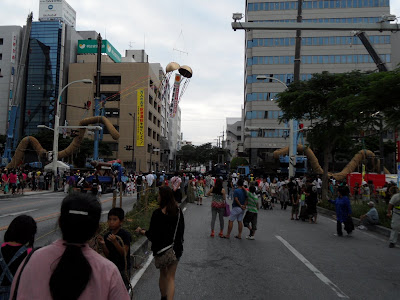
The tug of war had ended, but only just. I arrived in time to survey the fallout. The little sections of rope people were taking back as souvenirs were in fact strands of a much bigger one, the largest hand-made rope in the world, in fact. You could still see it as part of the surreal scene that greeted me. A block away, several bright blue cranes were being slowly moved to the side of the road while people cleared the area. Slung between them was the rope - a huge thing a meter in diameter, cut apart in the middle to appease both sides and hanging quite dead either side of the road. In the middle, suspended by a rope attached to the towering buildings above, was a giant golden ball, open with it's streamer contents long since fluttered to the ground. Somewhere in the distance, the beeping horn of the truck carrying the winning team made it's presence felt. It was clear that a massive event had taken place here, and I had just missed it. Bah.

Rather than spitting my dummy out and insisting they should all get back here and have another go, I looked around for pieces of rope as a souvenir of at least being there on the day, but found nothing. The hoards of volunteer pullers on both sides had cleared the roads of any potential trophy they could get their hands on, it is considered good luck indeed to take some home with you. As I thought of giving up and moving on, my eyes settled on an American guy in traditional Okinawan garb on the street corner who had large lengths of rope around his neck; he was using a pocket knife to cut his prize up and give to anyone who wanted a bit. I took my place in the gathering around him and got hold of a little piece, with which I was happy.

I got myself a few sticks of chicken Yakitori from a nearby stall and plonked myself in the grounds of a nearby building with a load of other people. A dog tied to a bush took an interest in the sticky meaty chunks in my styrofoam cup and woofed at me constantly until I threw a bit in his direction. Then I heard the beeping and drumming of the winning team again, who were clearly doing a lap of honour. They had got stuck in the traffic under the monorail, so I got into place and waved to them as they went by, and were all too happy to give me a mini performance as they passed.

As darkness quickly descended my mind turned to tomorrow; I needed to know where the bus station was and the times for Nago. Asahibashi station was the nearest to the terminus and a stop down from Kokusai, so I took the trip.
After checking the times and the bus stand (Stand #14, buses between about 6am and 6pm), I headed over the bridge that crosses the Kumoji river. Part two of the day's festivities was just getting going. The Onoyama Park had been hijacked by a hundred or so stalls, selling large amounts of Yakitori, Noodles, or for the American contingent, large piles of chips. Sprinkled between these were souvenir shops, seaside-style challenge games, (amongst others balloon popping, where instead of a goldfish you won a baby chicken) and raffle stalls. Okinawa's local beer, Orion, was out in full force as a major sponsor, with lanterns and posters bearing their name everywhere, and all over the entrance to the sports ground, which had been given over to live music. The sizeable 'Orion Beer Paradise' performance stage at the front had a couple of thousand people of all ages sat on the ground waiting for things to start, munching away on various warm foodstuffs. The air had cooled and the mood of the people was relaxed and happy, even though it was getting seriously busy.

After a further look through the various repeating stalls, I returned to the music, which had by 7pm started. I managed to find myself a lazy spot on a little hill at the back where I could lean onto one of the gnarled old trees quite comfortably. The bands played a mix of more traditional Japanese fare, a bit of J-Pop, and unexpectedly, quite a bit of world music, particularly with a Spanish theme. It was all very pleasant and relaxing, and a nice start to my short time in Okinawa.

Sometime later I got the monorail back. I checked my washing but it was not yet dry (amazingly) so I left it overnight. I spent a little time chatting with people and comparing rope lengths, and then went to bed.