Things were going well since Kyoto. Every day I was feeling stronger and was able to achieve more. Though my time on Shikoku island was rapidly coming to a close I was feeling positive.
I had made another change to my schedule. Originally, my plan was to head directly from Takamatsu to Osaka via Awaji Island, a small elongated stretch of land tethered to both Shikoku and Honshu by long road bridges. The original route would mean traversing this route, and it would require most of the day, most of it involving buses, and possibly another expensive ferry.
I still had a day in hand, and I had not yet set up my accommodation for the next stop of the journey, so I made a choice. Instead of the Awaji island route, I decided to head back to the Great Seto Bridge and cross there to Okayama. From there, strike a blow in the face of my prior invalided state and go north to Tottori and pay a visit to its famous beach, before finally taking the train back south-east to Himeji where I would stop for the night.
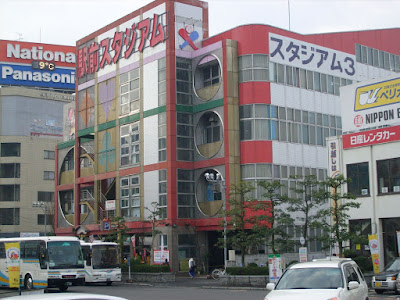
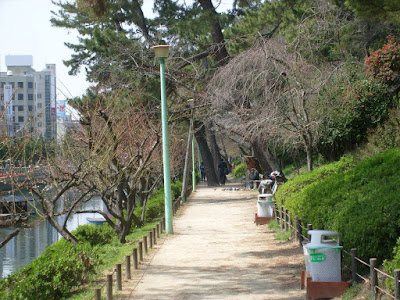
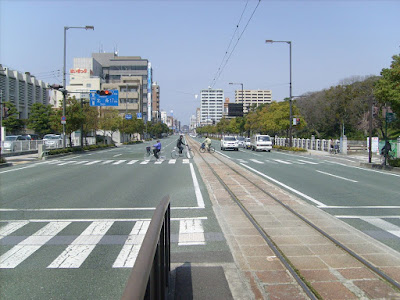
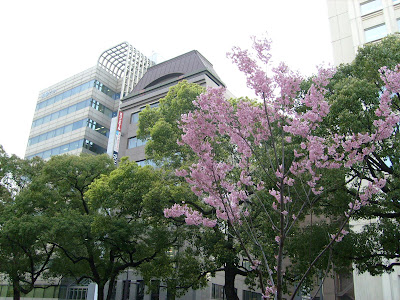
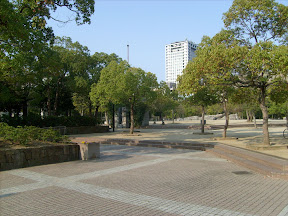 The JTB I had passed the previous evening would be the first stop, and after mooching around one of the less glamorous inner city blocks at 7.30 on a cold foggy morning, I decided to swing by. Unfortunately it was still closed and wouldn't open until ten, so I headed over the road to Chuo Park, a small open area accessible via an underpass bisecting a busy crossroads. (The underpass, like many others in Japan was beautifully decorated and spotless, this one containing expansive murals made from stone and glass with miniature spotlights giving them an eerie glow. The pictures I took don't do them justice.)
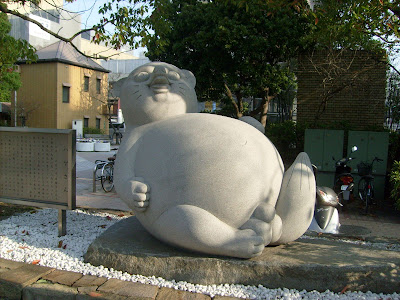
There was little in the park worth looking at, and because there was only an hour to spare and I had no guide book with me, there was little point in venturing further into the city, so I perused the statues to baseball heroes and the stone Tanuki who was clearly enjoying the airy feeling a life devoid of underwear would provide. I ended up sat with a rabble of scraggy pigeons on the steps of a small amphitheatre until the target hour came around.
However, it was so unremarkable and nothing was happening that I got bored and nipped into a Lawsons and grabbed some breakfast (sarnies and choccy) and then went back to the hotel to check out, using their internet to check the various train connections I would need to make later on in the day.
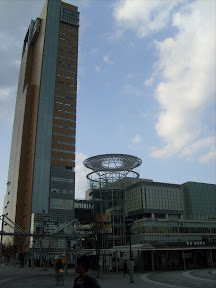 When JTB finally opened, I had been sat for a while shivering in the cold morning, munching away on the last of the choccy, and was glad to sit down and parlez with someone in a relatively warm room, although it was a bit of a struggle as the woman behind the counter knew little to no Japanese. However after a lot of diagram drawing and flipping backward and forward in my now pretty dog-eared phrase book, I managed to get booked into Himeji, Osaka, Hammamatsu and Shinjuku, which meant no more advance booking was required. The original plan was to spend 2 nights in Osaka, but it was clear by this point that the 300-mile journey to the next destination (Mt. Fuji) was going to be too long for one day, so by spending one of them in Hammamatsu midway between, the pressure would be lessened somewhat. Shinjuku was the most expensive so far, as it was right in the middle of a fashionable, bustling city, weighing in at 9300yen (about £47 - although that is still miles less than a night in London).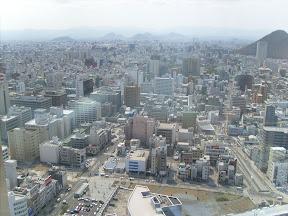
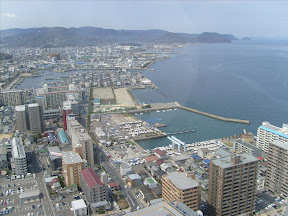
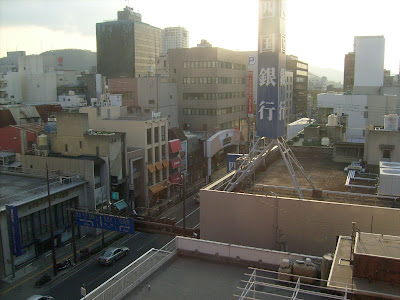
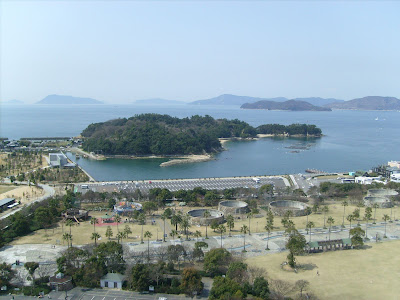
Pleased that I had no more of that to do, I retraced my steps back to the station and bought a ticket for Okayama. There was a little time before it went, so I took the opportunity to at least get an arial view of the city I was largely ignoring. I went to the Symbol Tower, placed right next to the train station, which has a viewing platform. Floor 30, where the main views are taken from, was closed for some reason, but the one below still had some reasonable views of Shikoku's most populated city, particularly those looking out to Takamatsu Port and the Inland Sea. Shikoku Island has much more going for it than I had given credit for, and now I was leaving, but I will be back one day and will spend some time exploring in more detail.
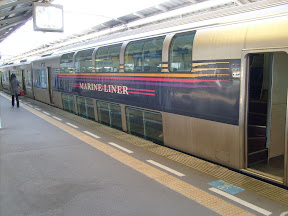 I headed back to the station avoiding some sort of publicity event going on in the concourse, and was intrigued to find myself booked on a double-decker train. Any hopes of decent views were dashed when it became apparent that I was on the bottom bunk and my journey would be made up of the views of ankles and train wheels. Not wanting to put up with the situation for long,
 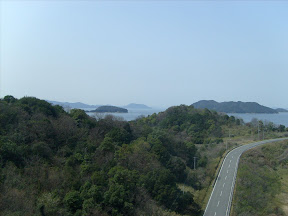 I waited in my seat until the ticket inspector had done his rounds and then sneaked onto the upper floor, where I met an American couple who were clicking away happily with their perfect view. The chain of bridges that spanned the Inland Sea seemed to go on for ages, and there was no land left undeveloped on the small islands that marked the end of one bridge and the start of the next.
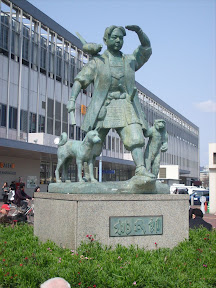 By Okayama - home of Peach Boy - I had made the decision that I was going to go to Tottori, as up until then I could make a guess by the hours remaining in the day. Entering the ticket office, I managed to get a ticket after some confusion with the times (my initial one set off a minute from when I was given it, but luckily a fellow ticket buyer helped me out to get it exchanged for a ticket for the next train instead). Since there was another half hour to wait before the train departed, I went over the pedestrian bridge from the station to the Okayama Digital Museum (situated next to an NHK building, complete with furry Domo representative to greet me!).
 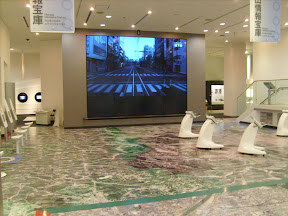 It was dead inside, and there was no English on the signs, but it was quite interesting to mooch around for a while, studying the gorgeous hi-res digital pictures and restored early art prints. There was even an exhibit where you played virtual tram tours around Okayama on little pushcarts, although it would have benefited from more than just me beeping and screeching around.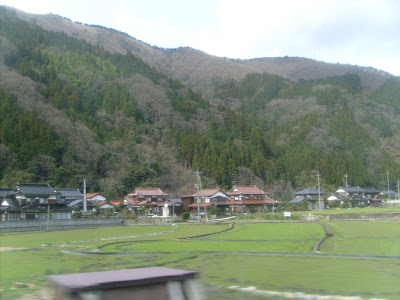
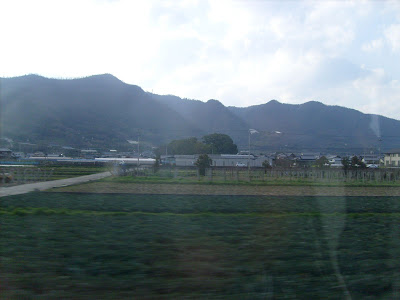
The Okayama-Tottori journey came around and seemed to take forever, heading from the southern to the northern coast, although the scenery was nicer here, with less of the typical defacing of the natural surroundings with buildings and roads and industry, this section of track conveyed a feeling more of a symbiotic relationship between man and nature. It was all very nice to look at, although I was clock-watching - I could make Tottori and back again, but there wasn't much wiggle room to use if things went wrong. (I was told that the JR train went over a private line, much like at Ise, and so there would be a surcharge, although no-one ever asked for one on the journey.)
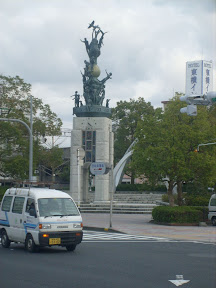 When I arrived at Tottori Station, it was still quite some way from the beach; I had been expecting to step out of the carriage and see something akin to Blackpool Front, but there was no immediate sign that this was a coastal town at all. In fact, it was a sizeable city I had just arrived at, and one that for the first time, seemed genuinely and completely foreign. I have mentioned a general lack of English signs before now, and Shikoku was quite bad for it, but Tottori was worse. As if shunned by the tourists who head straight for the more interesting parts on the south coast (or perhaps they had all skipped to Hiroshima like I had due to dikky tummies and awful hotels), Tottori made no attempt to welcome the foreign tourist whatsoever. After much symbolism at the ticket office, I got myself a ticket for the last train to Himeji which left at 6.40pm. I left my larger backpack in a locker in the station and went to the bus park across the road, spending a little time searching fruitlessly for signs for the beach. The people behind the desk were not very useful either, they spoke no English at all and had no translations of the timetables. Typically, my phrasebook also decided that there was no need to include the translation of the word 'beach' either.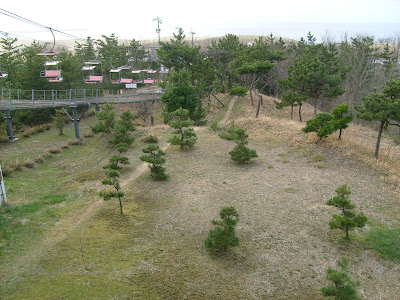
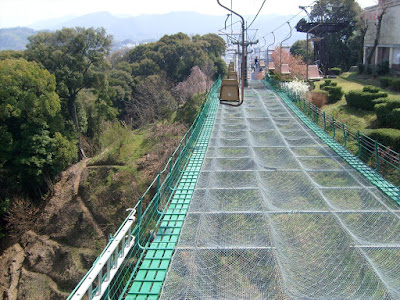
Not having much of a clue, I headed outside to the bus terminus and was relieved to see a cartoon drawing of a beach with a bucket and spade over the #0 bus. I got on and 20 minutes and 360yen later, after climbing a small hill to a parking area, departed. Out beyond the buildings surrounding me was the distant sound of waves and the salty smell of sea air. There was a ropeway down to the beach, but the guy seemingly in charge of it was babbling at me and I wasn't too keen on the swaying seats in the sea breeze, so I headed down a sandy track containing what I hoped were camel tracks (they are available as rides, it said in the book), then crossed a main road and started to hit dunes.
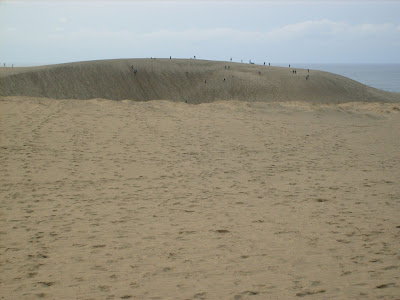
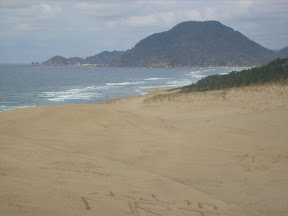
Tottori beach is very large, consisting of an inital flat-ish area that leads down into a valley,
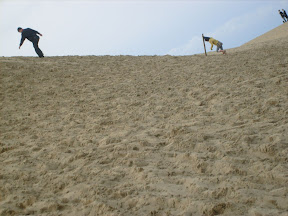 on the other side of which is a huge dune, which I had now challenged myself to climb. The sun was becoming ever lower in the sky by this point so I had to hurry if I was going to experience a Japanese beach. By the time I was in the valley it was clear this was a popular spot; there were dozens of people clomping about in the sand, writing rude words and generally expelling energy. I worked my way through the streams of manic children and started the ascent up the steep dune, each step in the sand sank down half of what I had reached, but I eventually made it to the top.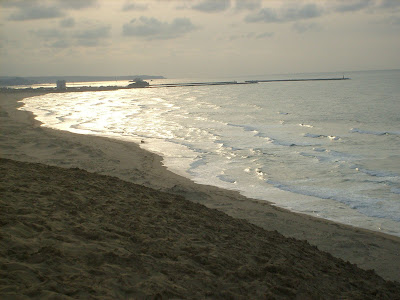
The sun was getting low on the horizon and the sight of the sea opened up in front of me. The tide was just on the turn and the sunlight shimmered over it as my eyes tracked the beach from the west as far as I could see, rounding a cape to the east. It had taken two attempts to get here, and it was worth it. I stumbled down the other side towards the sea and dipped a hand into the water to symbolise my journey from south to north sides of the country. After days and days of towns and cities and rails, it was nice to experience a completely natural sight for once and stroll along the shoreline.
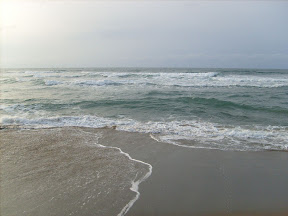
After a while though, I became a little bored and more than a bit hungry, so I started to make my way back. It was only 5pm, so I had plenty of time. I was just about to cross the road for a shop that might have sold much-needed tasty treats, when a bus appeared at a stop that was different to the one I had come in on, but was heading in the right direction. Figuring I might be best getting back to the station earlier rather than later, I checked it went to the station and got on.
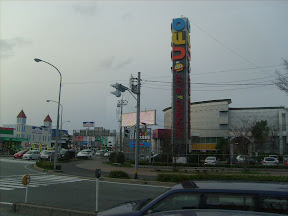 What followed was one of the most worrying trips I have taken. Leaving at 5.15, I thought I was going to be fine, but an hour later, the driver was still happily pootling around Tottori, stopping at every place imaginable on his route. I was getting very fidgety when at long last we arrived at the station at 6.35 - 5 minutes before the train left - and sped quickly to the train, only just remembering to retrieve my backpack from the lockers.
The train to Himeji was bathed in darkness, and I finally arrived at the station just past 8pm in the pouring rain. After winding through the covered shopping arcades and finally finding my hotel, I checked in and then headed back to an Italian Tomato and had yet another bolognaise. There was an Internet Cafe on the ground floor of the hotel which I checked into and the computer I landed with accepted my SDHC card, which many of them by this point of the journey hadn't, so I posted loads of pictures and caught up with my emails. I went to bed about 11:30 after emptying my shoes of sand (and keeping it for a Tottori souvenir).