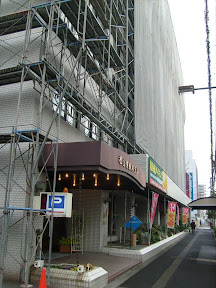
Now I had finally got to Shikoku Island, it was time to work out exactly what to do there. My expectations of the island were basically 'a bit more of Japan', which was broadly true, although there seemed to be a slight change in temperature and overall 'feel' of the place. If you stopped to try to get hold of a concrete example of the difference around you, it was near imperceptible, but it did feel like another nation. The most tangible difference was that English was very much a second-rate language here, as if the islanders had less use for it because the ebb and flow of tourists rarely crossed the waters to come see them.
No matter; I considered my options while flicking through my book. Shikoku (Shi-Koku, meaning four provinces - referring to the prefectures it is split into, Kagawa, Kochi, Ehime and Tokushima) is similar to Hokkaido in that it contains a few major cities surrounded by large expanses of rural and forested areas. Despite a large portion of island to work at, comparable in size to Western Honshu, I had only allowed for three days on the island - and one of them was yesterday. This left me with a Hokkaido-like rush on, which I didn't want to do.
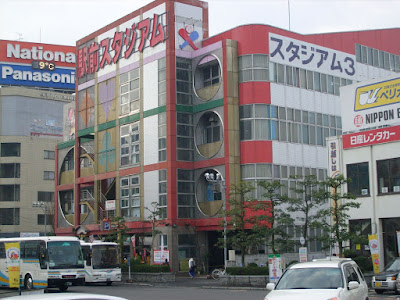
Currently in Matsuyama (Ehime) on the west coast, I was due to stop overnight in Takamatsu on the east (Tokushima) side of the island by the end of the day. That left two options with the intervening hours. Either I could spend a day on the trains, taking the anticlockwise route around the south coast of the island which would include places like Uwajima, (which has a museum dedicated to sex, and who doesn't want to see that?), several famous spas (a Japanese tourist must-do which I had yet to try) and the apparently beautiful sea views round Yawatahama and Susaki. My other option was to head clockwise round the north coast on a less scenic or interesting route but on a natural collision course with Takamatsu.
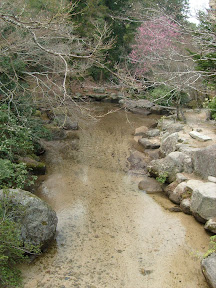
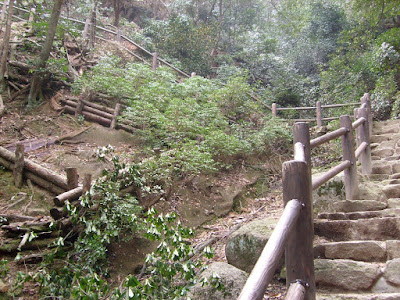
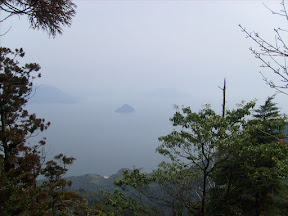
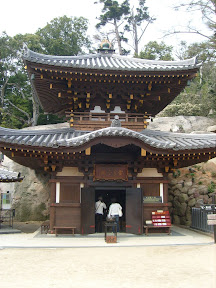
Perhaps surprisingly, I decided on the latter. This was because taking the south route was probably going to be too long to take in a single day, which means I wouldn't be able to make any stops and look around. It's a route that needs at least 3 or 4 days to get around on its own, and I didn't have that luxury. Instead, I would look to see what Matsuyama would have to offer (there is plenty, as shown in the piccies here) and then head to Takamatsu near the end of the day.
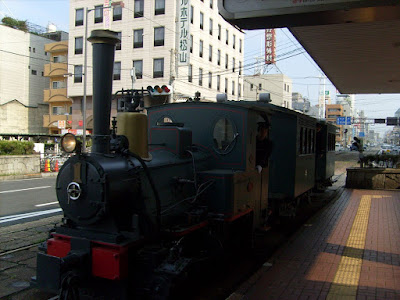
I woke at about 6, checking out before 8am. Sticking both bags into the lockers at Matsuyama Station, I was free to tramp around Matsuyama for about 6 hours before needing to head back, the train journey worked out at about 3 hours, so I would try to make it before darkness fell. My Takamatsu map showed the hotel as being some way from the station, and taking into account the innacuracy of these things, there would need to be a bit of buffer room at the other end.
Just across the road from the station is a tram station, filling up slowly with the local office-goers. Exiting from the thin underpass, my worries about getting around were strengthened when the journeys board had no English on it at all. Eventually, by deducing what the symbols meant and the colour coding, I plumped for #5 of the available lines, and was pleased when the intermediate stops (which were translated into English) came and went in the right order.
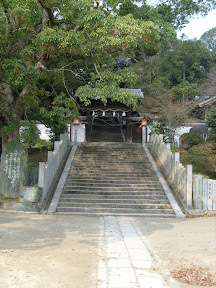 I got off in the centre of the city at the Okaido stop. It seemed to be the closest one to the main attraction - Matsuyama Castle. Situated in the centre of Shiroyama Park, (a steep climb to the plateau on top of Mount Katsuyama), it is accessed at the east side via a steeply inclined path, or if you're feeling flushed, the twin transports of a ropeway and chairlift are available.
Starting up some pretty important looking steps (the steps seemed like they were enormous after yesterdays Miyajima trek and I was sick of them!), I was disappointed that it wasn't the entrance to the place I was looking for. Instead, it was the Shinonome-Jinja shrine at the base of the hill. Deflated slightly at the outlay of stair-climbing-to-reward ratio, I took a chance and headed out the path round the back, and was pleased to see both the ropeway and chairlift in front of me over a pathway that led promisingly upwards. Deciding that I felt well enough to make it up unaided, I carried on using the manual method rather than looking for the entrance to the girly easy way up.
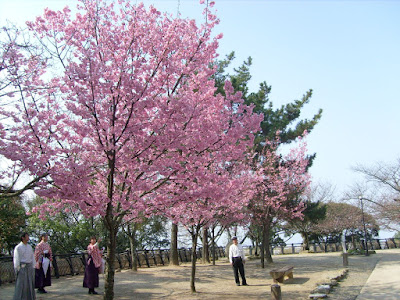
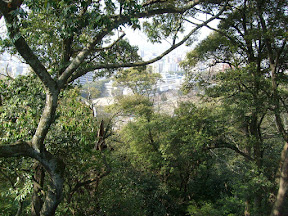
Even though the hill was steep, it was a very nice trail to take. The city scenes I was looking at a few minutes before had been completely replaced by woodland canopies that filtered the morning sun pleasingly. The hugely recognisable curved castle walls began to appear before long, and a few ladies in traditional hakama Japanese dress unwittingly led me to the outer castle entrance.
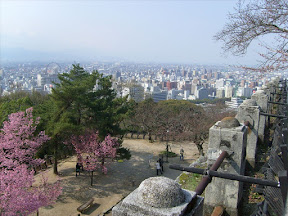
Matsuyama Castle, like many others is surrounded by successive inner walls, each made from tightly interlocking stones curving from the base like an inverse buttress. The inner areas accessible by a single gate which is often large and imposing. This was more true here than many others, just one of the areas being a very wide open plateau containing seats, Sakura trees in full bloom (the first ones I'd seen properly open), and a couple of shops poised to take advantage of those who came up here for the fantastic views of what was now clearly a very big city.
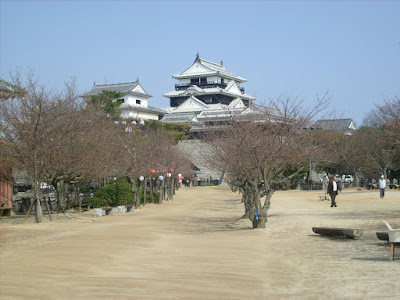
After crossing the attendants palm with silver (500 yen) and heading through more gates, I arrived eventually at the innermost courtyards where some other tourists suddenly appeared. Shoes had to come off and go into a plastic bag, but this time they were replaced by a pair of flip-flops, although only after a long wait as the shoe guy found some 'outsize' ones for western feet.
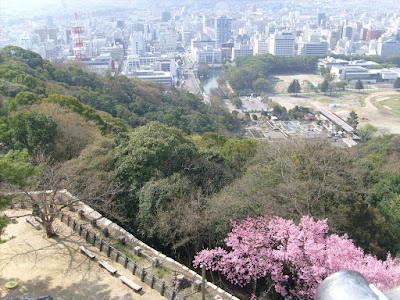
Matsuyama castle is narrow and cramped, with several steep staircases to go up and down in. This was a problem in flip flops, and lets just say I am glad there were handrails everywhere. Getting to the top of the castle is definitely something to see; the views were more gorgeous still than those outside and the castle itself is full of artefacts with thankfully English (ish) signs to tell you all about them. You could even take a camera in.
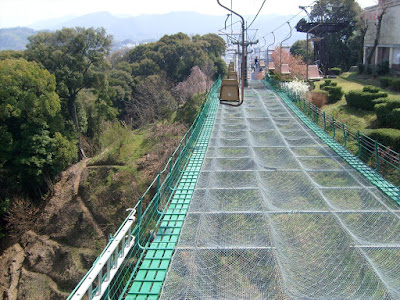
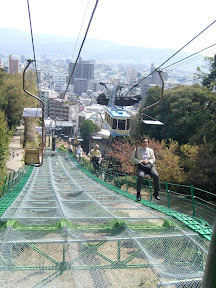 I had by now exhausted my castle-exploring needs for a so I headed back down the way I had come and happened across the entrance to the chair lift and ropeway. Since I'd never been on a chairlift before I decided to give it a go (I was counting off the various modes of transport I'd been on throughout Japan and it was getting pretty extensive). After a little confusion with the tickets (and some helpful, patient smiling attendants pointing me at a now-obvious ticket machine) I paid my 1000yen and got on. Sort of, anyway. Chairlifts are a little wobbly at the best of times, and a moving target to get onto, but I just about managed to insert my buttocks into the scoop at the correct time and off I swung.
 The netting below looked less than able to hold my weight should things go wrong, and the nasty branchy thorny brambly woodland underneath looked even less appealing, so for the first half I held on for dear life while the chair found its equilibrium with the forward motion and stopped swaying. As the ride neared its conclusion I found myself relaxing a little and enjoying the morning sun and gentle breeze, until I realised that at the bottom I would have to disembark. Fortunately there were yet more people to come to my aid at the turnaround point and I managed to unscoop myself and carry on through the entrance shop I had missed on the way up and was finally deposited back on the street I had walked up.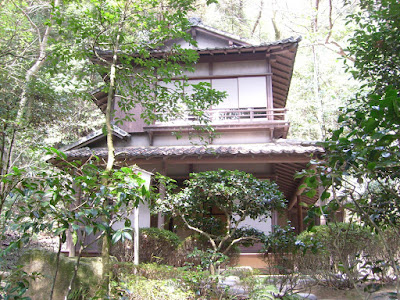
The day had progressed well and I had a little time left, so I carried on along the Ichibancho-dori main street until I came to the entrance of Bansui-so, a French-styled building used for various art exhibitions which unfortunately had been closed for refurbishment (you can see it here with its clothes off), so only the modest gardens in the grounds were available to look around. Aside from a reconstruction of Gudabutsuan, a house inhabited by a Shiki Masaoka, a famous Japanese Haiku poet, there was little really to do without the context of what was on show inside, so I moved on.
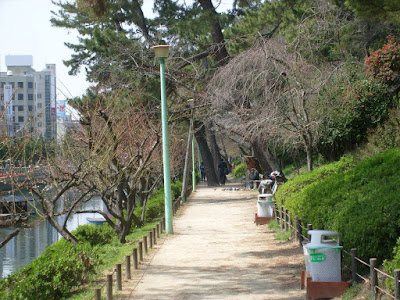
The main road darted to the left, and by going straight on, I travelled through a pleasant nature trail, with a hillock to the right covered in trees and shrubs and a moat to the left, keeping a bit of nature between the walkers and the main road and home to a family of swans, each with their own floating 'kennel'. It was the very outer perimeter of the castle, and gave you an idea of just how influential the ruling classes were out here. Within these bounds is the Prefectural Art Museum, in which I passed a little time looking at the calligraphy and children's charcoal drawing exhibits they had going at the time.
Getting a little bored, I looked for a building I had spotted on the map that provided cheap internet access, but typically when I had found it they were closed on the last Friday of each month, which just happened to be today. D'oh.
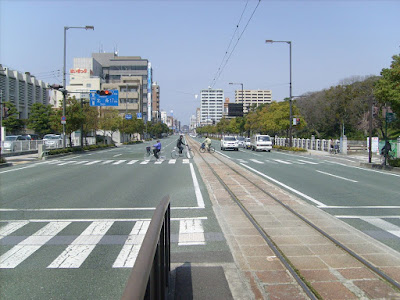
I headed to the nearest tram stop to head back to the station and waited. And waited some more. The trams were having to share a single piece of track at this point, and so far they only seemed to be heading in one direction - away from where I needed to be. Consulting my map again I realised that I was on the wrong line - again - and started the long trot along the line to the place I should have been at. Eventually, I arrived back at the station, although I had well and truly missed my intended train and would have to wait for an hour for the next one. I spent the time in the pleasant midday sun munching on what recognisable sandwiches I could find and one of those green tea KitKats they were flogging everywhere. Eventually I got onto the train and headed east.
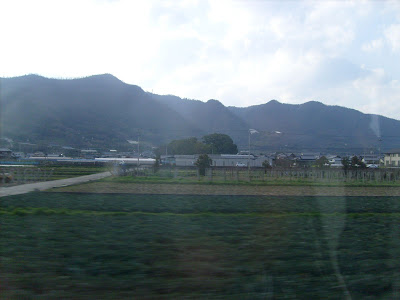
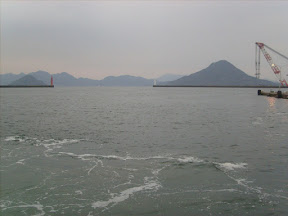
For a train route that hugged the north coast, it was distinctly light on beautiful sights. What few shots of the Inland sea (the straight of water between Shikoku and Honshu) I could get were uninspiring and often polluted by the usual power lines or ugly buildings,
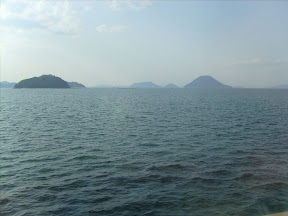 so it was a pretty dull experience, save for the constant worry that I was not on the right train; my ticket's carriage number was 7, but there was only four carriages on my train. The attendant tried to reassure me (assuming he understood my fears) but it wasn't until another train joined the front of ours that all became clear. At Tadotsu, the train split again, half of it heading over the Great Seto Bridge, one of several to link Shikoku with the mainland. Fortunately I was in the correct half and the carriages that were left trundled to their final stop at Takamatsu.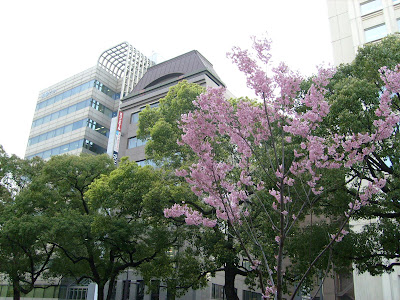
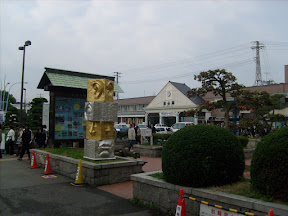
At the other end, I stepped off and into the city of Takamatsu, although the first few steps out of the station seemed to suggest it was a ghost town; it wasn't until I was firmly outside of the station plaza that signs of life came rushing back.
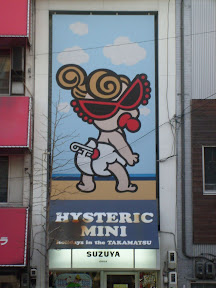 Wide roads split by a carriageway was the norm, often lined with trees and flanked on both sides by huge department stores and business offices. The map to the hotel showed the hotel as being several blocks away and, carefully counting the roads I crossed as I went, I was able to find the hotel, as well as a JTB office just on the corner of the same block. The hotel itself, the Takamatsu Washington, was a plush business hotel (with a sleazy looking entrance), and I was looked down upon I'm sure by the clean crisp-cut suits as I staggered in, trailing my less than clean shoes over their fancy checkerboard floor and not looking my absolute best it had to be said. No matter, I headed up to the room after checking in and dumped my items, then went back down and after a little internetting, headed out for some food.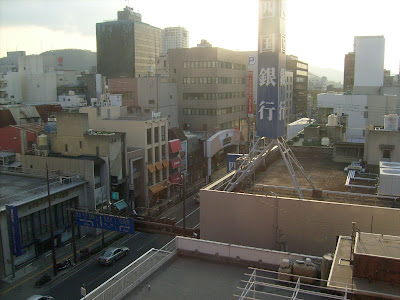
Predictably, this would be an Italian again, which I managed to find after a little scouring of the nearby streets in a block circle around the hotel, although I would have been confident to go somewhere a little different had the opportunity presented itself. Eggplant and spicy beef spaghetti was a little different to the norm, I convinced myself, with some very vegetable-laden tomato soup for starters. The 'white chocolate cake' was actually choc-chip spongy stuff with some cheesecake on top. It was all a little pricey (weighing in at about 2000 yen - about a tenner which was quite expensive for a Japanese meal) but very nice. I ambled the long way around the streets in the darkness until I reached my hotel once more and then went to bed.